

co-design in green infrastructure planning and design can reduce public costs and
engage the public more directly in sustainable city agendas.
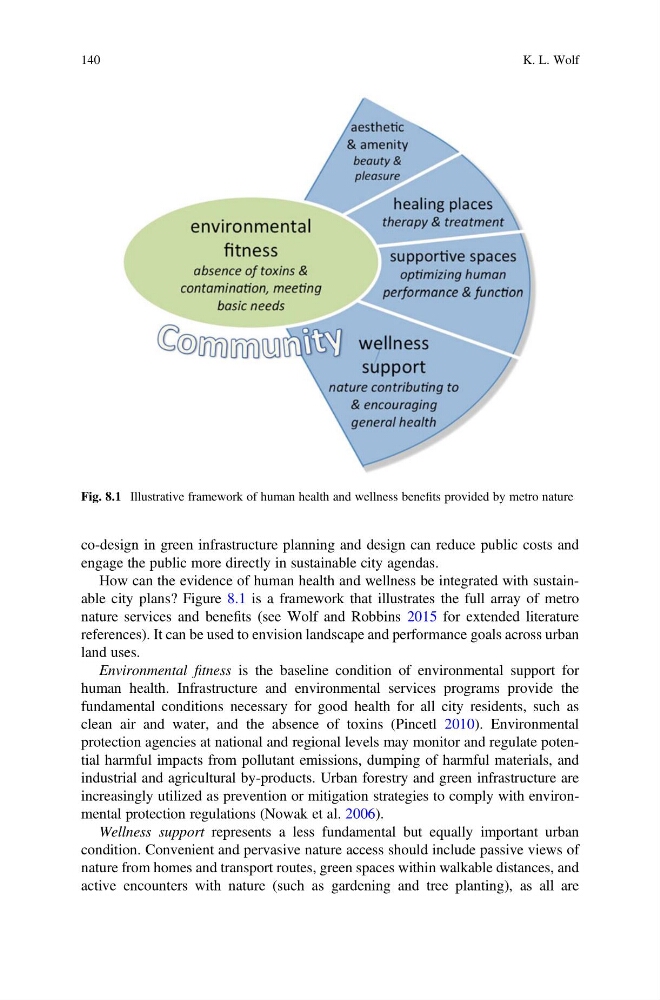
How can the evidence of human health and wellness be integrated with sustainable city plans? Figure 8.1 is a framework that illustrates the full array of metro
nature services and benefits (see Wolf and Robbins 2015 for extended literature
references). It can be used to envision landscape and performance goals across urban
land uses.
Environmental fitness is the baseline condition of environmental support for
human health. Infrastructure and environmental services programs provide the
fundamental conditions necessary for good health for all city residents, such as
clean air and water, and the absence of toxins (Pincetl 2010). Environmental
protection agencies at national and regional levels may monitor and regulate potential harmful impacts from pollutant emissions, dumping of harmful materials, and
industrial and agricultural by-products. Urban forestry and green infrastructure are
increasingly utilized as prevention or mitigation strategies to comply with environmental protection regulations (Nowak et al. 2006).
Wellness support represents a less fundamental but equally important urban
condition. Convenient and pervasive nature access should include passive views of
nature from homes and transport routes, green spaces within walkable distances, and
active encounters with nature (such as gardening and tree planting), as all are
Fig. 8.1 Illustrative framework of human health and wellness benefits provided by metro nature
140
K. L. Wolf
engage the public more directly in sustainable city agendas.
How can the evidence of human health and wellness be integrated with sustainable city plans? Figure 8.1 is a framework that illustrates the full array of metro
nature services and benefits (see Wolf and Robbins 2015 for extended literature
references). It can be used to envision landscape and performance goals across urban
land uses.
Environmental fitness is the baseline condition of environmental support for
human health. Infrastructure and environmental services programs provide the
fundamental conditions necessary for good health for all city residents, such as
clean air and water, and the absence of toxins (Pincetl 2010). Environmental
protection agencies at national and regional levels may monitor and regulate potential harmful impacts from pollutant emissions, dumping of harmful materials, and
industrial and agricultural by-products. Urban forestry and green infrastructure are
increasingly utilized as prevention or mitigation strategies to comply with environmental protection regulations (Nowak et al. 2006).
Wellness support represents a less fundamental but equally important urban
condition. Convenient and pervasive nature access should include passive views of
nature from homes and transport routes, green spaces within walkable distances, and
active encounters with nature (such as gardening and tree planting), as all are
Fig. 8.1 Illustrative framework of human health and wellness benefits provided by metro nature
140
K. L. Wolf