

Mathematical Induction
55
does not look like a geometric series, it is easy to transform this finite geometric series into
a more familiar looking expression:
20
E 3.2i = 3.32+3.64+...+3.220
i=5
= 96.1 +96.2+.-. +96.215
15
= 196.2/
i=O
A very useful feature of a geometric series is that we can find a closed form for its sum.
Here, we focus on the sum of a finite geometric series. The sum of an infinite geometric
series is usually studied in a calculus course, since the limiting process is needed. Although
it seems to be unrelated at first, we will begin by proving that for any n E N, 1 - xn+
1 has
1 - x as a factor. After proving this by induction, we will apply the result to summing the
finite geometric series.
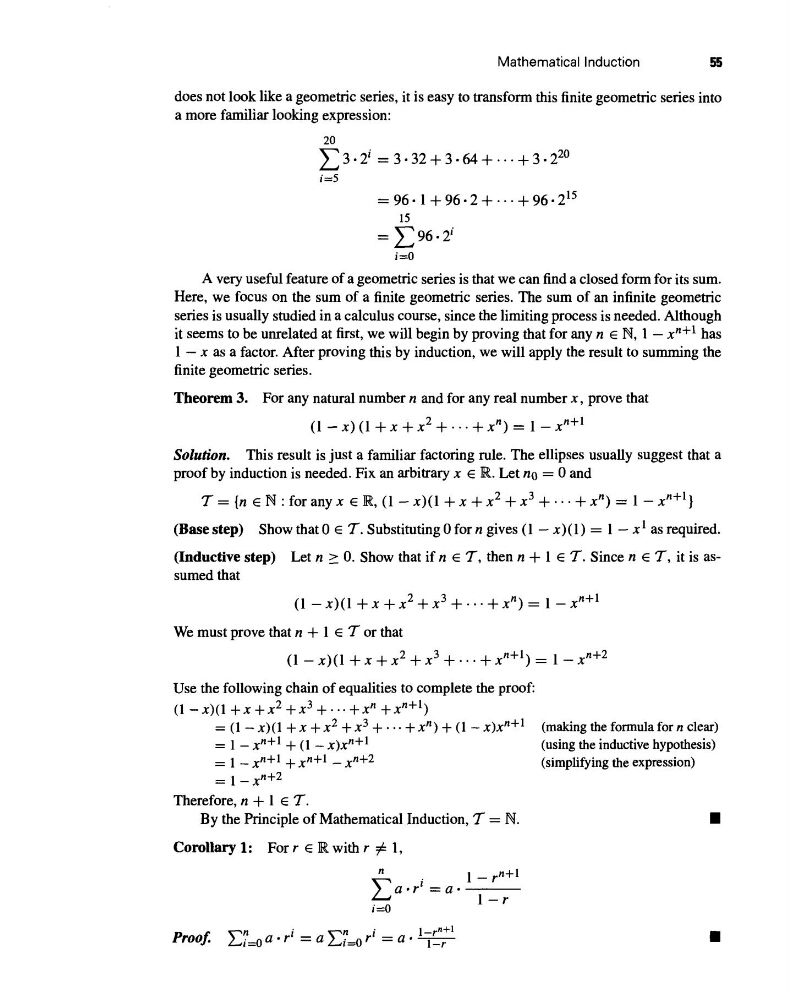
Theorem 3. For any natural number n and for any real number x, prove that
(1 - x) (I + x + X2 +''". + Xn) = I - xn+lI
Solution. This result is just a familiar factoring rule. The ellipses usually suggest that a
proof by induction is needed. Fix an arbitrary x E R. Let no = 0 and
T"={n EN:foranyx ER,(I -x)(±+x+x
2 +x
3 +...+xn)= -xn+
1 I
(Base step) Show that 0 E T. Substituting 0 for n gives (1 - x)(1) = 1 - x as required.
(Inductive step) Let n > 0. Show that if n E T, then n + 1 E T. Since n E T, it is assumed that
(I - x)(1 + x + x2 + x3 +.. + xn) =1-xn+l
We must prove that n + 1 E T or that
(1 -x) (I +x + x2 + x3
+.- +xn+l) =
xn+2
Use the following chain of equalities to complete the proof:
(1 -x)(l +x +x
2 +x
3 +... +xn +xn+l)
(1 - x)(1 + x + x
2 + x
3 +... + xn) + (I - x)xn+l (making the formula for n clear)
- xn+1 + (1 - x)xn+l
(using the inductive hypothesis)
- xn+1 + xn+l - xn+2
(simplifying the expression)
- -xn+2
Therefore, n + 1 E T.
By the Principle of Mathematical Induction, T = N.
U
Corollary 1: For r E R•with r 0 1,
n
1 rn+l
Y- a-ri =a.
i=0
Proof.
n oari =a r
a -rn+l
_i4= a=
a ,
)-=0 ri = a " 1-r
•
55
does not look like a geometric series, it is easy to transform this finite geometric series into
a more familiar looking expression:
20
E 3.2i = 3.32+3.64+...+3.220
i=5
= 96.1 +96.2+.-. +96.215
15
= 196.2/
i=O
A very useful feature of a geometric series is that we can find a closed form for its sum.
Here, we focus on the sum of a finite geometric series. The sum of an infinite geometric
series is usually studied in a calculus course, since the limiting process is needed. Although
it seems to be unrelated at first, we will begin by proving that for any n E N, 1 - xn+
1 has
1 - x as a factor. After proving this by induction, we will apply the result to summing the
finite geometric series.
Theorem 3. For any natural number n and for any real number x, prove that
(1 - x) (I + x + X2 +''". + Xn) = I - xn+lI
Solution. This result is just a familiar factoring rule. The ellipses usually suggest that a
proof by induction is needed. Fix an arbitrary x E R. Let no = 0 and
T"={n EN:foranyx ER,(I -x)(±+x+x
2 +x
3 +...+xn)= -xn+
1 I
(Base step) Show that 0 E T. Substituting 0 for n gives (1 - x)(1) = 1 - x as required.
(Inductive step) Let n > 0. Show that if n E T, then n + 1 E T. Since n E T, it is assumed that
(I - x)(1 + x + x2 + x3 +.. + xn) =1-xn+l
We must prove that n + 1 E T or that
(1 -x) (I +x + x2 + x3
+.- +xn+l) =
xn+2
Use the following chain of equalities to complete the proof:
(1 -x)(l +x +x
2 +x
3 +... +xn +xn+l)
(1 - x)(1 + x + x
2 + x
3 +... + xn) + (I - x)xn+l (making the formula for n clear)
- xn+1 + (1 - x)xn+l
(using the inductive hypothesis)
- xn+1 + xn+l - xn+2
(simplifying the expression)
- -xn+2
Therefore, n + 1 E T.
By the Principle of Mathematical Induction, T = N.
U
Corollary 1: For r E R•with r 0 1,
n
1 rn+l
Y- a-ri =a.
i=0
Proof.
n oari =a r
a -rn+l
_i4= a=
a ,
)-=0 ri = a " 1-r
•