

534
CHAPTER 8 Discrete Probability
form an independent set. In other words (recall Definition 2 of Section 8.5.1:
P(X 1 = X 1 , X 2 X2- ..... X = X) = H P(Xi = xi)
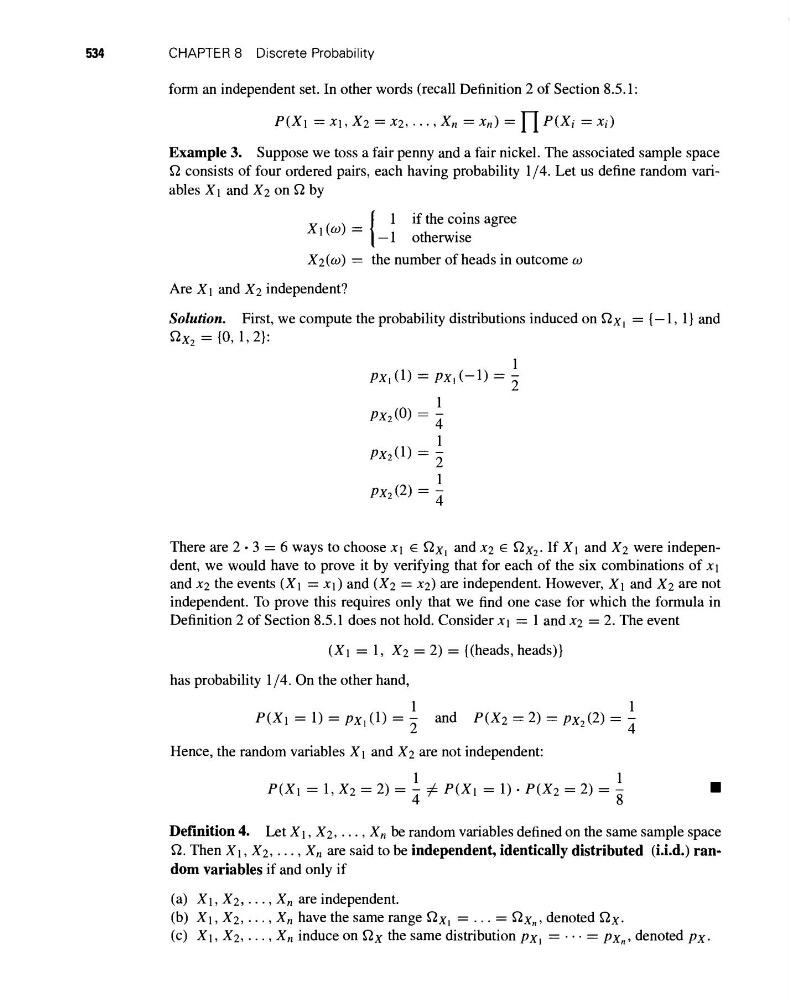
Example 3. Suppose we toss a fair penny and a fair nickel. The associated sample space
Qa consists of four ordered pairs, each having probability 1/4. Let us define random variables X 1 and X 2 on Qa by
X (0)=
1 if the coins agree
I -1
otherwise
X 2 ((w)
the number of heads in outcome a)
Are X 1 and X 2 independent?
Solution. First, we compute the probability distributions induced on x= {1-1, 11 and
fax 2 = {0, 1, 2):
1
PX 1 ) = px 1 (-1) =
1
px 2 (O) = -
1
Px 2 (1) =
1
Px 2 (
2 ) =
There are 2 . 3 = 6 ways to choose xj E fax 1 and x2 E• fx 2 . If XI and X 2 were independent, we would have to prove it by verifying that for each of the six combinations of xI
and X2 the events (XI = xj) and (X 2 = x2) are independent. However, X1 and X 2 are not
independent. To prove this requires only that we find one case for which the formula in
Definition 2 of Section 8.5.1 does not hold. Consider xj = 1 and x2 = 2. The event
(X 1 = 1, X 2 = 2) = {(heads, heads))
has probability 1/4. On the other hand,
1
1
P(Xi = 1)=px,(l)= -
and P(X 2 =2)=Px 2 (2)2
4
Hence, the random variables X 1 and X 2 are not independent:
1
1
P(X 1 = 1, X 2 = 2) =
A # P(XI = 1). P(X 2 = 2)
48
Definition 4. Let X 1 , X 2 ... , Xn be random variables defined on the same sample space
Qa. Then X 1 , X 2 ... , Xn are said to be independent, identically distributed (i.i.d.) random variables if and only if
(a) X 1 , X 2 ... , X, are independent.
(b) X 1 , X 2 ,..., X, have the same range axj ....
QX,, denoted fQx.
(c) X 1 , X 2 ,
. .... X, induce on £
2 x the same distribution PXl .....
px,, denoted px.