

Cross Product Sample Spaces
493
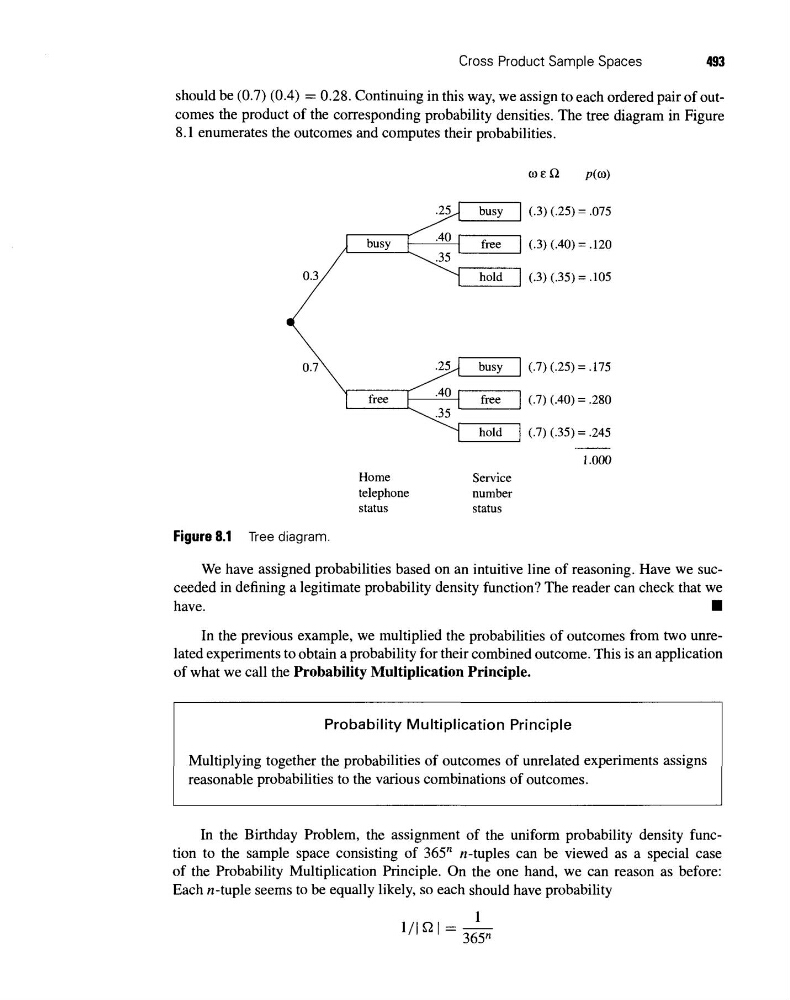
should be (0.7) (0.4) = 0.28. Continuing in this way, we assign to each ordered pair of outcomes the product of the corresponding probability densities. The tree diagram in Figure
8.1 enumerates the outcomes and computes their probabilities.
o )
p(O)
.25
busy
(.3) (.25) =.075
busy
free
(.3) (.40) = .120
Shold
(.3) (.35) = .105
0.7
.25
busy
(.7) (.25) =.175
free
free.
(.7) (.40) = .280
hold
(.7) (.35) = .245
1.000
Home
Service
telephone
number
status
status
Figure 8.1 Tree diagram.
We have assigned probabilities based on an intuitive line of reasoning. Have we succeeded in defining a legitimate probability density function? The reader can check that we
have.
0
In the previous example, we multiplied the probabilities of outcomes from two unrelated experiments to obtain a probability for their combined outcome. This is an application
of what we call the Probability Multiplication Principle.
Probability Multiplication Principle
Multiplying together the probabilities of outcomes of unrelated experiments assigns
reasonable probabilities to the various combinations of outcomes.
In the Birthday Problem, the assignment of the uniform probability density function to the sample space consisting of 365' n-tuples can be viewed as a special case
of the Probability Multiplication Principle. On the one hand, we can reason as before:
Each n-tuple seems to be equally likely, so each should have probability
1
1/I
365n 365n