

Operations on Sets
17
Definition 2. Let A and B be sets. The intersection of A and B, denoted by A n B, is
{x :xE A and x E B)
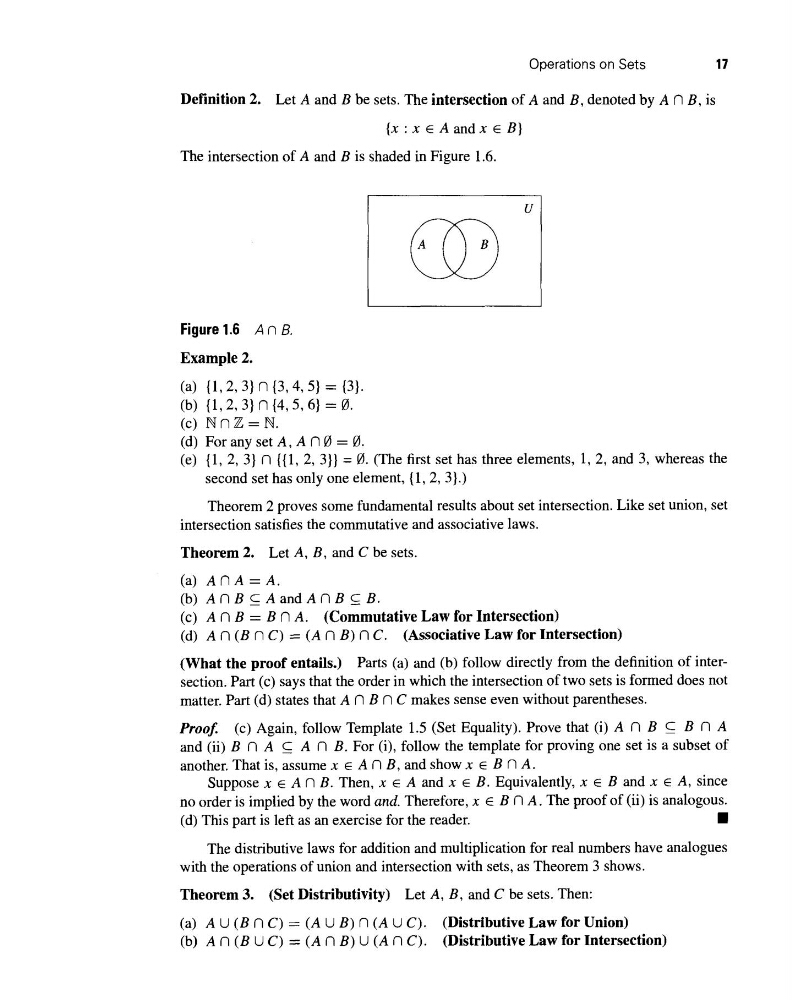
The intersection of A and B is shaded in Figure 1.6.
U
Figure 1.6 A n B.
Example 2.
(a) {1,2, 3} n {3,4,51 = 13).
(b) {1, 2, 31 n 14, 5, 6) = 0.
(c) N•nZ =N.
(d) For any set A, A n 0 =0.
(e) {1, 2, 3) n {{1, 2, 3}1 = 0. (The first set has three elements, 1, 2, and 3, whereas the
second set has only one element, (1, 2, 31.)
Theorem 2 proves some fundamental results about set intersection. Like set union, set
intersection satisfies the commutative and associative laws.
Theorem 2. Let A, B, and C be sets.
(a) ANA=A.
(b) ANBCAandANBCB.
(c) A n B = B n A. (Commutative Law for Intersection)
(d) A n (B n C) = (A n B) n C. (Associative Law for Intersection)
(What the proof entails.) Parts (a) and (b) follow directly from the definition of intersection. Part (c) says that the order in which the intersection of two sets is formed does not
matter. Part (d) states that A n B n C makes sense even without parentheses.
Proof (c) Again, follow Template 1.5 (Set Equality). Prove that (i) A n B C B n A
and (ii) B n A C A n B. For (i), follow the template for proving one set is a subset of
another. That is, assume x E A n B, and show x E B n A.
Suppose x E A n B. Then, x E A and x E B. Equivalently, x E B and x E A, since
no order is implied by the word and. Therefore, x E B n A. The proof of (ii) is analogous.
(d) This part is left as an exercise for the reader.
0
The distributive laws for addition and multiplication for real numbers have analogues
with the operations of union and intersection with sets, as Theorem 3 shows.
Theorem 3. (Set Distributivity) Let A, B, and C be sets. Then:
(a) A U (B n C) = (A U B) n (A U C). (Distributive Law for Union)
(b) A A (B U C) = (A n B) U (A n C). (Distributive Law for Intersection)
17
Definition 2. Let A and B be sets. The intersection of A and B, denoted by A n B, is
{x :xE A and x E B)
The intersection of A and B is shaded in Figure 1.6.
U
Figure 1.6 A n B.
Example 2.
(a) {1,2, 3} n {3,4,51 = 13).
(b) {1, 2, 31 n 14, 5, 6) = 0.
(c) N•nZ =N.
(d) For any set A, A n 0 =0.
(e) {1, 2, 3) n {{1, 2, 3}1 = 0. (The first set has three elements, 1, 2, and 3, whereas the
second set has only one element, (1, 2, 31.)
Theorem 2 proves some fundamental results about set intersection. Like set union, set
intersection satisfies the commutative and associative laws.
Theorem 2. Let A, B, and C be sets.
(a) ANA=A.
(b) ANBCAandANBCB.
(c) A n B = B n A. (Commutative Law for Intersection)
(d) A n (B n C) = (A n B) n C. (Associative Law for Intersection)
(What the proof entails.) Parts (a) and (b) follow directly from the definition of intersection. Part (c) says that the order in which the intersection of two sets is formed does not
matter. Part (d) states that A n B n C makes sense even without parentheses.
Proof (c) Again, follow Template 1.5 (Set Equality). Prove that (i) A n B C B n A
and (ii) B n A C A n B. For (i), follow the template for proving one set is a subset of
another. That is, assume x E A n B, and show x E B n A.
Suppose x E A n B. Then, x E A and x E B. Equivalently, x E B and x E A, since
no order is implied by the word and. Therefore, x E B n A. The proof of (ii) is analogous.
(d) This part is left as an exercise for the reader.
0
The distributive laws for addition and multiplication for real numbers have analogues
with the operations of union and intersection with sets, as Theorem 3 shows.
Theorem 3. (Set Distributivity) Let A, B, and C be sets. Then:
(a) A U (B n C) = (A U B) n (A U C). (Distributive Law for Union)
(b) A A (B U C) = (A n B) U (A n C). (Distributive Law for Intersection)