

Exercises
251
W Exercises
1. Let X = {1,2, 3, 4} and Y = {5, 6, 7, 8,9}. Let F = {(1, 5), (2,7), (4,9), (3, 8)}.
Show that F is a function from X to Y. Find F1 , and list its elements. Is F1 a
function? Why, or why not?
2. Let S = {(0, 8), (1, 10), (2, 12), (3, 14), (4, 16), (5, 18), (6, 20), (7, 22)). Is S a function?
Why, or why not? Find S-1, and list its elements. Is S-1 a function? Why, or why not?
Identify the domain of S-1.
3. Let X = {1, 2, 3, 41. Let F : X -* IR be a function defined as the set of ordered pairs
{(1, 2), (2, 3), (3, 4), (4, 5)}. Let G : R -* IR be the function defined as G(x) = x
2 .
What is G o F?
4. Let F : R --* R be defined as F(x) = 2x + 8. Let G : R --* R be defined as G(y) =
(y - 8)/2. Prove that F o G = IdR and G o F = IdR.
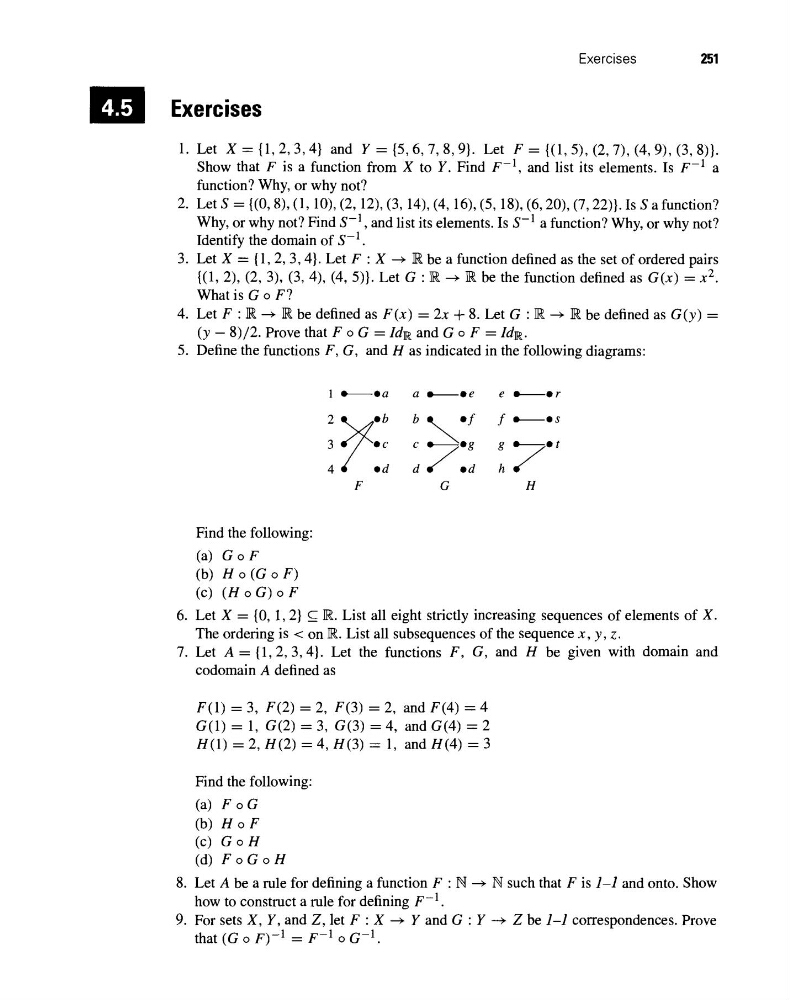
5. Define the functions F, G, and H as indicated in the following diagrams:
1 --a
a
-- ee
e *--r
2~
.b
b
*1ý f fees
3
c
C -
eg
g
e- t
4
e d
d
./ed
h
F
G
H
Find the following:
(a) G o F
(b) H o (G o F)
(c) (H o G) o F
6. Let X = {0, I, 21 _ IR. List all eight strictly increasing sequences of elements of X.
The ordering is < on IR. List all subsequences of the sequence x, y, z.
7. Let A = {1, 2, 3, 4}. Let the functions F, G, and H be given with domain and
codomain A defined as
F(1) = 3, F(2) = 2, F(3) = 2, and F(4) = 4
G(1) = 1, G(2) = 3, G(3) = 4, and G(4) = 2
H(1) = 2, H(2) = 4, H(3) = 1, and H(4) = 3
Find the following:
(a) F o G
(b) H o F
(c) Go H
(d) FoGoH
8. Let A be a rule for defining a function F : N --* N such that F is 1-1 and onto. Show
how to construct a rule for defining F1 .
9. For sets X, Y, and Z, let F : X ->. Y and G : Y -* Z be 1-1 correspondences. Prove
that (G o F)1 = F1 o G1 .
251
W Exercises
1. Let X = {1,2, 3, 4} and Y = {5, 6, 7, 8,9}. Let F = {(1, 5), (2,7), (4,9), (3, 8)}.
Show that F is a function from X to Y. Find F1 , and list its elements. Is F1 a
function? Why, or why not?
2. Let S = {(0, 8), (1, 10), (2, 12), (3, 14), (4, 16), (5, 18), (6, 20), (7, 22)). Is S a function?
Why, or why not? Find S-1, and list its elements. Is S-1 a function? Why, or why not?
Identify the domain of S-1.
3. Let X = {1, 2, 3, 41. Let F : X -* IR be a function defined as the set of ordered pairs
{(1, 2), (2, 3), (3, 4), (4, 5)}. Let G : R -* IR be the function defined as G(x) = x
2 .
What is G o F?
4. Let F : R --* R be defined as F(x) = 2x + 8. Let G : R --* R be defined as G(y) =
(y - 8)/2. Prove that F o G = IdR and G o F = IdR.
5. Define the functions F, G, and H as indicated in the following diagrams:
1 --a
a
-- ee
e *--r
2~
.b
b
*1ý f fees
3
c
C -
eg
g
e- t
4
e d
d
./ed
h
F
G
H
Find the following:
(a) G o F
(b) H o (G o F)
(c) (H o G) o F
6. Let X = {0, I, 21 _ IR. List all eight strictly increasing sequences of elements of X.
The ordering is < on IR. List all subsequences of the sequence x, y, z.
7. Let A = {1, 2, 3, 4}. Let the functions F, G, and H be given with domain and
codomain A defined as
F(1) = 3, F(2) = 2, F(3) = 2, and F(4) = 4
G(1) = 1, G(2) = 3, G(3) = 4, and G(4) = 2
H(1) = 2, H(2) = 4, H(3) = 1, and H(4) = 3
Find the following:
(a) F o G
(b) H o F
(c) Go H
(d) FoGoH
8. Let A be a rule for defining a function F : N --* N such that F is 1-1 and onto. Show
how to construct a rule for defining F1 .
9. For sets X, Y, and Z, let F : X ->. Y and G : Y -* Z be 1-1 correspondences. Prove
that (G o F)1 = F1 o G1 .