

Basic Definitions
223
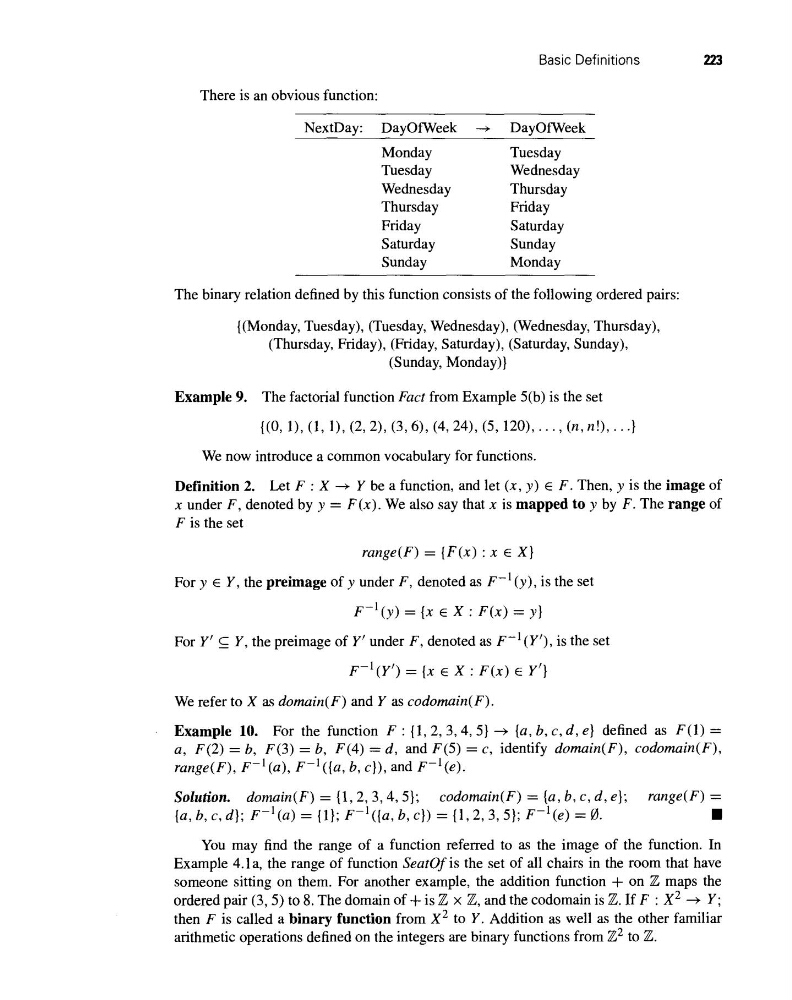
There is an obvious function:
NextDay: DayOfWeek ->
DayOfWeek
Monday
Tuesday
Tuesday
Wednesday
Wednesday
Thursday
Thursday
Friday
Friday
Saturday
Saturday
Sunday
Sunday
Monday
The binary relation defined by this function consists of the following ordered pairs:
{(Monday, Tuesday), (Tuesday, Wednesday), (Wednesday, Thursday),
(Thursday, Friday), (Friday, Saturday), (Saturday, Sunday),
(Sunday, Monday))
Example 9. The factorial function Fact from Example 5(b) is the set
{(0, 1), (1, 1), (2, 2), (3, 6), (4, 24), (5, 120).
(n, n!)....
We now introduce a common vocabulary for functions.
Definition 2. Let F : X --* Y be a function, and let (x, y) E F. Then, y is the image of
x under F, denoted by y = F(x). We also say that x is mapped to y by F. The range of
F is the set
range(F) = {F(x) : x E X}
For y E Y, the preimage of y under F, denoted as F1 (y), is the set
F-l(y) = {x E X : F(x) = y}
For Y' C Y, the preimage of Y' under F, denoted as F
1 (Y'), is the set
F-'(Y') = {x e X : F(x) E Y'}
We refer to X as domain(F) and Y as codomain(F).
Example 10. For the function F : {1, 2, 3, 4, 5} --* {a, b, c, d, e} defined as F(l) =
a, F(2) = b, F(3) = b, F(4) = d, and F(5) = c, identify domain(F), codomain(F),
range(F), F-1(a), F1 ({a, b, c}), and F1 (e).
Solution. domain(F) = {1, 2, 3,4, 5}; codomain(F) = (a, b, c, d, ej; range(F) =
{a, b, c, dj; F-1(a) =- {1}; F1 ({a, b, c)) = {1, 2, 3, 5}; F-1(e) = 0.
U
You may find the range of a function referred to as the image of the function. In
Example 4.1 a, the range of function SeatOf is the set of all chairs in the room that have
someone sitting on them. For another example, the addition function + on Z maps the
ordered pair (3, 5) to 8. The domain of + is Z x Z, and the codomain is Z. If F : X2 -- * y;
then F is called a binary function from X
2 to Y. Addition as well as the other familiar
arithmetic operations defined on the integers are binary functions from Z2 to Z.
223
There is an obvious function:
NextDay: DayOfWeek ->
DayOfWeek
Monday
Tuesday
Tuesday
Wednesday
Wednesday
Thursday
Thursday
Friday
Friday
Saturday
Saturday
Sunday
Sunday
Monday
The binary relation defined by this function consists of the following ordered pairs:
{(Monday, Tuesday), (Tuesday, Wednesday), (Wednesday, Thursday),
(Thursday, Friday), (Friday, Saturday), (Saturday, Sunday),
(Sunday, Monday))
Example 9. The factorial function Fact from Example 5(b) is the set
{(0, 1), (1, 1), (2, 2), (3, 6), (4, 24), (5, 120).
(n, n!)....
We now introduce a common vocabulary for functions.
Definition 2. Let F : X --* Y be a function, and let (x, y) E F. Then, y is the image of
x under F, denoted by y = F(x). We also say that x is mapped to y by F. The range of
F is the set
range(F) = {F(x) : x E X}
For y E Y, the preimage of y under F, denoted as F1 (y), is the set
F-l(y) = {x E X : F(x) = y}
For Y' C Y, the preimage of Y' under F, denoted as F
1 (Y'), is the set
F-'(Y') = {x e X : F(x) E Y'}
We refer to X as domain(F) and Y as codomain(F).
Example 10. For the function F : {1, 2, 3, 4, 5} --* {a, b, c, d, e} defined as F(l) =
a, F(2) = b, F(3) = b, F(4) = d, and F(5) = c, identify domain(F), codomain(F),
range(F), F-1(a), F1 ({a, b, c}), and F1 (e).
Solution. domain(F) = {1, 2, 3,4, 5}; codomain(F) = (a, b, c, d, ej; range(F) =
{a, b, c, dj; F-1(a) =- {1}; F1 ({a, b, c)) = {1, 2, 3, 5}; F-1(e) = 0.
U
You may find the range of a function referred to as the image of the function. In
Example 4.1 a, the range of function SeatOf is the set of all chairs in the room that have
someone sitting on them. For another example, the addition function + on Z maps the
ordered pair (3, 5) to 8. The domain of + is Z x Z, and the codomain is Z. If F : X2 -- * y;
then F is called a binary function from X
2 to Y. Addition as well as the other familiar
arithmetic operations defined on the integers are binary functions from Z2 to Z.