

Relational Databases: An Introduction
209
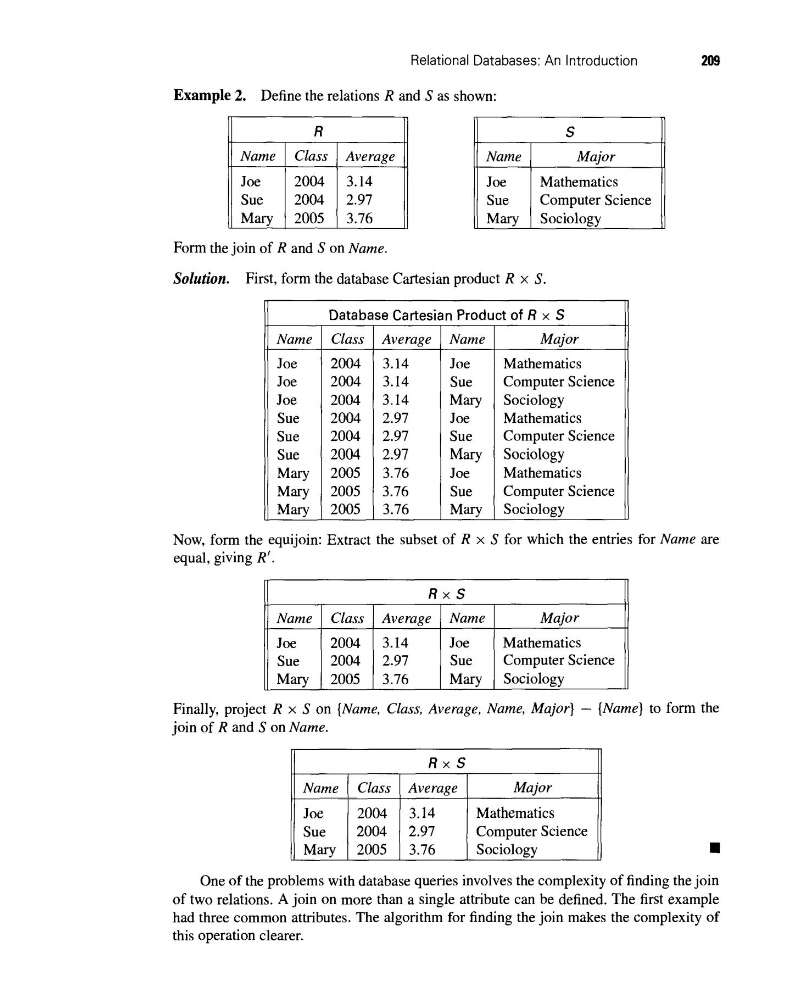
Example 2. Define the relations R and S as shown:
R
S
Name Class Average
Name
Major
Joe
2004
3.14
Joe
Mathematics
Sue
2004
2.97
Sue
Computer Science
Mary
2005
3.76
Mary
Sociology
Form the join of R and S on Name.
Solution. First, form the database Cartesian product R x S.
Database Cartesian Product of R x S
Name Class Average Name
Major
Joe
2004
3.14
Joe
Mathematics
Joe
2004
3.14
Sue
Computer Science
Joe
2004
3.14
Mary
Sociology
Sue
2004
2.97
Joe
Mathematics
Sue
2004
2.97
Sue
Computer Science
Sue
2004
2.97
Mary
Sociology
Mary
2005
3.76
Joe
Mathematics
Mary
2005
3.76
Sue
Computer Science
Mary
2005
3.76
Mary
Sociology
Now, form the equijoin: Extract the subset of R x S for which the entries for Name are
equal, giving R'.
RxS
Name Class Average Name
Major
Joe
2004
3.14
Joe
Mathematics
Sue
2004
2.97
Sue
Computer Science
Mary
2005
3.76
Mary
Sociology
Finally, project R x S on {Name, Class, Average, Name, Major} - {Name} to form the
join of R and S on Name.
RxS
Name Class Average
Major
Joe
2004
3.14
Mathematics
Sue
2004
2.97
Computer Science
Mary
2005
3.76
Sociology
U
One of the problems with database queries involves the complexity of finding the join
of two relations. A join on more than a single attribute can be defined. The first example
had three common attributes. The algorithm for finding the join makes the complexity of
this operation clearer.
209
Example 2. Define the relations R and S as shown:
R
S
Name Class Average
Name
Major
Joe
2004
3.14
Joe
Mathematics
Sue
2004
2.97
Sue
Computer Science
Mary
2005
3.76
Mary
Sociology
Form the join of R and S on Name.
Solution. First, form the database Cartesian product R x S.
Database Cartesian Product of R x S
Name Class Average Name
Major
Joe
2004
3.14
Joe
Mathematics
Joe
2004
3.14
Sue
Computer Science
Joe
2004
3.14
Mary
Sociology
Sue
2004
2.97
Joe
Mathematics
Sue
2004
2.97
Sue
Computer Science
Sue
2004
2.97
Mary
Sociology
Mary
2005
3.76
Joe
Mathematics
Mary
2005
3.76
Sue
Computer Science
Mary
2005
3.76
Mary
Sociology
Now, form the equijoin: Extract the subset of R x S for which the entries for Name are
equal, giving R'.
RxS
Name Class Average Name
Major
Joe
2004
3.14
Joe
Mathematics
Sue
2004
2.97
Sue
Computer Science
Mary
2005
3.76
Mary
Sociology
Finally, project R x S on {Name, Class, Average, Name, Major} - {Name} to form the
join of R and S on Name.
RxS
Name Class Average
Major
Joe
2004
3.14
Mathematics
Sue
2004
2.97
Computer Science
Mary
2005
3.76
Sociology
U
One of the problems with database queries involves the complexity of finding the join
of two relations. A join on more than a single attribute can be defined. The first example
had three common attributes. The algorithm for finding the join makes the complexity of
this operation clearer.