

Truth and Logical Truth
107
The reader should note that, intuitively, (p A q) -* p "asserts" that if p and q are both
T, then p is T. Thus, we expect it to be a tautology.
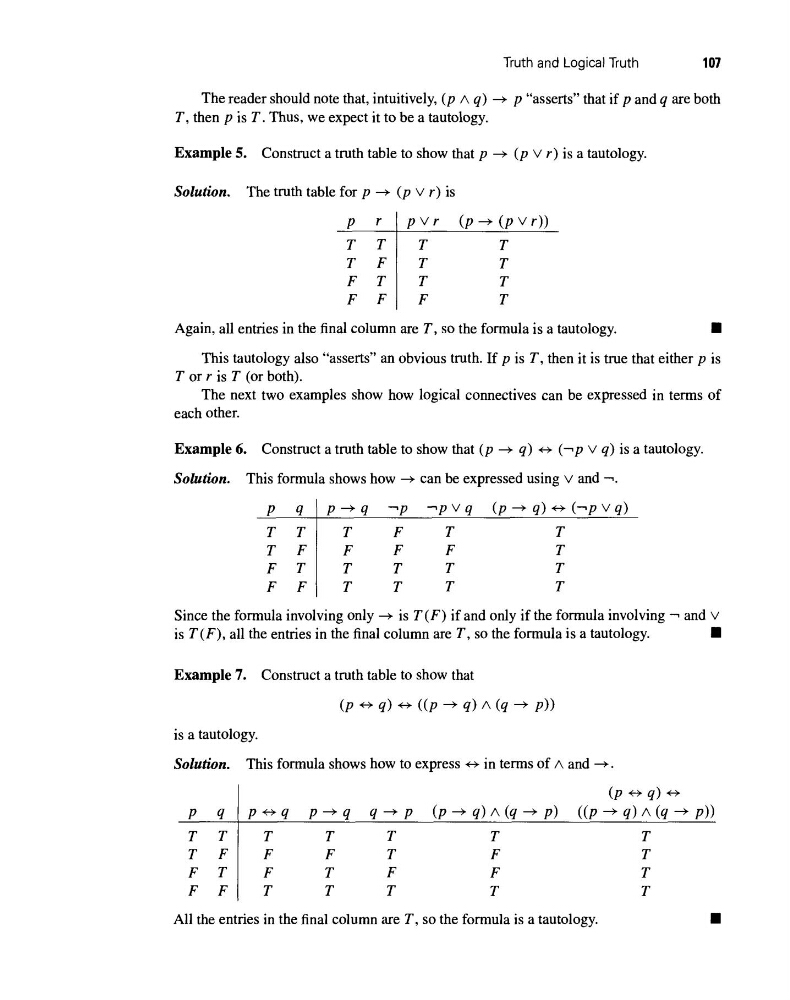
Example 5. Construct a truth table to show that p -- (p V r) is a tautology.
Solution. The truth table for p -+ (p v r) is
p
r
pvr
(p-+ (pvr))
T T
T
T
T F
T
T
F
T
T
T
F
F
F
T
Again, all entries in the final column are T, so the formula is a tautology.
U
This tautology also "asserts" an obvious truth. If p is T, then it is true that either p is
T or r is T (or both).
The next two examples show how logical connectives can be expressed in terms of
each other.
Example 6. Construct a truth table to show that (p --* q) ++ (-p V q) is a tautology.
Solution. This formula shows how -- can be expressed using v and -.
p
q
p--+q
-p
-ppVq
(p-+q) *(-pVq)
T T
T
F
T
T
T
F
F
F
F
T
F
T
T
T
T
T
F
F
T
T
T
T
Since the formula involving only -). is T(F) if and only if the formula involving - and V
is T(F), all the entries in the final column are T, so the formula is a tautology.
U
Example 7. Construct a truth table to show that
(p +- q) --* ((p -+ q) A (q -÷ p))
is a tautology.
Solution. This formula shows how to express +* in terms of A and -+.
(p •* q) +p
q
p*+q
p--+q
q-+p
(p-q)
A(q--.p)
((p --+ q) A (q -
p))
T
T
T
T
T
T
T
T
F
F
F
T
F
T
F
T
F
T
F
F
T
F
F
T
T
T
T
T
All the entries in the final column are T, so the formula is a tautology.
U
107
The reader should note that, intuitively, (p A q) -* p "asserts" that if p and q are both
T, then p is T. Thus, we expect it to be a tautology.
Example 5. Construct a truth table to show that p -- (p V r) is a tautology.
Solution. The truth table for p -+ (p v r) is
p
r
pvr
(p-+ (pvr))
T T
T
T
T F
T
T
F
T
T
T
F
F
F
T
Again, all entries in the final column are T, so the formula is a tautology.
U
This tautology also "asserts" an obvious truth. If p is T, then it is true that either p is
T or r is T (or both).
The next two examples show how logical connectives can be expressed in terms of
each other.
Example 6. Construct a truth table to show that (p --* q) ++ (-p V q) is a tautology.
Solution. This formula shows how -- can be expressed using v and -.
p
q
p--+q
-p
-ppVq
(p-+q) *(-pVq)
T T
T
F
T
T
T
F
F
F
F
T
F
T
T
T
T
T
F
F
T
T
T
T
Since the formula involving only -). is T(F) if and only if the formula involving - and V
is T(F), all the entries in the final column are T, so the formula is a tautology.
U
Example 7. Construct a truth table to show that
(p +- q) --* ((p -+ q) A (q -÷ p))
is a tautology.
Solution. This formula shows how to express +* in terms of A and -+.
(p •* q) +p
q
p*+q
p--+q
q-+p
(p-q)
A(q--.p)
((p --+ q) A (q -
p))
T
T
T
T
T
T
T
T
F
F
F
T
F
T
F
T
F
T
F
F
T
F
F
T
T
T
T
T
All the entries in the final column are T, so the formula is a tautology.
U