

156
J. Wang
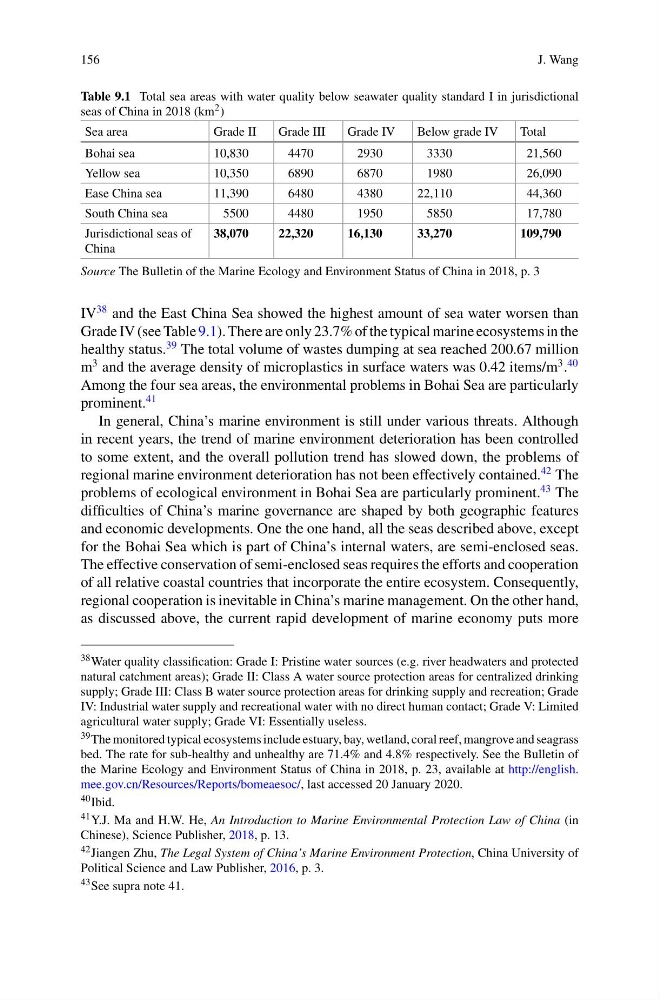
Table 9.1 Total sea areas with water quality below seawater quality standard I in jurisdictional
seas of China in 2018 (km 2 )
Sea area
Grade II
Grade III
Grade IV
Below grade IV
Total
Bohai sea
10,830
4470
2930
3330
21,560
Yellow sea
10,350
6890
6870
1980
26,090
Ease China sea
11,390
6480
4380
22,110
44,360
South China sea
5500
4480
1950
5850
17,780
Jurisdictional seas of
China
38,070
22,320
16,130
33,270
109,790
Source The Bulletin of the Marine Ecology and Environment Status of China in 2018, p. 3
IV
38 and the East China Sea showed the highest amount of sea water worsen than
Grade IV (see Table 9.1). There are only 23.7% of the typical marine ecosystems in the
healthy status.
39 The total volume of wastes dumping at sea reached 200.67 million
m
3 and the average density of microplastics in surface waters was 0.42 items/m
3 .
40
Among the four sea areas, the environmental problems in Bohai Sea are particularly
prominent.
41
In general, China’s marine environment is still under various threats. Although
in recent years, the trend of marine environment deterioration has been controlled
to some extent, and the overall pollution trend has slowed down, the problems of
regional marine environment deterioration has not been effectively contained.
42 The
problems of ecological environment in Bohai Sea are particularly prominent.
43 The
difficulties of China’s marine governance are shaped by both geographic features
and economic developments. One the one hand, all the seas described above, except
for the Bohai Sea which is part of China’s internal waters, are semi-enclosed seas.
The effective conservation of semi-enclosed seas requires the efforts and cooperation
of all relative coastal countries that incorporate the entire ecosystem. Consequently,
regional cooperation is inevitable in China’s marine management. On the other hand,
as discussed above, the current rapid development of marine economy puts more
38 Water quality classification: Grade I: Pristine water sources (e.g. river headwaters and protected
natural catchment areas); Grade II: Class A water source protection areas for centralized drinking
supply; Grade III: Class B water source protection areas for drinking supply and recreation; Grade
IV: Industrial water supply and recreational water with no direct human contact; Grade V: Limited
agricultural water supply; Grade VI: Essentially useless.
39 The monitored typical ecosystems include estuary, bay, wetland, coral reef, mangrove and seagrass
bed. The rate for sub-healthy and unhealthy are 71.4% and 4.8% respectively. See the Bulletin of
the Marine Ecology and Environment Status of China in 2018, p. 23, available at http://english.
mee.gov.cn/Resources/Reports/bomeaesoc/, last accessed 20 January 2020.
40 Ibid.
41 Y.J. Ma and H.W. He, An Introduction to Marine Environmental Protection Law of China (in
Chinese), Science Publisher, 2018, p. 13.
42 Jiangen Zhu, The Legal System of China’s Marine Environment Protection, China University of
Political Science and Law Publisher, 2016, p. 3.
43 See supra note 41.
J. Wang
Table 9.1 Total sea areas with water quality below seawater quality standard I in jurisdictional
seas of China in 2018 (km 2 )
Sea area
Grade II
Grade III
Grade IV
Below grade IV
Total
Bohai sea
10,830
4470
2930
3330
21,560
Yellow sea
10,350
6890
6870
1980
26,090
Ease China sea
11,390
6480
4380
22,110
44,360
South China sea
5500
4480
1950
5850
17,780
Jurisdictional seas of
China
38,070
22,320
16,130
33,270
109,790
Source The Bulletin of the Marine Ecology and Environment Status of China in 2018, p. 3
IV
38 and the East China Sea showed the highest amount of sea water worsen than
Grade IV (see Table 9.1). There are only 23.7% of the typical marine ecosystems in the
healthy status.
39 The total volume of wastes dumping at sea reached 200.67 million
m
3 and the average density of microplastics in surface waters was 0.42 items/m
3 .
40
Among the four sea areas, the environmental problems in Bohai Sea are particularly
prominent.
41
In general, China’s marine environment is still under various threats. Although
in recent years, the trend of marine environment deterioration has been controlled
to some extent, and the overall pollution trend has slowed down, the problems of
regional marine environment deterioration has not been effectively contained.
42 The
problems of ecological environment in Bohai Sea are particularly prominent.
43 The
difficulties of China’s marine governance are shaped by both geographic features
and economic developments. One the one hand, all the seas described above, except
for the Bohai Sea which is part of China’s internal waters, are semi-enclosed seas.
The effective conservation of semi-enclosed seas requires the efforts and cooperation
of all relative coastal countries that incorporate the entire ecosystem. Consequently,
regional cooperation is inevitable in China’s marine management. On the other hand,
as discussed above, the current rapid development of marine economy puts more
38 Water quality classification: Grade I: Pristine water sources (e.g. river headwaters and protected
natural catchment areas); Grade II: Class A water source protection areas for centralized drinking
supply; Grade III: Class B water source protection areas for drinking supply and recreation; Grade
IV: Industrial water supply and recreational water with no direct human contact; Grade V: Limited
agricultural water supply; Grade VI: Essentially useless.
39 The monitored typical ecosystems include estuary, bay, wetland, coral reef, mangrove and seagrass
bed. The rate for sub-healthy and unhealthy are 71.4% and 4.8% respectively. See the Bulletin of
the Marine Ecology and Environment Status of China in 2018, p. 23, available at http://english.
mee.gov.cn/Resources/Reports/bomeaesoc/, last accessed 20 January 2020.
40 Ibid.
41 Y.J. Ma and H.W. He, An Introduction to Marine Environmental Protection Law of China (in
Chinese), Science Publisher, 2018, p. 13.
42 Jiangen Zhu, The Legal System of China’s Marine Environment Protection, China University of
Political Science and Law Publisher, 2016, p. 3.
43 See supra note 41.