

72
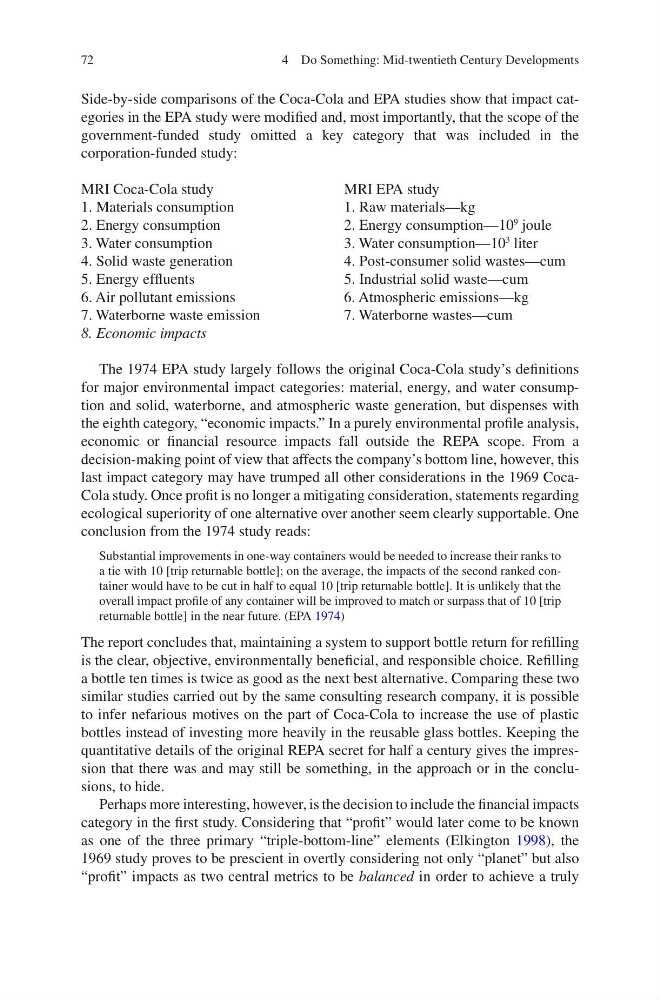
Side-by-side comparisons of the Coca-Cola and EPA studies show that impact categories in the EPA study were modified and, most importantly, that the scope of the
government-funded study omitted a key category that was included in the
corporation- funded study:
MRI Coca-Cola study
MRI EPA study
1. Materials consumption
1. Raw materials—kg
2. Energy consumption
2. Energy consumption—10
9
joule
3. Water consumption
3. Water consumption—10
3
liter
4. Solid waste generation
4. Post-consumer solid wastes—cum
5. Energy effluents
5. Industrial solid waste—cum
6. Air pollutant emissions
6. Atmospheric emissions—kg
7. Waterborne waste emission
7. Waterborne wastes—cum
8. Economic impacts
The 1974 EPA study largely follows the original Coca-Cola study’s definitions
for major environmental impact categories: material, energy, and water consumption and solid, waterborne, and atmospheric waste generation, but dispenses with
the eighth category, “economic impacts.” In a purely environmental profile analysis,
economic or financial resource impacts fall outside the REPA scope. From a
decision- making point of view that affects the company’s bottom line, however, this
last impact category may have trumped all other considerations in the 1969 CocaCola study. Once profit is no longer a mitigating consideration, statements regarding
ecological superiority of one alternative over another seem clearly supportable. One
conclusion from the 1974 study reads:
Substantial improvements in one-way containers would be needed to increase their ranks to
a tie with 10 [trip returnable bottle]; on the average, the impacts of the second ranked container would have to be cut in half to equal 10 [trip returnable bottle]. It is unlikely that the
overall impact profile of any container will be improved to match or surpass that of 10 [trip
returnable bottle] in the near future. (EPA 1974)
The report concludes that, maintaining a system to support bottle return for refilling
is the clear, objective, environmentally beneficial, and responsible choice. Refilling
a bottle ten times is twice as good as the next best alternative. Comparing these two
similar studies carried out by the same consulting research company, it is possible
to infer nefarious motives on the part of Coca-Cola to increase the use of plastic
bottles instead of investing more heavily in the reusable glass bottles. Keeping the
quantitative details of the original REPA secret for half a century gives the impression that there was and may still be something, in the approach or in the conclusions, to hide.
Perhaps more interesting, however, is the decision to include the financial impacts
category in the first study. Considering that “profit” would later come to be known
as one of the three primary “triple-bottom-line” elements (Elkington 1998), the
1969 study proves to be prescient in overtly considering not only “planet” but also
“profit” impacts as two central metrics to be balanced in order to achieve a truly
4 Do Something: Mid-twentieth Century Developments
Side-by-side comparisons of the Coca-Cola and EPA studies show that impact categories in the EPA study were modified and, most importantly, that the scope of the
government-funded study omitted a key category that was included in the
corporation- funded study:
MRI Coca-Cola study
MRI EPA study
1. Materials consumption
1. Raw materials—kg
2. Energy consumption
2. Energy consumption—10
9
joule
3. Water consumption
3. Water consumption—10
3
liter
4. Solid waste generation
4. Post-consumer solid wastes—cum
5. Energy effluents
5. Industrial solid waste—cum
6. Air pollutant emissions
6. Atmospheric emissions—kg
7. Waterborne waste emission
7. Waterborne wastes—cum
8. Economic impacts
The 1974 EPA study largely follows the original Coca-Cola study’s definitions
for major environmental impact categories: material, energy, and water consumption and solid, waterborne, and atmospheric waste generation, but dispenses with
the eighth category, “economic impacts.” In a purely environmental profile analysis,
economic or financial resource impacts fall outside the REPA scope. From a
decision- making point of view that affects the company’s bottom line, however, this
last impact category may have trumped all other considerations in the 1969 CocaCola study. Once profit is no longer a mitigating consideration, statements regarding
ecological superiority of one alternative over another seem clearly supportable. One
conclusion from the 1974 study reads:
Substantial improvements in one-way containers would be needed to increase their ranks to
a tie with 10 [trip returnable bottle]; on the average, the impacts of the second ranked container would have to be cut in half to equal 10 [trip returnable bottle]. It is unlikely that the
overall impact profile of any container will be improved to match or surpass that of 10 [trip
returnable bottle] in the near future. (EPA 1974)
The report concludes that, maintaining a system to support bottle return for refilling
is the clear, objective, environmentally beneficial, and responsible choice. Refilling
a bottle ten times is twice as good as the next best alternative. Comparing these two
similar studies carried out by the same consulting research company, it is possible
to infer nefarious motives on the part of Coca-Cola to increase the use of plastic
bottles instead of investing more heavily in the reusable glass bottles. Keeping the
quantitative details of the original REPA secret for half a century gives the impression that there was and may still be something, in the approach or in the conclusions, to hide.
Perhaps more interesting, however, is the decision to include the financial impacts
category in the first study. Considering that “profit” would later come to be known
as one of the three primary “triple-bottom-line” elements (Elkington 1998), the
1969 study proves to be prescient in overtly considering not only “planet” but also
“profit” impacts as two central metrics to be balanced in order to achieve a truly
4 Do Something: Mid-twentieth Century Developments