

57
growth diminishes. Harmful metals, stable in more alkaline soils, dissolve and are
free to be taken up by plants as the pH levels in soil drop. As aluminum, mercury,
and other heavy metals are released, trees weaken and forests suffer.
Oceans also act as one of the most effective sponges or “sinks” for airborne carbon dioxide. As oceans become more acidic, it makes it more difficult for marine
organisms to form shells and skeletons that are primarily made of calcium, because
calcium is dissolved by acids. These vulnerable species, which evolved in less
acidic oceans, are now beginning to show severe signs of stress as alkaline habitats
become less and less available. At some point, if the trends continue at the same
rate, the acidity of the oceans will reach a point where calcium cannot coalesce to
form shells or skeletons, and calcifying species, such as corals, clams, mussels, sea
urchins, and others, will go extinct.
3.7 Conclusion
It is easy to think we can do something about the waste problems we face, that technological solutions are readily available, but effective tactics used to solve one problem may exacerbate another. Global climate summits set international targets for the
net reduction of greenhouse gas emissions. Commitments are made. Some are kept
and some are not. Some come with other side effects. In fact, one solution to reduce
the use of common ozone-depleting chlorofluorocarbons increased the production
and use of hydrofluorocarbons, which are powerful greenhouse gasses. Transitional
technology strategies like these are stabilizing half-measures that often simply shift
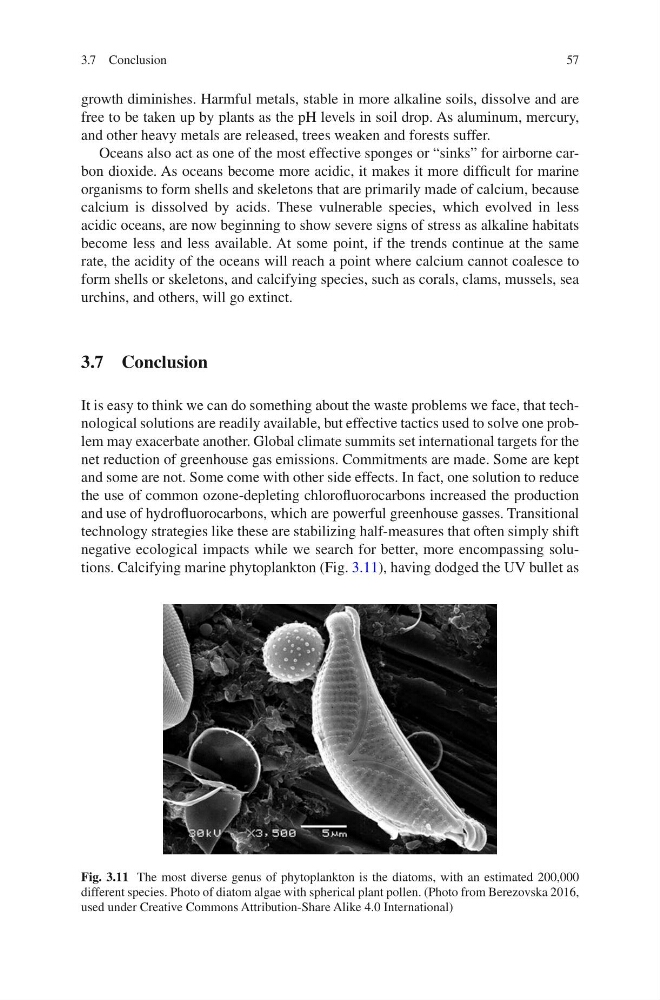
negative ecological impacts while we search for better, more encompassing solutions. Calcifying marine phytoplankton (Fig. 3.11), having dodged the UV bullet as
Fig. 3.11 The most diverse genus of phytoplankton is the diatoms, with an estimated 200,000
different species. Photo of diatom algae with spherical plant pollen. (Photo from Berezovska 2016,
used under Creative Commons Attribution-Share Alike 4.0 International)
3.7 Conclusion
growth diminishes. Harmful metals, stable in more alkaline soils, dissolve and are
free to be taken up by plants as the pH levels in soil drop. As aluminum, mercury,
and other heavy metals are released, trees weaken and forests suffer.
Oceans also act as one of the most effective sponges or “sinks” for airborne carbon dioxide. As oceans become more acidic, it makes it more difficult for marine
organisms to form shells and skeletons that are primarily made of calcium, because
calcium is dissolved by acids. These vulnerable species, which evolved in less
acidic oceans, are now beginning to show severe signs of stress as alkaline habitats
become less and less available. At some point, if the trends continue at the same
rate, the acidity of the oceans will reach a point where calcium cannot coalesce to
form shells or skeletons, and calcifying species, such as corals, clams, mussels, sea
urchins, and others, will go extinct.
3.7 Conclusion
It is easy to think we can do something about the waste problems we face, that technological solutions are readily available, but effective tactics used to solve one problem may exacerbate another. Global climate summits set international targets for the
net reduction of greenhouse gas emissions. Commitments are made. Some are kept
and some are not. Some come with other side effects. In fact, one solution to reduce
the use of common ozone-depleting chlorofluorocarbons increased the production
and use of hydrofluorocarbons, which are powerful greenhouse gasses. Transitional
technology strategies like these are stabilizing half-measures that often simply shift
negative ecological impacts while we search for better, more encompassing solutions. Calcifying marine phytoplankton (Fig. 3.11), having dodged the UV bullet as
Fig. 3.11 The most diverse genus of phytoplankton is the diatoms, with an estimated 200,000
different species. Photo of diatom algae with spherical plant pollen. (Photo from Berezovska 2016,
used under Creative Commons Attribution-Share Alike 4.0 International)
3.7 Conclusion