

55
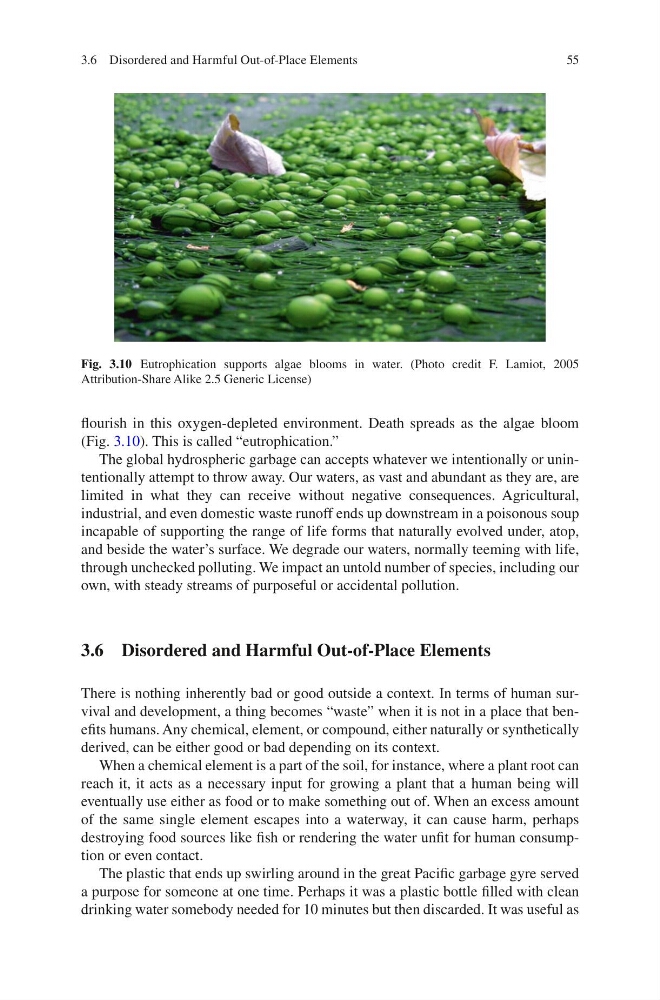
flourish in this oxygen-depleted environment. Death spreads as the algae bloom
(Fig. 3.10). This is called “eutrophication.”
The global hydrospheric garbage can accepts whatever we intentionally or unintentionally attempt to throw away. Our waters, as vast and abundant as they are, are
limited in what they can receive without negative consequences. Agricultural,
industrial, and even domestic waste runoff ends up downstream in a poisonous soup
incapable of supporting the range of life forms that naturally evolved under, atop,
and beside the water’s surface. We degrade our waters, normally teeming with life,
through unchecked polluting. We impact an untold number of species, including our
own, with steady streams of purposeful or accidental pollution.
3.6 Disordered and Harmful Out-of-Place Elements
There is nothing inherently bad or good outside a context. In terms of human survival and development, a thing becomes “waste” when it is not in a place that benefits humans. Any chemical, element, or compound, either naturally or synthetically
derived, can be either good or bad depending on its context.
When a chemical element is a part of the soil, for instance, where a plant root can
reach it, it acts as a necessary input for growing a plant that a human being will
eventually use either as food or to make something out of. When an excess amount
of the same single element escapes into a waterway, it can cause harm, perhaps
destroying food sources like fish or rendering the water unfit for human consumption or even contact.
The plastic that ends up swirling around in the great Pacific garbage gyre served
a purpose for someone at one time. Perhaps it was a plastic bottle filled with clean
drinking water somebody needed for 10 minutes but then discarded. It was useful as
Fig. 3.10 Eutrophication supports algae blooms in water. (Photo credit F. Lamiot, 2005
Attribution-Share Alike 2.5 Generic License)
3.6 Disordered and Harmful Out-of-Place Elements
flourish in this oxygen-depleted environment. Death spreads as the algae bloom
(Fig. 3.10). This is called “eutrophication.”
The global hydrospheric garbage can accepts whatever we intentionally or unintentionally attempt to throw away. Our waters, as vast and abundant as they are, are
limited in what they can receive without negative consequences. Agricultural,
industrial, and even domestic waste runoff ends up downstream in a poisonous soup
incapable of supporting the range of life forms that naturally evolved under, atop,
and beside the water’s surface. We degrade our waters, normally teeming with life,
through unchecked polluting. We impact an untold number of species, including our
own, with steady streams of purposeful or accidental pollution.
3.6 Disordered and Harmful Out-of-Place Elements
There is nothing inherently bad or good outside a context. In terms of human survival and development, a thing becomes “waste” when it is not in a place that benefits humans. Any chemical, element, or compound, either naturally or synthetically
derived, can be either good or bad depending on its context.
When a chemical element is a part of the soil, for instance, where a plant root can
reach it, it acts as a necessary input for growing a plant that a human being will
eventually use either as food or to make something out of. When an excess amount
of the same single element escapes into a waterway, it can cause harm, perhaps
destroying food sources like fish or rendering the water unfit for human consumption or even contact.
The plastic that ends up swirling around in the great Pacific garbage gyre served
a purpose for someone at one time. Perhaps it was a plastic bottle filled with clean
drinking water somebody needed for 10 minutes but then discarded. It was useful as
Fig. 3.10 Eutrophication supports algae blooms in water. (Photo credit F. Lamiot, 2005
Attribution-Share Alike 2.5 Generic License)
3.6 Disordered and Harmful Out-of-Place Elements