

53
ever before, and we have not been able to keep all of it from ending up in our
streams, rivers, lakes, and oceans.
As a result, giant islands the size of Texas, discovered at the end of the twentieth
century but accumulating long before, have formed in the Pacific Ocean. Wind and
ocean currents allow these floating islands of garbage not only to persist but to continue to grow. As the churning flotsam breaks down over time, pieces of plastic, at
various stages of weathering and disintegration, form three-dimensional columns of
waste that extend down below the surface of the Pacific. There, fish and other marine
life mistake the smaller particles for plankton and ingest them. Likewise, on the
surface, hungry seabirds mistake colorful pieces of plastic for food for themselves
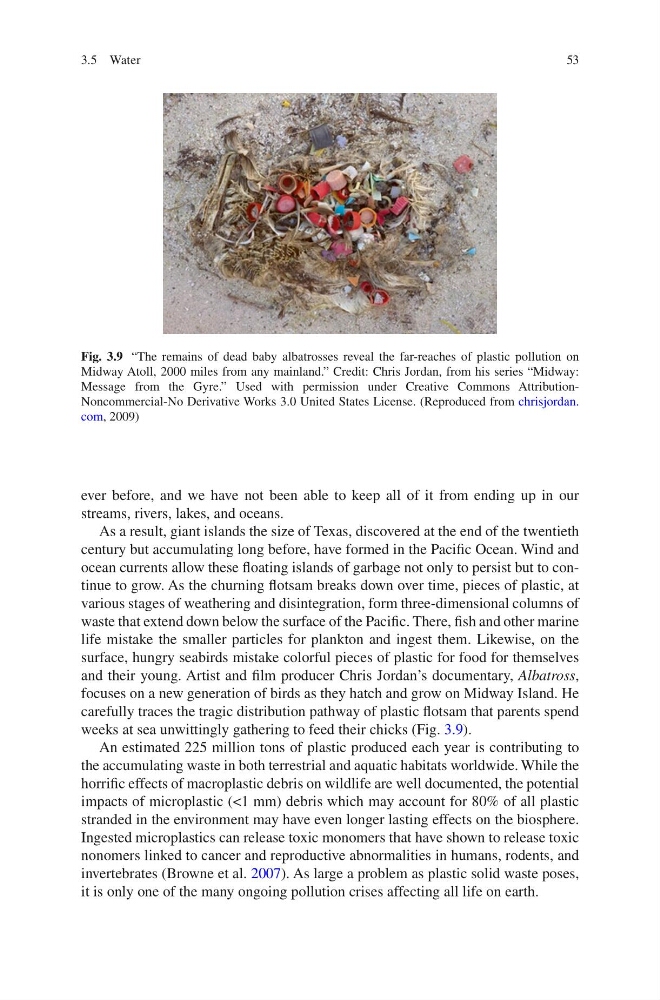
and their young. Artist and film producer Chris Jordan’s documentary, Albatross,
focuses on a new generation of birds as they hatch and grow on Midway Island. He
carefully traces the tragic distribution pathway of plastic flotsam that parents spend
weeks at sea unwittingly gathering to feed their chicks (Fig. 3.9).
An estimated 225 million tons of plastic produced each year is contributing to
the accumulating waste in both terrestrial and aquatic habitats worldwide. While the
horrific effects of macroplastic debris on wildlife are well documented, the potential
impacts of microplastic (<1 mm) debris which may account for 80% of all plastic
stranded in the environment may have even longer lasting effects on the biosphere.
Ingested microplastics can release toxic monomers that have shown to release toxic
nonomers linked to cancer and reproductive abnormalities in humans, rodents, and
invertebrates (Browne et al. 2007). As large a problem as plastic solid waste poses,
it is only one of the many ongoing pollution crises affecting all life on earth.
Fig. 3.9 “The remains of dead baby albatrosses reveal the far-reaches of plastic pollution on
Midway Atoll, 2000 miles from any mainland.” Credit: Chris Jordan, from his series “Midway:
Message from the Gyre.” Used with permission under Creative Commons AttributionNoncommercial- No Derivative Works 3.0 United States License. (Reproduced from chrisjordan.
com, 2009)
3.5 Water
ever before, and we have not been able to keep all of it from ending up in our
streams, rivers, lakes, and oceans.
As a result, giant islands the size of Texas, discovered at the end of the twentieth
century but accumulating long before, have formed in the Pacific Ocean. Wind and
ocean currents allow these floating islands of garbage not only to persist but to continue to grow. As the churning flotsam breaks down over time, pieces of plastic, at
various stages of weathering and disintegration, form three-dimensional columns of
waste that extend down below the surface of the Pacific. There, fish and other marine
life mistake the smaller particles for plankton and ingest them. Likewise, on the
surface, hungry seabirds mistake colorful pieces of plastic for food for themselves
and their young. Artist and film producer Chris Jordan’s documentary, Albatross,
focuses on a new generation of birds as they hatch and grow on Midway Island. He
carefully traces the tragic distribution pathway of plastic flotsam that parents spend
weeks at sea unwittingly gathering to feed their chicks (Fig. 3.9).
An estimated 225 million tons of plastic produced each year is contributing to
the accumulating waste in both terrestrial and aquatic habitats worldwide. While the
horrific effects of macroplastic debris on wildlife are well documented, the potential
impacts of microplastic (<1 mm) debris which may account for 80% of all plastic
stranded in the environment may have even longer lasting effects on the biosphere.
Ingested microplastics can release toxic monomers that have shown to release toxic
nonomers linked to cancer and reproductive abnormalities in humans, rodents, and
invertebrates (Browne et al. 2007). As large a problem as plastic solid waste poses,
it is only one of the many ongoing pollution crises affecting all life on earth.
Fig. 3.9 “The remains of dead baby albatrosses reveal the far-reaches of plastic pollution on
Midway Atoll, 2000 miles from any mainland.” Credit: Chris Jordan, from his series “Midway:
Message from the Gyre.” Used with permission under Creative Commons AttributionNoncommercial- No Derivative Works 3.0 United States License. (Reproduced from chrisjordan.
com, 2009)
3.5 Water