

27
The four laws of thermodynamics taken together help us to think about energy
exchanges in terms of one-way transformations of highly concentrated, wellordered, sources into dissipated lower-grade heat energy that is no longer capable of
effecting change through doing work. They also establish the general boundary conditions inside of which we all live and between which we can measure changes. The
relative harm or good these measurable changes cause depends on spatiotemporal
scales being evaluated. Measurable local short-term gains, made by harnessing
energy transformations through technological advances, may yield long-term harm
elsewhere or, in the case of the environment, to the overall larger system.
2.6 Joule: The Official Energy Unit
James Prescott Joule was a nineteenth-century British physicist who explored the
relationship between heat and work. In a series of experiments carried out between
1845 and 1847, Joule used three custom-built instruments to precisely measure the
subtle temperature rise from the friction caused by gravity-driven small paddles
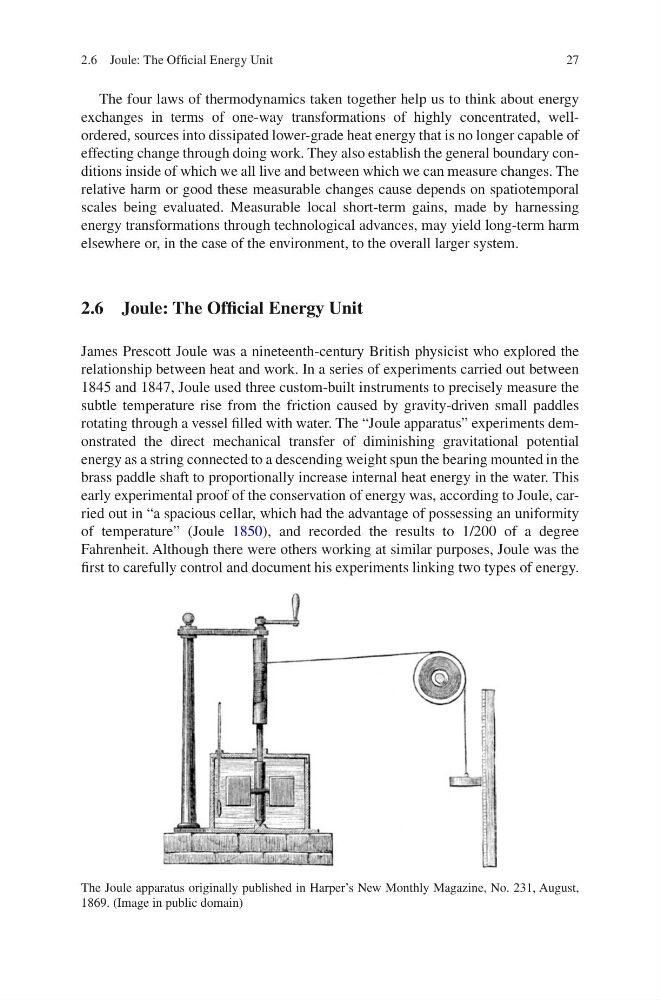
rotating through a vessel filled with water. The “Joule apparatus” experiments demonstrated the direct mechanical transfer of diminishing gravitational potential
energy as a string connected to a descending weight spun the bearing mounted in the
brass paddle shaft to proportionally increase internal heat energy in the water. This
early experimental proof of the conservation of energy was, according to Joule, carried out in “a spacious cellar, which had the advantage of possessing an uniformity
of temperature” (Joule 1850), and recorded the results to 1/200 of a degree
Fahrenheit. Although there were others working at similar purposes, Joule was the
first to carefully control and document his experiments linking two types of energy.
The Joule apparatus originally published in Harper’s New Monthly Magazine, No. 231, August,
1869. (Image in public domain)
2.6 Joule: The Official Energy Unit
The four laws of thermodynamics taken together help us to think about energy
exchanges in terms of one-way transformations of highly concentrated, wellordered, sources into dissipated lower-grade heat energy that is no longer capable of
effecting change through doing work. They also establish the general boundary conditions inside of which we all live and between which we can measure changes. The
relative harm or good these measurable changes cause depends on spatiotemporal
scales being evaluated. Measurable local short-term gains, made by harnessing
energy transformations through technological advances, may yield long-term harm
elsewhere or, in the case of the environment, to the overall larger system.
2.6 Joule: The Official Energy Unit
James Prescott Joule was a nineteenth-century British physicist who explored the
relationship between heat and work. In a series of experiments carried out between
1845 and 1847, Joule used three custom-built instruments to precisely measure the
subtle temperature rise from the friction caused by gravity-driven small paddles
rotating through a vessel filled with water. The “Joule apparatus” experiments demonstrated the direct mechanical transfer of diminishing gravitational potential
energy as a string connected to a descending weight spun the bearing mounted in the
brass paddle shaft to proportionally increase internal heat energy in the water. This
early experimental proof of the conservation of energy was, according to Joule, carried out in “a spacious cellar, which had the advantage of possessing an uniformity
of temperature” (Joule 1850), and recorded the results to 1/200 of a degree
Fahrenheit. Although there were others working at similar purposes, Joule was the
first to carefully control and document his experiments linking two types of energy.
The Joule apparatus originally published in Harper’s New Monthly Magazine, No. 231, August,
1869. (Image in public domain)
2.6 Joule: The Official Energy Unit