

165
8.6 Comparison of LCIA Tools
The different tools addressed here all answer the same questions and are built on the
same scientifically backed framework. That being said, they each offer different
functionalities that are better suited to different situations. It is important for designers to know about the different tools in order to find the best option to bring LCA
into their own workflows.
8.6.1 WBLCA Tools
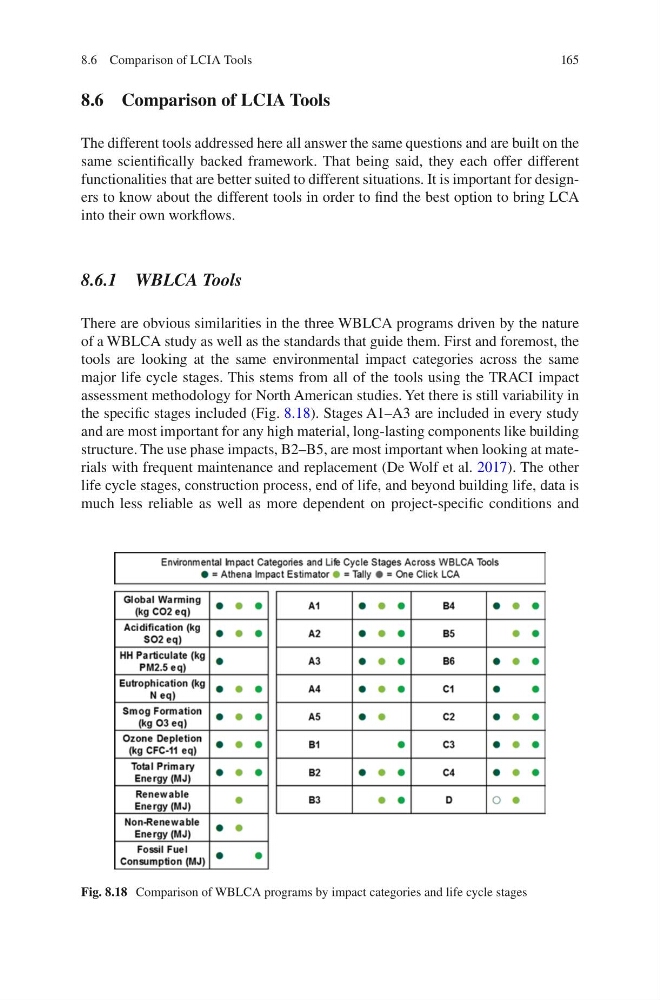
There are obvious similarities in the three WBLCA programs driven by the nature
of a WBLCA study as well as the standards that guide them. First and foremost, the
tools are looking at the same environmental impact categories across the same
major life cycle stages. This stems from all of the tools using the TRACI impact
assessment methodology for North American studies. Yet there is still variability in
the specific stages included (Fig. 8.18). Stages A1–A3 are included in every study
and are most important for any high material, long-lasting components like building
structure. The use phase impacts, B2–B5, are most important when looking at materials with frequent maintenance and replacement (De Wolf et al. 2017). The other
life cycle stages, construction process, end of life, and beyond building life, data is
much less reliable as well as more dependent on project-specific conditions and
Fig. 8.18 Comparison of WBLCA programs by impact categories and life cycle stages
8.6 Comparison of LCIA Tools
8.6 Comparison of LCIA Tools
The different tools addressed here all answer the same questions and are built on the
same scientifically backed framework. That being said, they each offer different
functionalities that are better suited to different situations. It is important for designers to know about the different tools in order to find the best option to bring LCA
into their own workflows.
8.6.1 WBLCA Tools
There are obvious similarities in the three WBLCA programs driven by the nature
of a WBLCA study as well as the standards that guide them. First and foremost, the
tools are looking at the same environmental impact categories across the same
major life cycle stages. This stems from all of the tools using the TRACI impact
assessment methodology for North American studies. Yet there is still variability in
the specific stages included (Fig. 8.18). Stages A1–A3 are included in every study
and are most important for any high material, long-lasting components like building
structure. The use phase impacts, B2–B5, are most important when looking at materials with frequent maintenance and replacement (De Wolf et al. 2017). The other
life cycle stages, construction process, end of life, and beyond building life, data is
much less reliable as well as more dependent on project-specific conditions and
Fig. 8.18 Comparison of WBLCA programs by impact categories and life cycle stages
8.6 Comparison of LCIA Tools