

123
background processes, and the designer is completely removed from the process.
Instead, users enter information about material quantities and receive information in
the LCIA phase of the design. The whole LCI phase happens completely outside of
the control and view of the user. This does not make this stage in the process any
less important. In using an LCI database, and by removing the user from the LCI
phase of the study, LCIA tools make the process much faster and accessible to a
wider audience.
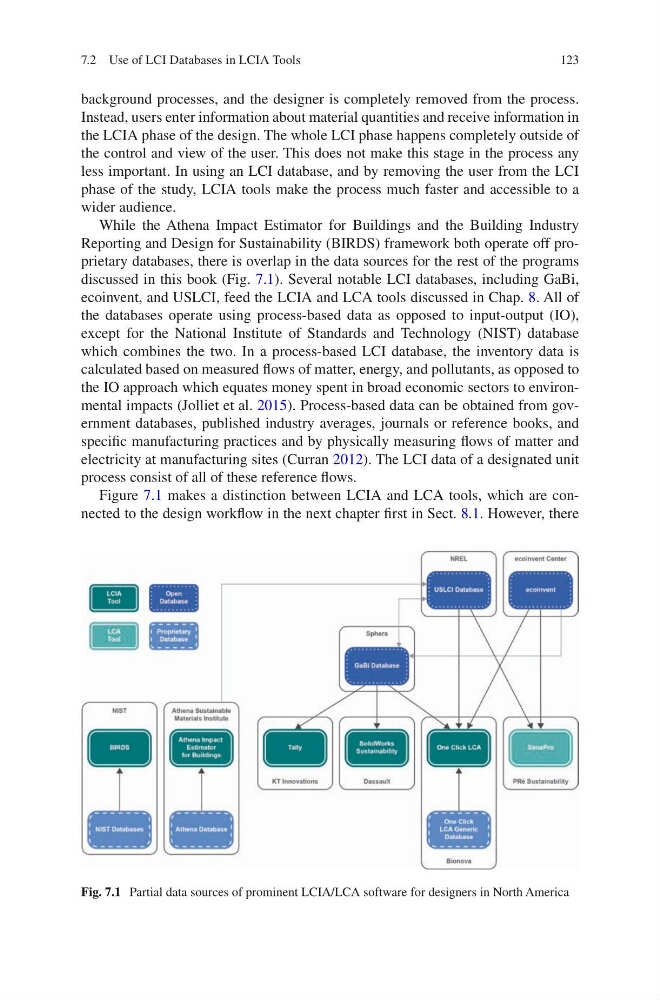
While the Athena Impact Estimator for Buildings and the Building Industry
Reporting and Design for Sustainability (BIRDS) framework both operate off proprietary databases, there is overlap in the data sources for the rest of the programs
discussed in this book (Fig. 7.1). Several notable LCI databases, including GaBi,
ecoinvent, and USLCI, feed the LCIA and LCA tools discussed in Chap. 8. All of
the databases operate using process-based data as opposed to input-output (IO),
except for the National Institute of Standards and Technology (NIST) database
which combines the two. In a process-based LCI database, the inventory data is
calculated based on measured flows of matter, energy, and pollutants, as opposed to
the IO approach which equates money spent in broad economic sectors to environmental impacts (Jolliet et al. 2015). Process-based data can be obtained from government databases, published industry averages, journals or reference books, and
specific manufacturing practices and by physically measuring flows of matter and
electricity at manufacturing sites (Curran 2012). The LCI data of a designated unit
process consist of all of these reference flows.
Figure 7.1 makes a distinction between LCIA and LCA tools, which are connected to the design workflow in the next chapter first in Sect. 8.1. However, there
Fig. 7.1 Partial data sources of prominent LCIA/LCA software for designers in North America
7.2 Use of LCI Databases in LCIA Tools
background processes, and the designer is completely removed from the process.
Instead, users enter information about material quantities and receive information in
the LCIA phase of the design. The whole LCI phase happens completely outside of
the control and view of the user. This does not make this stage in the process any
less important. In using an LCI database, and by removing the user from the LCI
phase of the study, LCIA tools make the process much faster and accessible to a
wider audience.
While the Athena Impact Estimator for Buildings and the Building Industry
Reporting and Design for Sustainability (BIRDS) framework both operate off proprietary databases, there is overlap in the data sources for the rest of the programs
discussed in this book (Fig. 7.1). Several notable LCI databases, including GaBi,
ecoinvent, and USLCI, feed the LCIA and LCA tools discussed in Chap. 8. All of
the databases operate using process-based data as opposed to input-output (IO),
except for the National Institute of Standards and Technology (NIST) database
which combines the two. In a process-based LCI database, the inventory data is
calculated based on measured flows of matter, energy, and pollutants, as opposed to
the IO approach which equates money spent in broad economic sectors to environmental impacts (Jolliet et al. 2015). Process-based data can be obtained from government databases, published industry averages, journals or reference books, and
specific manufacturing practices and by physically measuring flows of matter and
electricity at manufacturing sites (Curran 2012). The LCI data of a designated unit
process consist of all of these reference flows.
Figure 7.1 makes a distinction between LCIA and LCA tools, which are connected to the design workflow in the next chapter first in Sect. 8.1. However, there
Fig. 7.1 Partial data sources of prominent LCIA/LCA software for designers in North America
7.2 Use of LCI Databases in LCIA Tools