

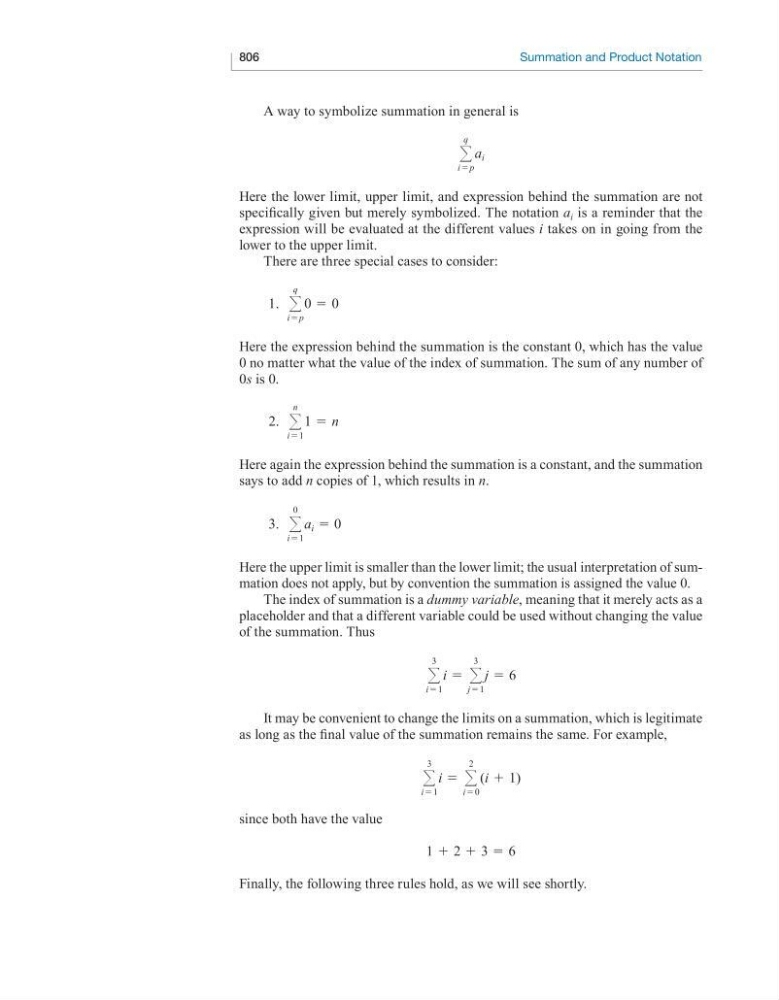
A way to symbolize summation in general is
∑
q
i=p
a i
Here the lower limit, upper limit, and expression behind the summation are not
specifically given but merely symbolized. The notation a i is a reminder that the
expression will be evaluated at the different values i takes on in going from the
lower to the upper limit.
There are three special cases to consider:
1. ∑
q
i=p
0 = 0
Here the expression behind the summation is the constant 0, which has the value
0 no matter what the value of the index of summation. The sum of any number of
0s is 0.
2. ∑
n
i=1
1 = n
Here again the expression behind the summation is a constant, and the summation
says to add n copies of 1, which results in n.
3. ∑
0
i=1
a i = 0
Here the upper limit is smaller than the lower limit; the usual interpretation of summation does not apply, but by convention the summation is assigned the value 0.
The index of summation is a dummy variable, meaning that it merely acts as a
placeholder and that a different variable could be used without changing the value
of the summation. Thus
∑
3
i=1
i = ∑
3
j=1
j = 6
It may be convenient to change the limits on a summation, which is legitimate
as long as the final value of the summation remains the same. For example,
∑
3
i=1
i = ∑
2
i=0
(i + 1)
since both have the value
1 + 2 + 3 = 6
Finally, the following three rules hold, as we will see shortly.
806
Summation and Product Notation
∑
q
i=p
a i
Here the lower limit, upper limit, and expression behind the summation are not
specifically given but merely symbolized. The notation a i is a reminder that the
expression will be evaluated at the different values i takes on in going from the
lower to the upper limit.
There are three special cases to consider:
1. ∑
q
i=p
0 = 0
Here the expression behind the summation is the constant 0, which has the value
0 no matter what the value of the index of summation. The sum of any number of
0s is 0.
2. ∑
n
i=1
1 = n
Here again the expression behind the summation is a constant, and the summation
says to add n copies of 1, which results in n.
3. ∑
0
i=1
a i = 0
Here the upper limit is smaller than the lower limit; the usual interpretation of summation does not apply, but by convention the summation is assigned the value 0.
The index of summation is a dummy variable, meaning that it merely acts as a
placeholder and that a different variable could be used without changing the value
of the summation. Thus
∑
3
i=1
i = ∑
3
j=1
j = 6
It may be convenient to change the limits on a summation, which is legitimate
as long as the final value of the summation remains the same. For example,
∑
3
i=1
i = ∑
2
i=0
(i + 1)
since both have the value
1 + 2 + 3 = 6
Finally, the following three rules hold, as we will see shortly.
806
Summation and Product Notation