

64
Formal Logic
As an extension to the deduction method, we can insert a “temporary”
hypothesis into a proof. If some wff T is introduced into a proof sequence as a
temporary hypothesis, and eventually a wff W is deduced from T and other hypotheses, then the wff T S W has been deduced from the other hypotheses and
can be inserted in the proof sequence.
eXAMPLe 31
The argument
[P(x) S (4y)Q(x, y)] S (4y)[P(x) S Q(x, y)]
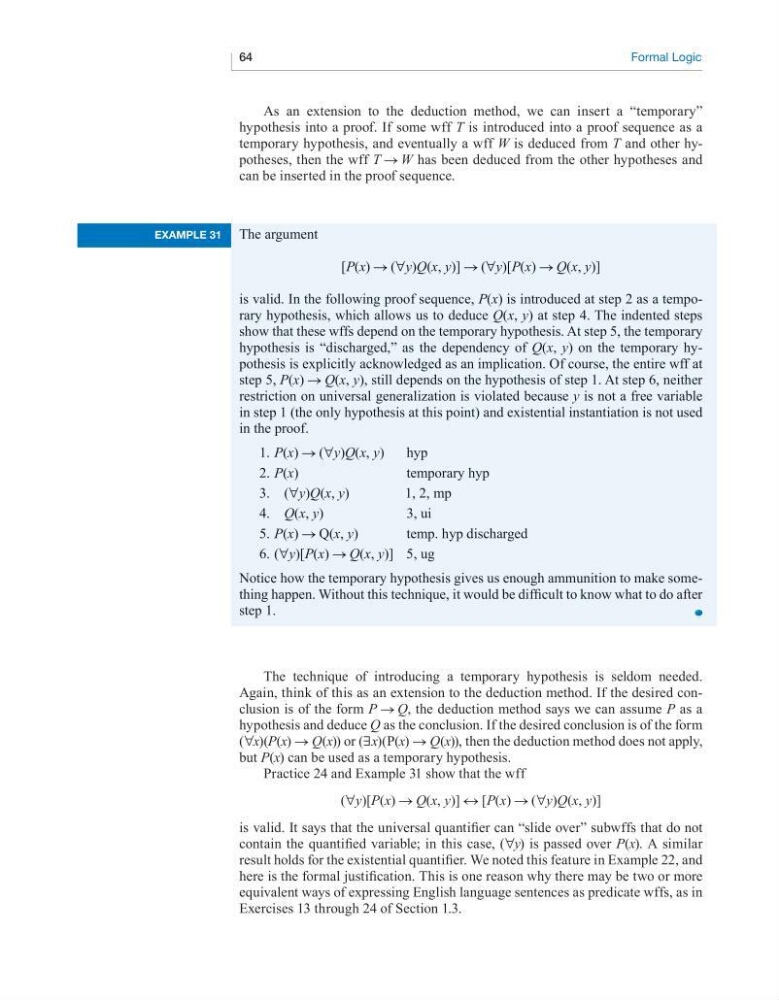
is valid. In the following proof sequence, P(x) is introduced at step 2 as a temporary hypothesis, which allows us to deduce Q(x, y) at step 4. The indented steps
show that these wffs depend on the temporary hypothesis. At step 5, the temporary
hypothesis is “discharged,” as the dependency of Q(x, y) on the temporary hypothesis is explicitly acknowledged as an implication. Of course, the entire wff at
step 5, P(x) S Q(x, y), still depends on the hypothesis of step 1. At step 6, neither
restriction on universal generalization is violated because y is not a free variable
in step 1 (the only hypothesis at this point) and existential instantiation is not used
in the proof.
1. P(x) S (4y)Q(x, y)
hyp
2. P(x)
temporary hyp
3. (4y)Q(x, y)
1, 2, mp
4. Q(x, y)
3, ui
5. P(x) S Q(x, y)
temp. hyp discharged
6. (4y)[P(x) S Q(x, y)] 5, ug
Notice how the temporary hypothesis gives us enough ammunition to make something happen. Without this technique, it would be difficult to know what to do after
step 1.
The technique of introducing a temporary hypothesis is seldom needed.
Again, think of this as an extension to the deduction method. If the desired conclusion is of the form P S Q, the deduction method says we can assume P as a
hypothesis and deduce Q as the conclusion. If the desired conclusion is of the form
(4x)(P(x) S Q(x)) or (E x)(P(x) S Q(x)), then the deduction method does not apply,
but P(x) can be used as a temporary hypothesis.
Practice 24 and Example 31 show that the wff
(4y)[P(x) S Q(x, y)] 4 [P(x) S (4y)Q(x, y)]
is valid. It says that the universal quantifier can “slide over” subwffs that do not
contain the quantified variable; in this case, (4y) is passed over P(x). A similar
result holds for the existential quantifier. We noted this feature in Example 22, and
here is the formal justification. This is one reason why there may be two or more
equivalent ways of expressing English language sentences as predicate wffs, as in
Exercises 13 through 24 of Section 1.3.
Formal Logic
As an extension to the deduction method, we can insert a “temporary”
hypothesis into a proof. If some wff T is introduced into a proof sequence as a
temporary hypothesis, and eventually a wff W is deduced from T and other hypotheses, then the wff T S W has been deduced from the other hypotheses and
can be inserted in the proof sequence.
eXAMPLe 31
The argument
[P(x) S (4y)Q(x, y)] S (4y)[P(x) S Q(x, y)]
is valid. In the following proof sequence, P(x) is introduced at step 2 as a temporary hypothesis, which allows us to deduce Q(x, y) at step 4. The indented steps
show that these wffs depend on the temporary hypothesis. At step 5, the temporary
hypothesis is “discharged,” as the dependency of Q(x, y) on the temporary hypothesis is explicitly acknowledged as an implication. Of course, the entire wff at
step 5, P(x) S Q(x, y), still depends on the hypothesis of step 1. At step 6, neither
restriction on universal generalization is violated because y is not a free variable
in step 1 (the only hypothesis at this point) and existential instantiation is not used
in the proof.
1. P(x) S (4y)Q(x, y)
hyp
2. P(x)
temporary hyp
3. (4y)Q(x, y)
1, 2, mp
4. Q(x, y)
3, ui
5. P(x) S Q(x, y)
temp. hyp discharged
6. (4y)[P(x) S Q(x, y)] 5, ug
Notice how the temporary hypothesis gives us enough ammunition to make something happen. Without this technique, it would be difficult to know what to do after
step 1.
The technique of introducing a temporary hypothesis is seldom needed.
Again, think of this as an extension to the deduction method. If the desired conclusion is of the form P S Q, the deduction method says we can assume P as a
hypothesis and deduce Q as the conclusion. If the desired conclusion is of the form
(4x)(P(x) S Q(x)) or (E x)(P(x) S Q(x)), then the deduction method does not apply,
but P(x) can be used as a temporary hypothesis.
Practice 24 and Example 31 show that the wff
(4y)[P(x) S Q(x, y)] 4 [P(x) S (4y)Q(x, y)]
is valid. It says that the universal quantifier can “slide over” subwffs that do not
contain the quantified variable; in this case, (4y) is passed over P(x). A similar
result holds for the existential quantifier. We noted this feature in Example 22, and
here is the formal justification. This is one reason why there may be two or more
equivalent ways of expressing English language sentences as predicate wffs, as in
Exercises 13 through 24 of Section 1.3.