

Section 9.1 Algebraic Structures
709
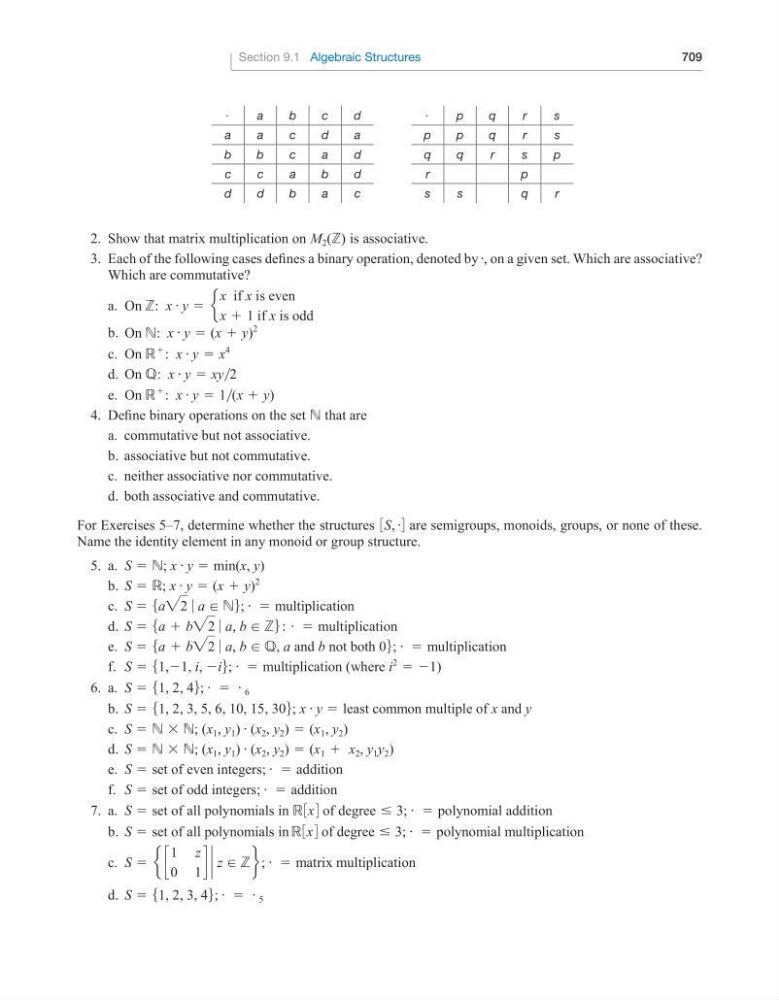
#
a
b
c
d
a
a
c
d
a
b
b
c
a
d
c
c
a
b
d
d
d
b
a
c
#
p
q
r
s
p
p
q
r
s
q
q
r
s
p
r
p
s
s
q
r
2. Show that matrix multiplication on M 2 (Z) is associative.
3. Each of the following cases defines a binary operation, denoted by # , on a given set. Which are associative?
Which are commutative?
a. On Z: x # y = e
x if x is even
x + 1 if x is odd
b. On N: x # y = (x + y)
2
c. On R
+
: x # y = x
4
d. On Q: x # y = xy∙2
e. On R
+
: x # y = 1∙(x + y)
4. Define binary operations on the set N that are
a. commutative but not associative.
b. associative but not commutative.
c. neither associative nor commutative.
d. both associative and commutative.
For Exercises 5–7, determine whether the structures 3S, # 4 are semigroups, monoids, groups, or none of these.
Name the identity element in any monoid or group structure.
5. a. S = N; x # y = min(x, y)
b. S = R; x # y = (x + y)
2
c. S = 5a"2 0 a [ N6; # = multiplication
d. S = 5a + b"2 0 a, b [ Z6; # = multiplication
e. S = 5a + b"2 0 a, b [ Q, a and b not both 06; # = multiplication
f. S = 51,−1, i, −i6; # = multiplication (where i
2
= −1)
6. a. S = 51, 2, 46; # = # 6
b. S = 51, 2, 3, 5, 6, 10, 15, 306; x # y = least common multiple of x and y
c. S = N × N; (x 1 , y 1 ) # (x 2 , y 2 ) = (x 1 , y 2 )
d. S = N × N; (x 1 , y 1 ) # (x 2 , y 2 ) = (x 1 + x 2 , y 1 y 2 )
e. S = set of even integers; # = addition
f. S = set of odd integers; # = addition
7. a. S = set of all polynomials in R3x 4 of degree ≤ 3; # = polynomial addition
b. S = set of all polynomials in R3x 4 of degree ≤ 3; # = polynomial multiplication
c. S = e c
1 z
0 1
d ` z [ Z f ; # = matrix multiplication
d. S = 51, 2, 3, 46; # = # 5