

Section 9.1 Algebraic Structures
707
We will finish this section by looking at some equivalence classes of groups
under isomorphism. Often we pick out one member of an equivalence class and
note that it is the typical member of that class and that all other groups in the class
look just like it (with different names).
A result concerning the nature of very small groups follows immediately
from Exercise 24 at the end of this section.
tHeoRem on sMALL GrouPs
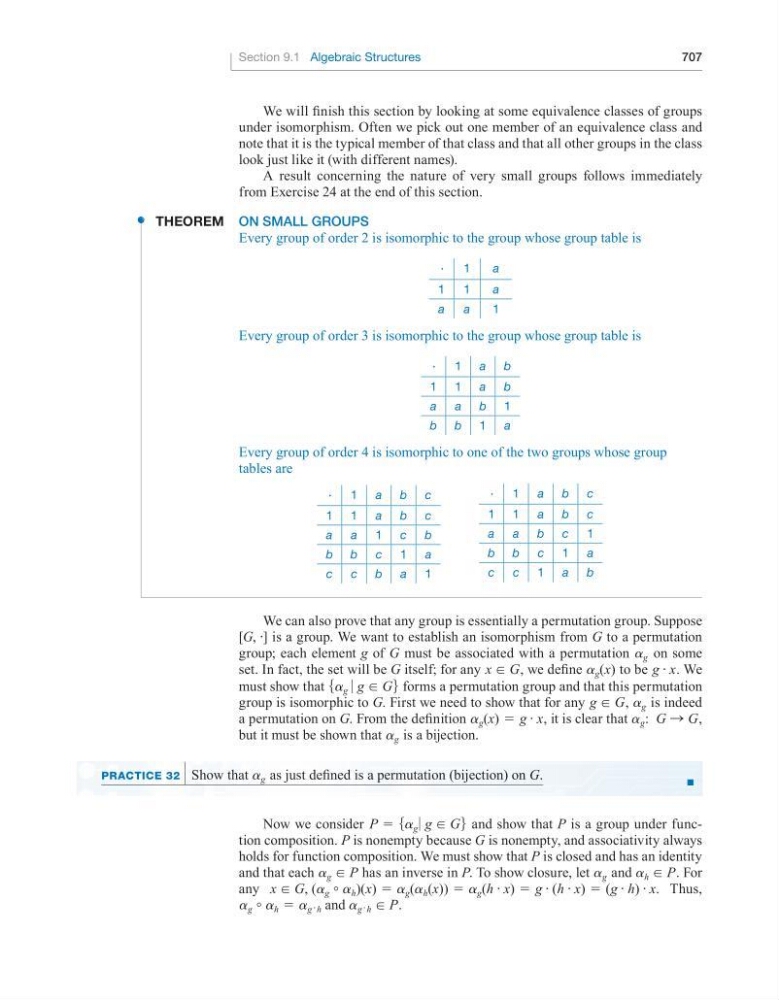
Every group of order 2 is isomorphic to the group whose group table is
# 1 a
1
1
a
a
a
1
Every group of order 3 is isomorphic to the group whose group table is
# 1 a b
1 1 a b
a
a b 1
b b 1 a
Every group of order 4 is isomorphic to one of the two groups whose group
tables are
# 1 a b c
1 1 a b c
a
a 1 c b
b b c 1 a
c c b a 1
# 1 a b c
1 1 a b c
a
a b c 1
b b c 1 a
c c 1 a b
We can also prove that any group is essentially a permutation group. Suppose
[G, # ] is a group. We want to establish an isomorphism from G to a permutation
group; each element g of G must be associated with a permutation a g on some
set. In fact, the set will be G itself; for any x [ G, we define a g (x) to be g # x. We
must show that 5a g 0 g [ G6 forms a permutation group and that this permutation
group is isomorphic to G. First we need to show that for any g [ G, a g is indeed
a permutation on G. From the definition a g (x) = g # x, it is clear that a g : G S G,
but it must be shown that a g is a bijection.
PrACtiCe 32 Show that a g as just defined is a permutation (bijection) on G.
■
Now we consider P = 5a g 0 g [ G6 and show that P is a group under function composition. P is nonempty because G is nonempty, and associativity always
holds for function composition. We must show that P is closed and has an identity
and that each a g [ P has an inverse in P. To show closure, let a g and a h [ P. For
any x [ G, (a g + a h )(x) = a g (a h (x)) = a g (h # x) = g # (h # x) = (g # h) # x. Thus,
a g + a h = a g # h and a g # h [ P.