

698
Modeling Arithmetic, Computation, and Languages
appear twice? If so, then the table says that there are two distinct elements x 1 and
x 2 of the group such that a # x 1 = b and a # x 2 = b. But by the theorem on solving
linear equations, this double occurrence cannot happen. Thus, a given element of
a finite group appears at most once in a given row of the group table. However,
to complete the row, each element must appear at least once. A similar result
holds for columns. Therefore, in a group table, each element appears exactly once
in each row and each column. This property alone, however, is not sufficient to
insure that a table represents a group; the operation must also be associative (see
Exercise 31).
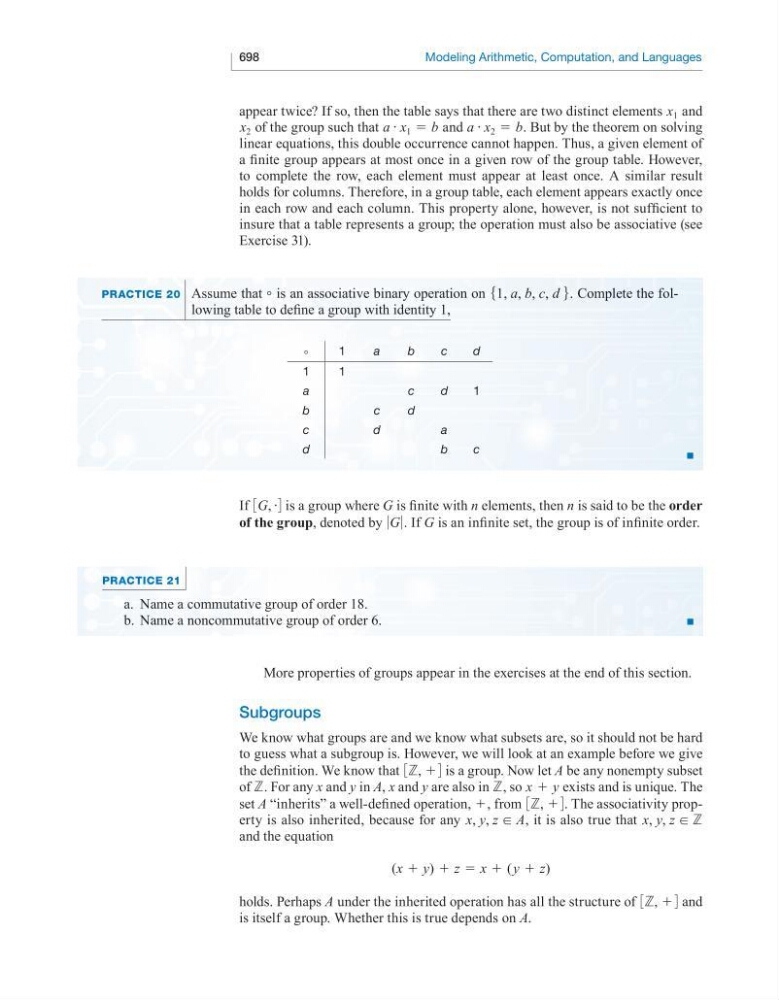
PrACtiCe 20 Assume that + is an associative binary operation on 51, a, b, c, d 6. Complete the following table to define a group with identity 1,
+
1
a
b
c
d
1
1
a
c
d
1
b
c
d
c
d
a
d
b
c
If 3G, # 4 is a group where G is finite with n elements, then n is said to be the order
of the group, denoted by 0 G0 . If G is an infinite set, the group is of infinite order.
PrACtiCe 21
a. Name a commutative group of order 18.
b. Name a noncommutative group of order 6.
More properties of groups appear in the exercises at the end of this section.
subgroups
We know what groups are and we know what subsets are, so it should not be hard
to guess what a subgroup is. However, we will look at an example before we give
the definition. We know that 3Z, + 4 is a group. Now let A be any nonempty subset
of Z. For any x and y in A, x and y are also in Z, so x + y exists and is unique. The
set A “inherits” a well-defined operation, +, from 3Z, + 4. The associativity property is also inherited, because for any x, y, z [ A, it is also true that x, y, z [ Z
and the equation
(x + y) + z = x + ( y + z)
holds. Perhaps A under the inherited operation has all the structure of 3Z, + 4 and
is itself a group. Whether this is true depends on A.
■
■