

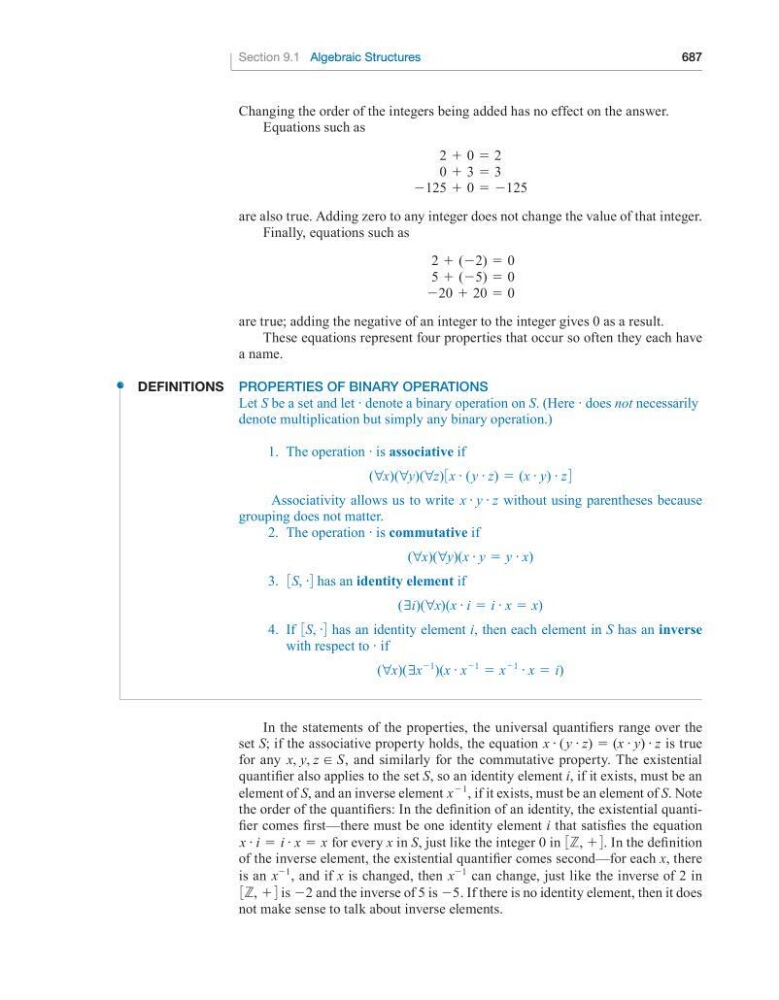
Section 9.1 Algebraic Structures
687
Section 9.1 Algebraic Structures
687
Changing the order of the integers being added has no effect on the answer.
Equations such as
2 + 0 = 2
0 + 3 = 3
−125 + 0 = −125
are also true. Adding zero to any integer does not change the value of that integer.
Finally, equations such as
2 + (−2) = 0
5 + (−5) = 0
−20 + 20 = 0
are true; adding the negative of an integer to the integer gives 0 as a result.
These equations represent four properties that occur so often they each have
a name.
DefinitionS ProPErtiEs of BinAry oPErAtions
Let S be a set and let # denote a binary operation on S. (Here # does not necessarily
denote multiplication but simply any binary operation.)
1. The operation # is associative if
(4x)(4y)(4z) 3x # ( y # z) = (x # y) # z 4
Associativity allows us to write x # y # z without using parentheses because
grouping does not matter.
2. The operation # is commutative if
(4x)(4y)(x # y = y # x)
3. 3S, # 4 has an identity element if
( E i)(4x)(x # i = i # x = x)
4. If 3S, # 4 has an identity element i, then each element in S has an inverse
with respect to # if
(4x)( E x
−1
)(x # x
−1
= x
−1 # x = i)
In the statements of the properties, the universal quantifiers range over the
set S; if the associative property holds, the equation x # ( y # z) = (x # y) # z is true
for any x, y, z [ S, and similarly for the commutative property. The existential
quantifier also applies to the set S, so an identity element i, if it exists, must be an
element of S, and an inverse element x
−1
, if it exists, must be an element of S. Note
the order of the quantifiers: In the definition of an identity, the existential quantifier comes first—there must be one identity element i that satisfies the equation
x # i = i # x = x for every x in S, just like the integer 0 in 3Z, + 4. In the definition
of the inverse element, the existential quantifier comes second—for each x, there
is an x
−1
, and if x is changed, then x
−1
can change, just like the inverse of 2 in
3Z, + 4 is −2 and the inverse of 5 is −5. If there is no identity element, then it does
not make sense to talk about inverse elements.
687
Section 9.1 Algebraic Structures
687
Changing the order of the integers being added has no effect on the answer.
Equations such as
2 + 0 = 2
0 + 3 = 3
−125 + 0 = −125
are also true. Adding zero to any integer does not change the value of that integer.
Finally, equations such as
2 + (−2) = 0
5 + (−5) = 0
−20 + 20 = 0
are true; adding the negative of an integer to the integer gives 0 as a result.
These equations represent four properties that occur so often they each have
a name.
DefinitionS ProPErtiEs of BinAry oPErAtions
Let S be a set and let # denote a binary operation on S. (Here # does not necessarily
denote multiplication but simply any binary operation.)
1. The operation # is associative if
(4x)(4y)(4z) 3x # ( y # z) = (x # y) # z 4
Associativity allows us to write x # y # z without using parentheses because
grouping does not matter.
2. The operation # is commutative if
(4x)(4y)(x # y = y # x)
3. 3S, # 4 has an identity element if
( E i)(4x)(x # i = i # x = x)
4. If 3S, # 4 has an identity element i, then each element in S has an inverse
with respect to # if
(4x)( E x
−1
)(x # x
−1
= x
−1 # x = i)
In the statements of the properties, the universal quantifiers range over the
set S; if the associative property holds, the equation x # ( y # z) = (x # y) # z is true
for any x, y, z [ S, and similarly for the commutative property. The existential
quantifier also applies to the set S, so an identity element i, if it exists, must be an
element of S, and an inverse element x
−1
, if it exists, must be an element of S. Note
the order of the quantifiers: In the definition of an identity, the existential quantifier comes first—there must be one identity element i that satisfies the equation
x # i = i # x = x for every x in S, just like the integer 0 in 3Z, + 4. In the definition
of the inverse element, the existential quantifier comes second—for each x, there
is an x
−1
, and if x is changed, then x
−1
can change, just like the inverse of 2 in
3Z, + 4 is −2 and the inverse of 5 is −5. If there is no identity element, then it does
not make sense to talk about inverse elements.