

c H a p t e R 8 review
teRminology
AND gate (p. 639)
Boolean algebra (p. 620)
Boolean expression
(p. 639)
canonical sum-of-products form
(p. 643)
combinational network (p. 642)
complement (of a Boolean algebra
element) (p. 625)
De Morgan’s laws (for a Boolean
algebra) (p. 624)
disjunctive normal form (p. 643)
double negation (for a Boolean
algebra) (p. 624)
dual (of a Boolean algebra
property) (p. 623)
equivalent Boolean expressions
(p. 645)
FPGA (p. 647)
full-adder (p. 650)
half-adder (p. 649)
idempotent property (of a Boolean
algebra) (p. 622)
inverter (p. 639)
isomorphic instances of a structure
(p. 626)
isomorphism (p. 626)
isomorphism for Boolean algebras
(p. 629)
NAND gate (p. 650)
NOR gate (p. 651)
OR gate (p. 639)
PLD (p. 647)
truth function (p. 640)
universal bound property (of a
Boolean algebra) (p. 624)
Self-teSt
Answer the following true-false questions.
section 8.1
1. In any Boolean algebra, x + x′ = 0.
2. Set theory is an instance of a Boolean algebra in
which + is set union and # is set intersection.
3. In any Boolean algebra, x + ( y + x # z) = x + y.
4. The dual of the equation in the previous statement
is x # 3 y # (x + z) 4 = x # y.
5. Any two Boolean algebras with 16 elements are
isomorphic.
section 8.2
1. A logic network for the Boolean expression
(x + y)′ could be built using one AND gate and
two inverters.
2. The canonical sum-of-products form for a truth
function f: 50, 16
n S 50, 16 has n terms.
3. Two single-bit binary numbers can be added using
a network consisting of two half-adders.
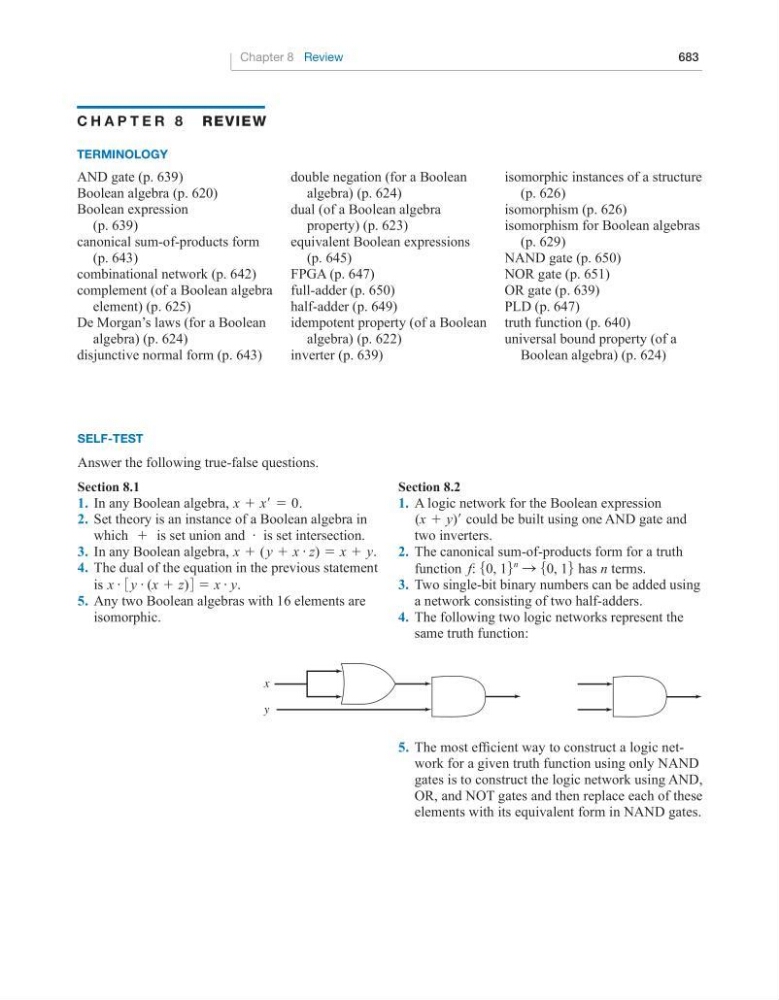
4. The following two logic networks represent the
same truth function:
5. The most efficient way to construct a logic network for a given truth function using only NAND
gates is to construct the logic network using AND,
OR, and NOT gates and then replace each of these
elements with its equivalent form in NAND gates.
Chapter 8 Review
683
x
y