

672
Boolean Algebra and Computer Logic
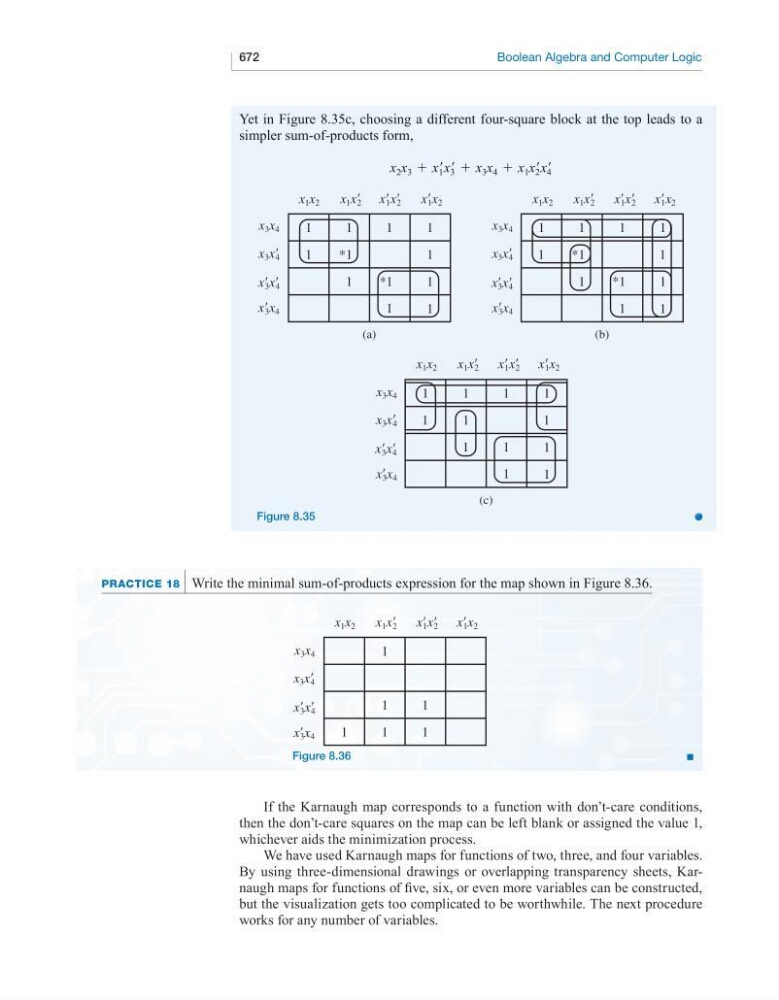
Yet in Figure 8.35c, choosing a different four-square block at the top leads to a
simpler sum-of-products form,
x 2 x 3 + x 1 ′x 3 ′ + x 3 x 4 + x 1 x 2 ′x 4 ′
1
1
1
1
1
1
1
1
1
(a)
(b)
1
1
1
1
1
1
1
1
1
*
*
*
*
1
1
1
1
1
1
1
1
1
1
1
1
1
1
1
1
1
1
(c)
x 1 x 2
x 3 x 4
x 1 xЈ 2
x 3 xЈ 4
xЈ 1 xЈ 2
xЈ 3 xЈ 4
xЈ 1 x 2
xЈ 3 x 4
x 1 x 2
x 3 x 4
x 1 xЈ 2
x 3 xЈ 4
xЈ 1 xЈ 2
xЈ 3 xЈ 4
xЈ 1 x 2
xЈ 3 x 4
x 1 x 2
x 3 x 4
x 1 xЈ 2
x 3 xЈ 4
xЈ 1 xЈ 2
xЈ 3 xЈ 4
xЈ 1 x 2
xЈ 3 x 4
figure 8.35
■
PraCtiCe 18 Write the minimal sum-of-products expression for the map shown in Figure 8.36.
1
1
1
1
1
1
x 1 x 2
x 3 x 4
x 1 xЈ 2
x 3 xЈ 4
xЈ 1 xЈ 2
xЈ 3 xЈ 4
xЈ 1 x 2
xЈ 3 x 4
figure 8.36
If the Karnaugh map corresponds to a function with don’t-care conditions,
then the don’t-care squares on the map can be left blank or assigned the value 1,
whichever aids the minimization process.
We have used Karnaugh maps for functions of two, three, and four variables.
By using three-dimensional drawings or overlapping transparency sheets, Karnaugh maps for functions of five, six, or even more variables can be constructed,
but the visualization gets too complicated to be worthwhile. The next procedure
works for any number of variables.