

670
Boolean Algebra and Computer Logic
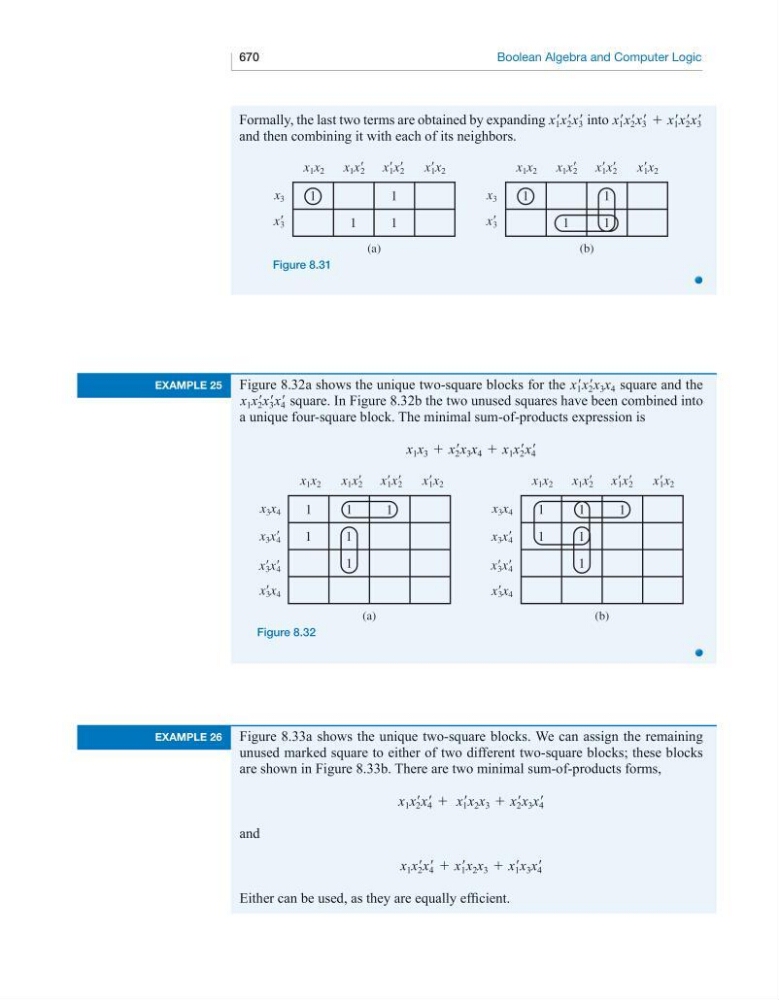
Formally, the last two terms are obtained by expanding x 1 ′x 2 ′x 3 ′ into x 1 ′x 2 ′x 3 ′ + x 1 ′x 2 ′x 3 ′
and then combining it with each of its neighbors.
(a)
1
1
1
1
(b)
1
1
1
1
x 1 x 2
x 3
x 1 xЈ 2 xЈ 1 xЈ 2
xЈ 3
xЈ 1 x 2
x 1 x 2
x 3
x 1 xЈ 2 xЈ 1 xЈ 2
xЈ 3
xЈ 1 x 2
figure 8.31
example 25
Figure 8.32a shows the unique two-square blocks for the x 1 ′x 2 ′x 3 x 4 square and the
x 1 x 2 ′x 3 ′x 4 ′ square. In Figure 8.32b the two unused squares have been combined into
a unique four-square block. The minimal sum-of-products expression is
x 1 x 3 + x 2 ′x 3 x 4 + x 1 x 2 ′x 4 ′
1
(a)
1
1
1
1
1
1
(b)
1
1
1
1
1
x 1 x 2
x 3 x 4
x 1 xЈ 2
x 3 xЈ 4
xЈ 1 xЈ 2
xЈ 3 xЈ 4
xЈ 1 x 2
xЈ 3 x 4
x 1 x 2
x 3 x 4
x 1 xЈ 2
x 3 xЈ 4
xЈ 1 xЈ 2
xЈ 3 xЈ 4
xЈ 1 x 2
xЈ 3 x 4
figure 8.32
example 26
Figure 8.33a shows the unique two-square blocks. We can assign the remaining
unused marked square to either of two different two-square blocks; these blocks
are shown in Figure 8.33b. There are two minimal sum-of-products forms,
x 1 x 2 ′x 4 ′ + x 1 ′x 2 x 3 + x 2 ′x 3 x 4 ′
and
x 1 x 2 ′x 4 ′ + x 1 ′x 2 x 3 + x 1 ′x 3 x 4 ′
Either can be used, as they are equally efficient.