

656
Boolean Algebra and Computer Logic
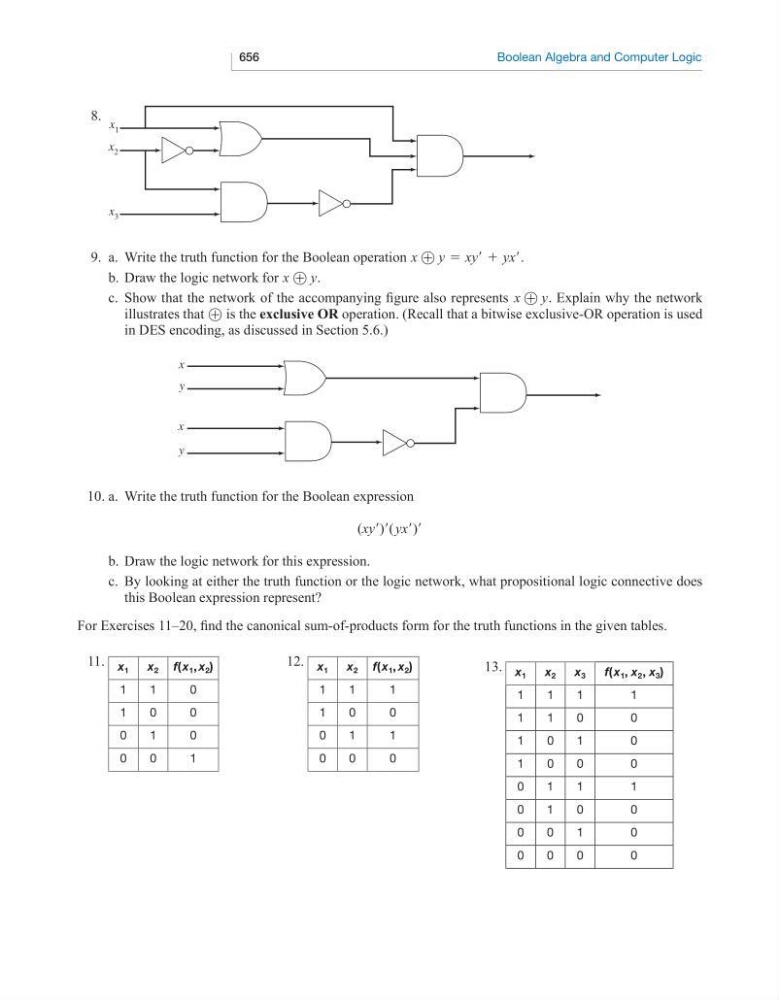
8.
x 3
x 2
x 1
9. a. Write the truth function for the Boolean operation x ! y = xy′ + yx′.
b. Draw the logic network for x ! y.
c. Show that the network of the accompanying figure also represents x ! y. Explain why the network
illustrates that ! is the exclusive Or operation. (Recall that a bitwise exclusive-OR operation is used
in DES encoding, as discussed in Section 5.6.)
x
y
x
y
10. a. Write the truth function for the Boolean expression
(xy′)′( yx′)′
b. Draw the logic network for this expression.
c. By looking at either the truth function or the logic network, what propositional logic connective does
this Boolean expression represent?
For Exercises 11–20, find the canonical sum-of-products form for the truth functions in the given tables.
11. x 1 x 2 f( x 1 , x 2 )
1
1
0
1
0
0
0
1
0
0
0
1
12. x 1 x 2 f( x 1 , x 2 )
1
1
1
1
0
0
0
1
1
0
0
0
13. x 1 x 2 x 3 f( x 1 , x 2 , x 3 )
1
1
1
1
1
1
0
0
1
0
1
0
1
0
0
0
0
1
1
1
0
1
0
0
0
0
1
0
0
0
0
0