

630
Boolean Algebra and Computer Logic
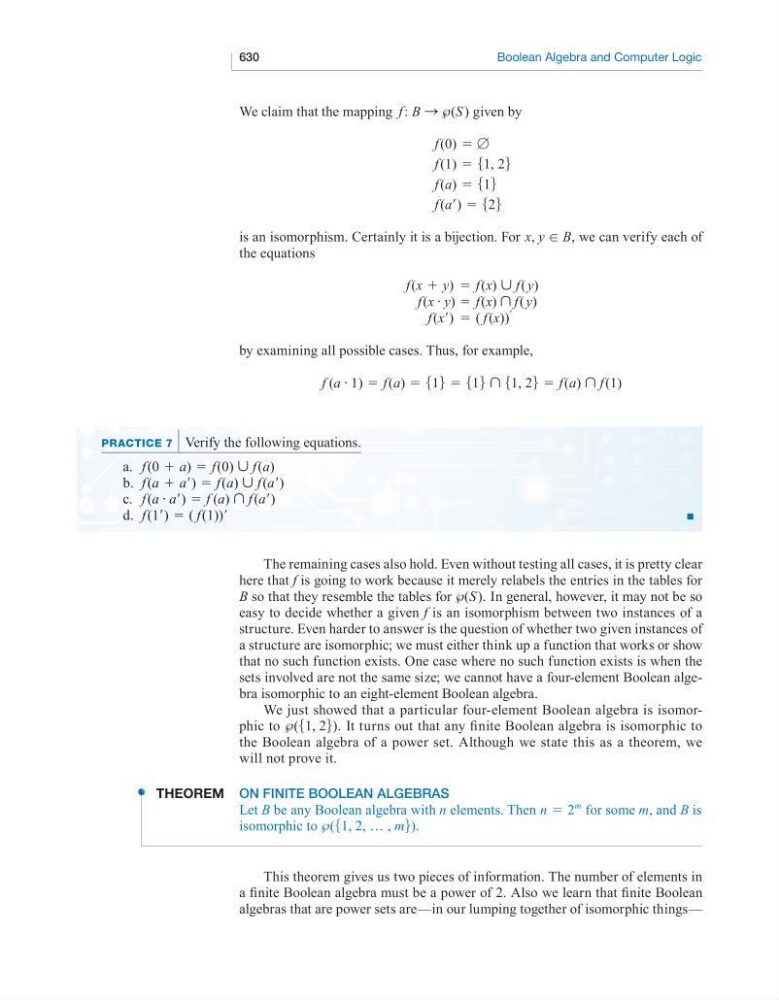
We claim that the mapping f : B S `(S ) given by
f (0) = [
f (1) = 51, 26
f (a) = 516
f (a′) = 526
is an isomorphism. Certainly it is a bijection. For x, y [ B, we can verify each of
the equations
f (x + y) = f (x) c f ( y)
f (x # y) = f (x) d f ( y)
f (x′) = ( f (x))
′
by examining all possible cases. Thus, for example,
f (a # 1) = f (a) = 516 = 516 d 51, 26 = f (a) d f (1)
■
Practice 7 Verify the following equations.
a. f (0 + a) = f (0) c f (a)
b. f (a + a′) = f (a) c f (a′)
c. f (a # a′) = f (a) d f (a′)
d. f (1′) = ( f (1))′
The remaining cases also hold. Even without testing all cases, it is pretty clear
here that f is going to work because it merely relabels the entries in the tables for
B so that they resemble the tables for `(S ). In general, however, it may not be so
easy to decide whether a given f is an isomorphism between two instances of a
structure. Even harder to answer is the question of whether two given instances of
a structure are isomorphic; we must either think up a function that works or show
that no such function exists. One case where no such function exists is when the
sets involved are not the same size; we cannot have a four-element Boolean algebra isomorphic to an eight-element Boolean algebra.
We just showed that a particular four-element Boolean algebra is isomorphic to `(51, 26). It turns out that any finite Boolean algebra is isomorphic to
the Boolean algebra of a power set. Although we state this as a theorem, we
will not prove it.
Theorem On Finite BOOlean algeBras
Let B be any Boolean algebra with n elements. Then n = 2
m
for some m, and B is
isomorphic to `(51, 2, … , m6).
This theorem gives us two pieces of information. The number of elements in
a finite Boolean algebra must be a power of 2. Also we learn that finite Boolean
algebras that are power sets are—in our lumping together of isomorphic things—