

example 16
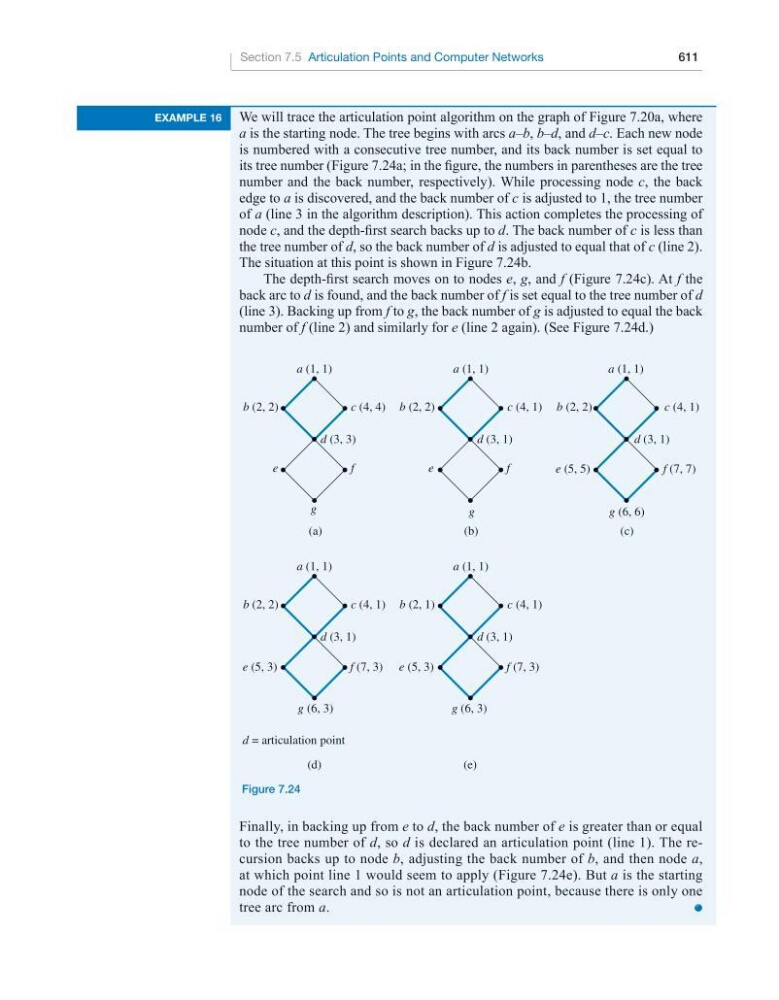
We will trace the articulation point algorithm on the graph of Figure 7.20a, where
a is the starting node. The tree begins with arcs a–b, b–d, and d–c. Each new node
is numbered with a consecutive tree number, and its back number is set equal to
its tree number (Figure 7.24a; in the figure, the numbers in parentheses are the tree
number and the back number, respectively). While processing node c, the back
edge to a is discovered, and the back number of c is adjusted to 1, the tree number
of a (line 3 in the algorithm description). This action completes the processing of
node c, and the depth-first search backs up to d. The back number of c is less than
the tree number of d, so the back number of d is adjusted to equal that of c (line 2).
The situation at this point is shown in Figure 7.24b.
The depth-first search moves on to nodes e, g, and f (Figure 7.24c). At f the
back arc to d is found, and the back number of f is set equal to the tree number of d
(line 3). Backing up from f to g, the back number of g is adjusted to equal the back
number of f (line 2) and similarly for e (line 2 again). (See Figure 7.24d.)
a (1, 1)
g
g
g (6, 6)
g (6, 3)
g (6, 3)
b (2, 2)
c (4, 4)
e
d (3, 3)
a (1, 1)
b (2, 2)
c (4, 1)
d (3, 1)
a (1, 1)
(a)
(b)
(d)
(e)
(c)
b (2, 2)
c (4, 1)
d (3, 1)
f
e
f
e (5, 5)
f (7, 7)
e (5, 3)
f (7, 3)
e (5, 3)
d = articulation point
f (7, 3)
a (1, 1)
b (2, 2)
c (4, 1)
d (3, 1)
a (1, 1)
b (2, 1)
c (4, 1)
d (3, 1)
Figure 7.24
Finally, in backing up from e to d, the back number of e is greater than or equal
to the tree number of d, so d is declared an articulation point (line 1). The recursion backs up to node b, adjusting the back number of b, and then node a,
at which point line 1 would seem to apply (Figure 7.24e). But a is the starting
node of the search and so is not an articulation point, because there is only one
tree arc from a.
Section 7.5 Articulation Points and Computer Networks
611