

s
Section 5.7 Matrices
451
c
2
4 3
4 −1 2
d £
5 3
2 2
6 5
§ = c
36
29
—
—
d
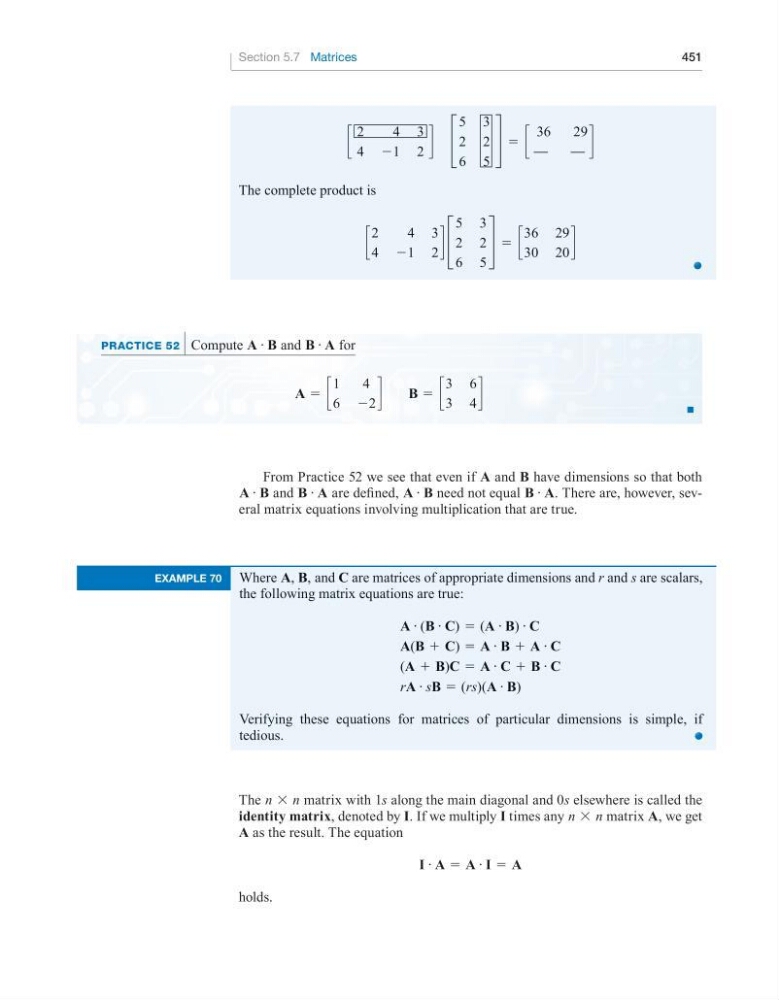
The complete product is
c
2
4 3
4 −1 2
d £
5 3
2 2
6 5
§ = c
36 29
30 20
d
■
PRaCtiCe 52 Compute a # b and b # a for
a = c
1
4
6 −2
d b = c
3 6
3 4
d
From Practice 52 we see that even if a and b have dimensions so that both
a # b and b # a are defined, a # b need not equal b # a. There are, however, several matrix equations involving multiplication that are true.
example 70
Where a, b, and C are matrices of appropriate dimensions and r and s are scalars,
the following matrix equations are true:
a # (b # C) = (a # b) # C
a(b + C) = a # b + a # C
(a + b)C = a # C + b # C
ra # sb = (rs)(a # b)
Verifying these equations for matrices of particular dimensions is simple, if
tedious.
The n × n matrix with 1s along the main diagonal and 0s elsewhere is called the
identity matrix, denoted by i. If we multiply i times any n × n matrix a, we get
a as the result. The equation
i # a = a # i = a
holds.
Section 5.7 Matrices
451
c
2
4 3
4 −1 2
d £
5 3
2 2
6 5
§ = c
36
29
—
—
d
The complete product is
c
2
4 3
4 −1 2
d £
5 3
2 2
6 5
§ = c
36 29
30 20
d
■
PRaCtiCe 52 Compute a # b and b # a for
a = c
1
4
6 −2
d b = c
3 6
3 4
d
From Practice 52 we see that even if a and b have dimensions so that both
a # b and b # a are defined, a # b need not equal b # a. There are, however, several matrix equations involving multiplication that are true.
example 70
Where a, b, and C are matrices of appropriate dimensions and r and s are scalars,
the following matrix equations are true:
a # (b # C) = (a # b) # C
a(b + C) = a # b + a # C
(a + b)C = a # C + b # C
ra # sb = (rs)(a # b)
Verifying these equations for matrices of particular dimensions is simple, if
tedious.
The n × n matrix with 1s along the main diagonal and 0s elsewhere is called the
identity matrix, denoted by i. If we multiply i times any n × n matrix a, we get
a as the result. The equation
i # a = a # i = a
holds.