

s
Section 5.6 The Mighty Mod Function
439
No values of 6 appear in the table, and each row is a circular left shift of the previous row.
6
0 1 2 3 4 5
0 0 1 2 3 4 5
1 1 2 3 4 5 0
2 2 3 4 5 0 1
3 3 4 5 0 1 2
4 4 5 0 1 2 3
5 5 0 1 2 3 4
We will need six tile images of various geometric designs:
Tile 0
T ile 1
T ile 2
T ile 3
T ile 4
T ile 5
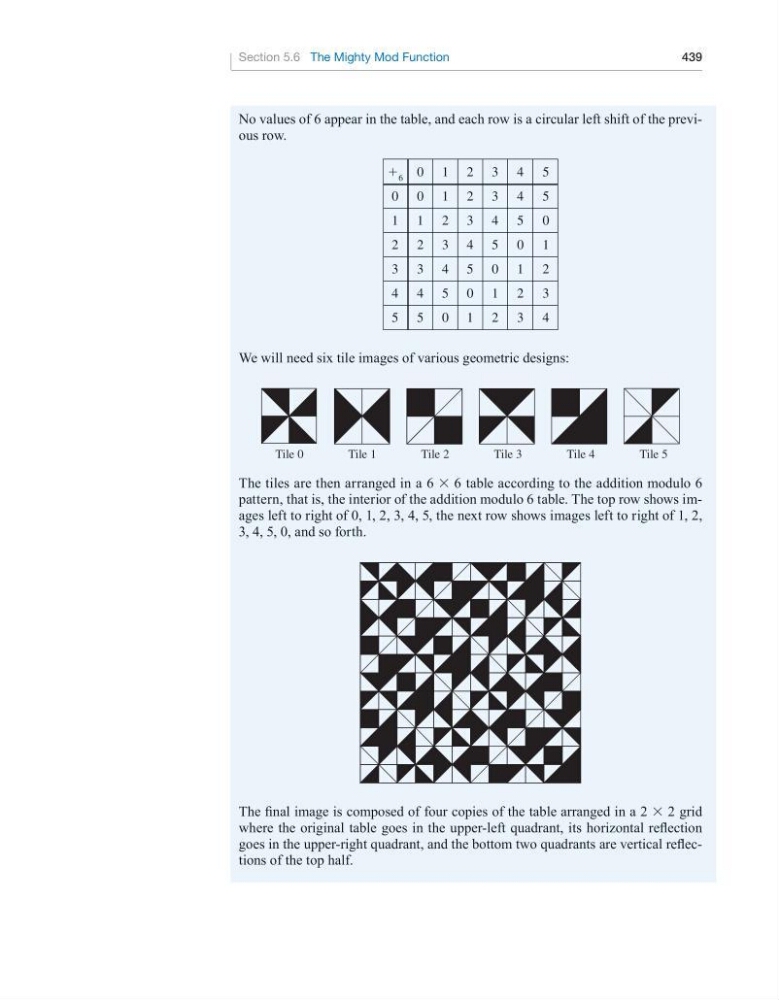
The tiles are then arranged in a 6 × 6 table according to the addition modulo 6
pattern, that is, the interior of the addition modulo 6 table. The top row shows images left to right of 0, 1, 2, 3, 4, 5, the next row shows images left to right of 1, 2,
3, 4, 5, 0, and so forth.
The final image is composed of four copies of the table arranged in a 2 × 2 grid
where the original table goes in the upper-left quadrant, its horizontal reflection
goes in the upper-right quadrant, and the bottom two quadrants are vertical reflections of the top half.
Section 5.6 The Mighty Mod Function
439
No values of 6 appear in the table, and each row is a circular left shift of the previous row.
6
0 1 2 3 4 5
0 0 1 2 3 4 5
1 1 2 3 4 5 0
2 2 3 4 5 0 1
3 3 4 5 0 1 2
4 4 5 0 1 2 3
5 5 0 1 2 3 4
We will need six tile images of various geometric designs:
Tile 0
T ile 1
T ile 2
T ile 3
T ile 4
T ile 5
The tiles are then arranged in a 6 × 6 table according to the addition modulo 6
pattern, that is, the interior of the addition modulo 6 table. The top row shows images left to right of 0, 1, 2, 3, 4, 5, the next row shows images left to right of 1, 2,
3, 4, 5, 0, and so forth.
The final image is composed of four copies of the table arranged in a 2 × 2 grid
where the original table goes in the upper-left quadrant, its horizontal reflection
goes in the upper-right quadrant, and the bottom two quadrants are vertical reflections of the top half.