

428
Relations, Functions, and Matrices
In the adult world, military information, financial information, and company proprietary information that must be transmitted securely uses the same process. The
original information (called the plaintext) is encrypted using an encryption key,
resulting in coded text called the ciphertext. The ciphertext is transmitted and
when it is received, it can be decoded using the corresponding decryption key.
Encryption and decryption are inverse functions in the sense that
decryption (encryption (plaintext)) = plaintext
If the message is intercepted by someone with no knowledge of the decryption key,
it will not be useful unless the encryption scheme can be broken. Cryptography
is the study of various encryption/decryption schemes. The broader term
cryptology includes not only cryptography but also the techniques used to analyze and “break” coded messages. One of the most famous examples of breaking
coded messages occurred during World War II when a British team that included
mathematician Alan Turing, working at Bletchley Park, was able to break the
supposedly invincible German “Enigma” code and decipher the plans of German
submarine movement.
Military use of cryptographic techniques can be traced back to Julius Caesar
who sent messages to his generals in the field using a scheme now known as the
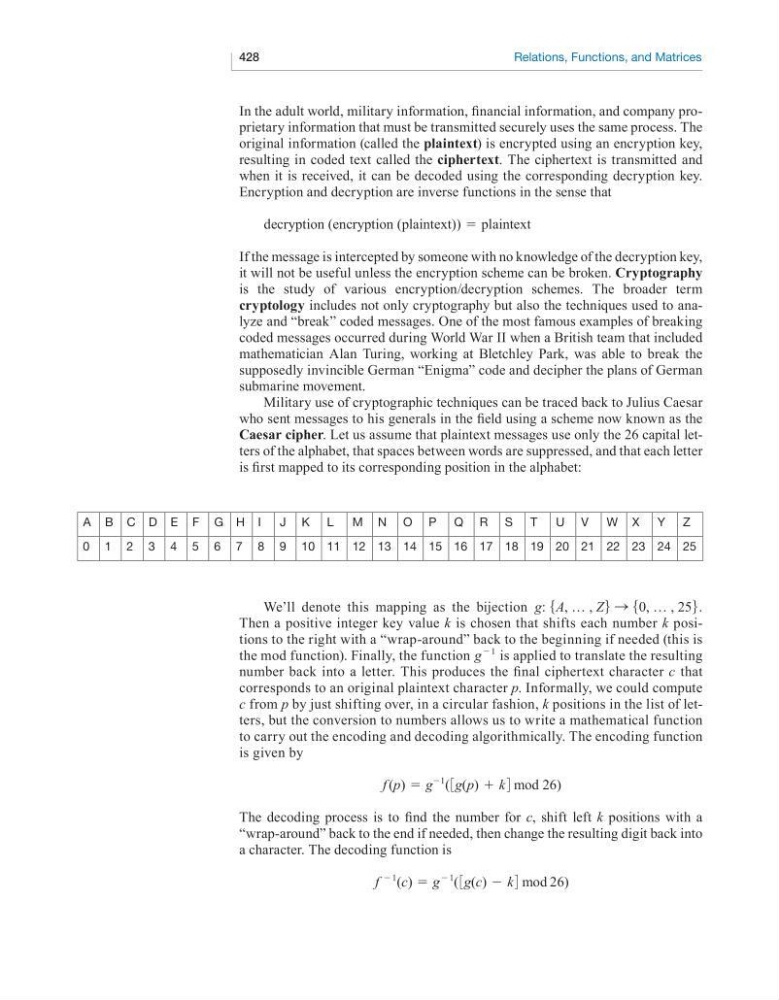
Caesar cipher. Let us assume that plaintext messages use only the 26 capital letters of the alphabet, that spaces between words are suppressed, and that each letter
is first mapped to its corresponding position in the alphabet:
A B C D E F G H I
J K L
M N O P Q R S T
U V W X Y Z
0 1 2 3 4 5 6 7 8 9 10 11 12 13 14 15 16 17 18 19 20 21 22 23 24 25
We’ll denote this mapping as the bijection g: 5A, … , Z6 S 50, … , 256.
Then a positive integer key value k is chosen that shifts each number k positions to the right with a “wrap-around” back to the beginning if needed (this is
the mod function). Finally, the function g
−1
is applied to translate the resulting
number back into a letter. This produces the final ciphertext character c that
corresponds to an original plaintext character p. Informally, we could compute
c from p by just shifting over, in a circular fashion, k positions in the list of letters, but the conversion to numbers allows us to write a mathematical function
to carry out the encoding and decoding algorithmically. The encoding function
is given by
f (p) = g
−1
( 3g(p) + k 4 mod 26)
The decoding process is to find the number for c, shift left k positions with a
“wrap-around” back to the end if needed, then change the resulting digit back into
a character. The decoding function is
f
−1
(c) = g
−1
( 3g(c) − k 4 mod 26)
Relations, Functions, and Matrices
In the adult world, military information, financial information, and company proprietary information that must be transmitted securely uses the same process. The
original information (called the plaintext) is encrypted using an encryption key,
resulting in coded text called the ciphertext. The ciphertext is transmitted and
when it is received, it can be decoded using the corresponding decryption key.
Encryption and decryption are inverse functions in the sense that
decryption (encryption (plaintext)) = plaintext
If the message is intercepted by someone with no knowledge of the decryption key,
it will not be useful unless the encryption scheme can be broken. Cryptography
is the study of various encryption/decryption schemes. The broader term
cryptology includes not only cryptography but also the techniques used to analyze and “break” coded messages. One of the most famous examples of breaking
coded messages occurred during World War II when a British team that included
mathematician Alan Turing, working at Bletchley Park, was able to break the
supposedly invincible German “Enigma” code and decipher the plans of German
submarine movement.
Military use of cryptographic techniques can be traced back to Julius Caesar
who sent messages to his generals in the field using a scheme now known as the
Caesar cipher. Let us assume that plaintext messages use only the 26 capital letters of the alphabet, that spaces between words are suppressed, and that each letter
is first mapped to its corresponding position in the alphabet:
A B C D E F G H I
J K L
M N O P Q R S T
U V W X Y Z
0 1 2 3 4 5 6 7 8 9 10 11 12 13 14 15 16 17 18 19 20 21 22 23 24 25
We’ll denote this mapping as the bijection g: 5A, … , Z6 S 50, … , 256.
Then a positive integer key value k is chosen that shifts each number k positions to the right with a “wrap-around” back to the beginning if needed (this is
the mod function). Finally, the function g
−1
is applied to translate the resulting
number back into a letter. This produces the final ciphertext character c that
corresponds to an original plaintext character p. Informally, we could compute
c from p by just shifting over, in a circular fashion, k positions in the list of letters, but the conversion to numbers allows us to write a mathematical function
to carry out the encoding and decoding algorithmically. The encoding function
is given by
f (p) = g
−1
( 3g(p) + k 4 mod 26)
The decoding process is to find the number for c, shift left k positions with a
“wrap-around” back to the end if needed, then change the resulting digit back into
a character. The decoding function is
f
−1
(c) = g
−1
( 3g(c) − k 4 mod 26)