

384
Relations, Functions, and Matrices
PRaCtiCe 23 Which of the following formulas are functions from the domain to the codomain indicated? For those that are not, why not?
a. f : S S T where S = T = 51, 2, 36, f = 5(1, 1), (2, 3), (3, 1), (2, 1)6
b. g: Z S N where g is defined by g(x) = 0 x 0 (the absolute value of x)
c. h: N S N where h is defined by h(x) = x − 4
d. f: S S T where S is the set of all people in your hometown, T is the set of all automobiles, and f
associates with each person the automobile that person owns
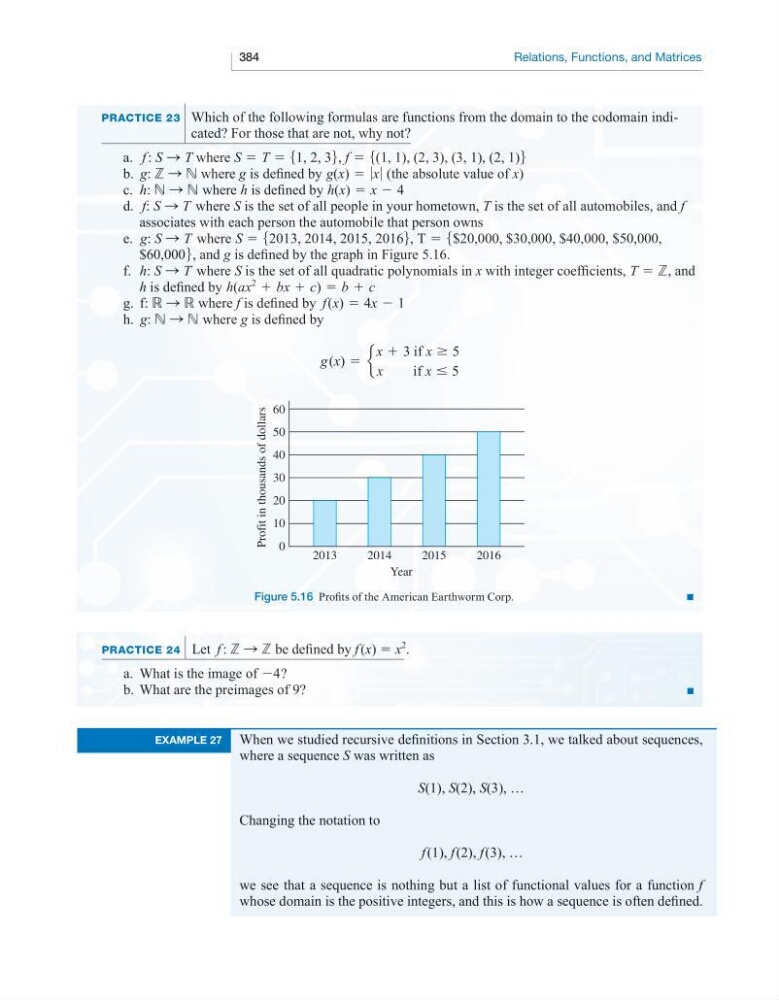
e. g: S S T where S = 52013, 2014, 2015, 20166, T = 5$20,000, $30,000, $40,000, $50,000,
$60,0006, and g is defined by the graph in Figure 5.16.
f. h: S S T where S is the set of all quadratic polynomials in x with integer coefficients, T = Z, and
h is defined by h(ax
2
+ bx + c) = b + c
g. f: R S R where f is defined by f (x) = 4x − 1
h. g: N S N where g is defined by
g (x) = e
x + 3 if x ≥ 5
x if x ≤ 5
2013
2014
2015
Year
2016
60
50
40
30
Profit in thousands of dollars
20
10
0
Figure 5.16 Profits of the American Earthworm Corp.
■
PRaCtiCe 24 Let f : Z S Z be defined by f (x) = x
2
.
a. What is the image of −4?
b. What are the preimages of 9?
■
example 27
When we studied recursive definitions in Section 3.1, we talked about sequences,
where a sequence S was written as
S(1), S(2), S(3), …
Changing the notation to
f (1), f (2), f (3), …
we see that a sequence is nothing but a list of functional values for a function f
whose domain is the positive integers, and this is how a sequence is often defined.
Relations, Functions, and Matrices
PRaCtiCe 23 Which of the following formulas are functions from the domain to the codomain indicated? For those that are not, why not?
a. f : S S T where S = T = 51, 2, 36, f = 5(1, 1), (2, 3), (3, 1), (2, 1)6
b. g: Z S N where g is defined by g(x) = 0 x 0 (the absolute value of x)
c. h: N S N where h is defined by h(x) = x − 4
d. f: S S T where S is the set of all people in your hometown, T is the set of all automobiles, and f
associates with each person the automobile that person owns
e. g: S S T where S = 52013, 2014, 2015, 20166, T = 5$20,000, $30,000, $40,000, $50,000,
$60,0006, and g is defined by the graph in Figure 5.16.
f. h: S S T where S is the set of all quadratic polynomials in x with integer coefficients, T = Z, and
h is defined by h(ax
2
+ bx + c) = b + c
g. f: R S R where f is defined by f (x) = 4x − 1
h. g: N S N where g is defined by
g (x) = e
x + 3 if x ≥ 5
x if x ≤ 5
2013
2014
2015
Year
2016
60
50
40
30
Profit in thousands of dollars
20
10
0
Figure 5.16 Profits of the American Earthworm Corp.
■
PRaCtiCe 24 Let f : Z S Z be defined by f (x) = x
2
.
a. What is the image of −4?
b. What are the preimages of 9?
■
example 27
When we studied recursive definitions in Section 3.1, we talked about sequences,
where a sequence S was written as
S(1), S(2), S(3), …
Changing the notation to
f (1), f (2), f (3), …
we see that a sequence is nothing but a list of functional values for a function f
whose domain is the positive integers, and this is how a sequence is often defined.