

346
Relations, Functions, and Matrices
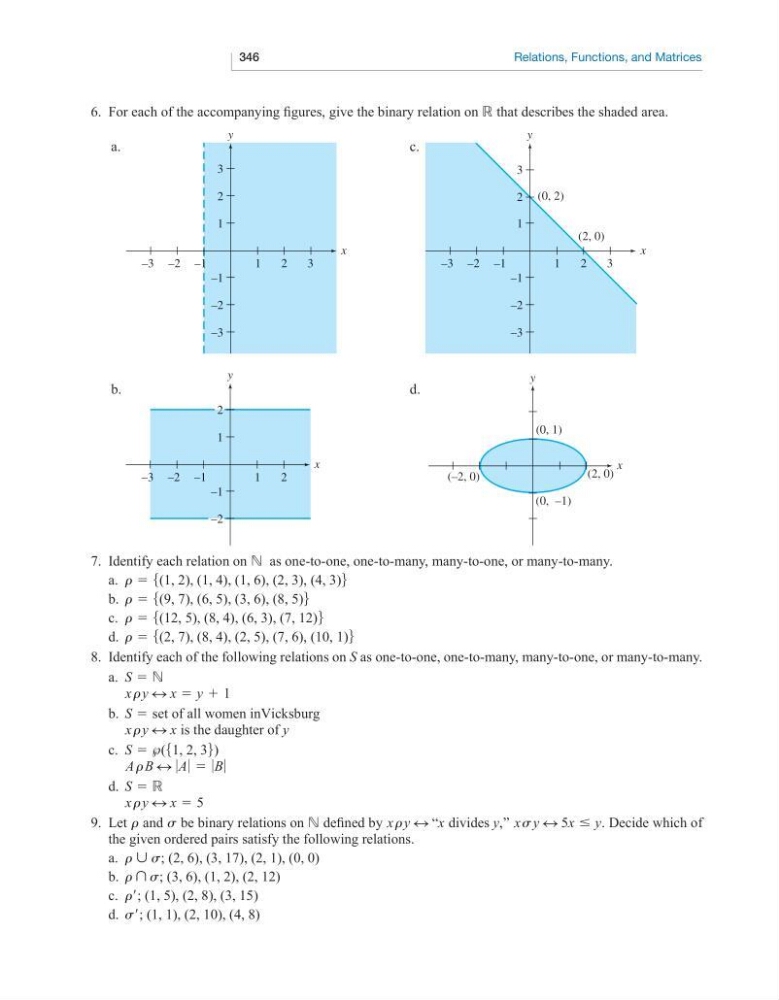
6. For each of the accompanying figures, give the binary relation on R that describes the shaded area.
3
2
1
–1
1
2
3
–2
–3
–2
–3
x
y
–1
3
2 (0, 2)
(2, 0)
1
–1
–1
1
2
3
–2
–3
–2
–3
x
y
2
1
–1
–1
1
2
–2
–3
–2
x
y
(2, 0)
(0, –1)
x
(–2, 0)
(0, 1)
y
7. Identify each relation on N as one-to-one, one-to-many, many-to-one, or many-to-many.
a. r = 5(1, 2), (1, 4), (1, 6), (2, 3), (4, 3)6
b. r = 5(9, 7), (6, 5), (3, 6), (8, 5)6
c. r = 5(12, 5), (8, 4), (6, 3), (7, 12)6
d. r = 5(2, 7), (8, 4), (2, 5), (7, 6), (10, 1)6
8. Identify each of the following relations on S as one-to-one, one-to-many, many-to-one, or many-to-many.
a. S = N
x r y 4 x = y + 1
b. S = set of all women inVicksburg
x r y 4 x is the daughter of y
c. S = `(51, 2, 36)
A r B 4 0 A0 = 0 B0
d. S = R
x r y 4 x = 5
9. Let r and s be binary relations on N defined by x r y 4 “x divides y,” x s y 4 5x ≤ y. Decide which of
the given ordered pairs satisfy the following relations.
a. r c s; (2, 6), (3, 17), (2, 1), (0, 0)
b. r d s; (3, 6), (1, 2), (2, 12)
c. r′; (1, 5), (2, 8), (3, 15)
d. s′; (1, 1), (2, 10), (4, 8)
a.
b.
c.
d.
Relations, Functions, and Matrices
6. For each of the accompanying figures, give the binary relation on R that describes the shaded area.
3
2
1
–1
1
2
3
–2
–3
–2
–3
x
y
–1
3
2 (0, 2)
(2, 0)
1
–1
–1
1
2
3
–2
–3
–2
–3
x
y
2
1
–1
–1
1
2
–2
–3
–2
x
y
(2, 0)
(0, –1)
x
(–2, 0)
(0, 1)
y
7. Identify each relation on N as one-to-one, one-to-many, many-to-one, or many-to-many.
a. r = 5(1, 2), (1, 4), (1, 6), (2, 3), (4, 3)6
b. r = 5(9, 7), (6, 5), (3, 6), (8, 5)6
c. r = 5(12, 5), (8, 4), (6, 3), (7, 12)6
d. r = 5(2, 7), (8, 4), (2, 5), (7, 6), (10, 1)6
8. Identify each of the following relations on S as one-to-one, one-to-many, many-to-one, or many-to-many.
a. S = N
x r y 4 x = y + 1
b. S = set of all women inVicksburg
x r y 4 x is the daughter of y
c. S = `(51, 2, 36)
A r B 4 0 A0 = 0 B0
d. S = R
x r y 4 x = 5
9. Let r and s be binary relations on N defined by x r y 4 “x divides y,” x s y 4 5x ≤ y. Decide which of
the given ordered pairs satisfy the following relations.
a. r c s; (2, 6), (3, 17), (2, 1), (0, 0)
b. r d s; (3, 6), (1, 2), (2, 12)
c. r′; (1, 5), (2, 8), (3, 15)
d. s′; (1, 1), (2, 10), (4, 8)
a.
b.
c.
d.