

306
Sets, Combinatorics, and Probability
example 70
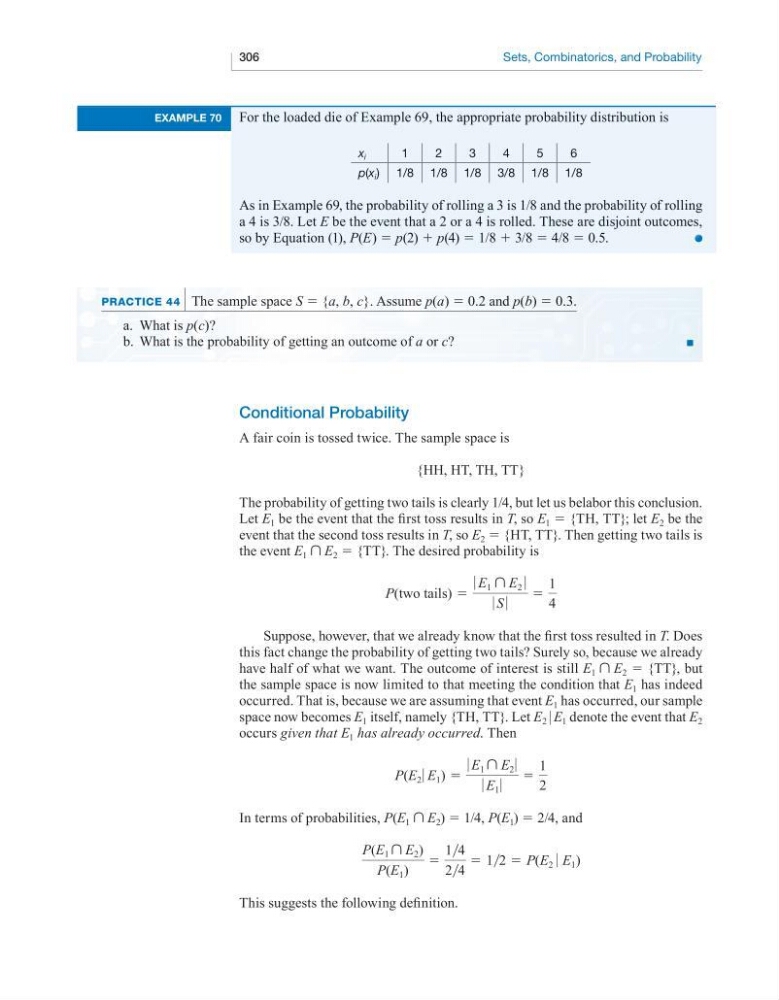
For the loaded die of Example 69, the appropriate probability distribution is
x i
1
2
3
4
5
6
p(x i ) 1/8 1/8 1/8 3/8 1/8 1/8
As in Example 69, the probability of rolling a 3 is 1/8 and the probability of rolling
a 4 is 3/8. Let E be the event that a 2 or a 4 is rolled. These are disjoint outcomes,
so by Equation (1), P(E) = p(2) + p(4) = 1/8 + 3/8 = 4/8 = 0.5.
PraCtiCe 44 The sample space S = {a, b, c}. Assume p(a) = 0.2 and p(b) = 0.3.
a. What is p(c)?
b. What is the probability of getting an outcome of a or c?
■
Conditional Probability
A fair coin is tossed twice. The sample space is
{HH, HT, TH, TT}
The probability of getting two tails is clearly 1/4, but let us belabor this conclusion.
Let E 1 be the event that the first toss results in T, so E 1 = {TH, TT}; let E 2 be the
event that the second toss results in T, so E 2 = {HT, TT}. Then getting two tails is
the event E 1 d E 2 = {TT}. The desired probability is
P(two tails) =
0 E 1 d E 2 0
0 S 0
=
1
4
Suppose, however, that we already know that the first toss resulted in T. Does
this fact change the probability of getting two tails? Surely so, because we already
have half of what we want. The outcome of interest is still E 1 d E 2 = {TT}, but
the sample space is now limited to that meeting the condition that E 1 has indeed
occurred. That is, because we are assuming that event E 1 has occurred, our sample
space now becomes E 1 itself, namely {TH, TT}. Let E 2 0 E 1 denote the event that E 2
occurs given that E 1 has already occurred. Then
P(E 2 0 E 1 ) =
0 E 1 d E 2 0
0 E 1 0
=
1
2
In terms of probabilities, P(E 1 d E 2 ) = 1/4, P(E 1 ) = 2/4, and
P(E 1 d E 2 )
P(E 1 )
=
1∙4
2∙4
= 1∙2 = P(E 2 0 E 1 )
This suggests the following definition.
Sets, Combinatorics, and Probability
example 70
For the loaded die of Example 69, the appropriate probability distribution is
x i
1
2
3
4
5
6
p(x i ) 1/8 1/8 1/8 3/8 1/8 1/8
As in Example 69, the probability of rolling a 3 is 1/8 and the probability of rolling
a 4 is 3/8. Let E be the event that a 2 or a 4 is rolled. These are disjoint outcomes,
so by Equation (1), P(E) = p(2) + p(4) = 1/8 + 3/8 = 4/8 = 0.5.
PraCtiCe 44 The sample space S = {a, b, c}. Assume p(a) = 0.2 and p(b) = 0.3.
a. What is p(c)?
b. What is the probability of getting an outcome of a or c?
■
Conditional Probability
A fair coin is tossed twice. The sample space is
{HH, HT, TH, TT}
The probability of getting two tails is clearly 1/4, but let us belabor this conclusion.
Let E 1 be the event that the first toss results in T, so E 1 = {TH, TT}; let E 2 be the
event that the second toss results in T, so E 2 = {HT, TT}. Then getting two tails is
the event E 1 d E 2 = {TT}. The desired probability is
P(two tails) =
0 E 1 d E 2 0
0 S 0
=
1
4
Suppose, however, that we already know that the first toss resulted in T. Does
this fact change the probability of getting two tails? Surely so, because we already
have half of what we want. The outcome of interest is still E 1 d E 2 = {TT}, but
the sample space is now limited to that meeting the condition that E 1 has indeed
occurred. That is, because we are assuming that event E 1 has occurred, our sample
space now becomes E 1 itself, namely {TH, TT}. Let E 2 0 E 1 denote the event that E 2
occurs given that E 1 has already occurred. Then
P(E 2 0 E 1 ) =
0 E 1 d E 2 0
0 E 1 0
=
1
2
In terms of probabilities, P(E 1 d E 2 ) = 1/4, P(E 1 ) = 2/4, and
P(E 1 d E 2 )
P(E 1 )
=
1∙4
2∙4
= 1∙2 = P(E 2 0 E 1 )
This suggests the following definition.