

286
Sets, Combinatorics, and Probability
speCial interest page
archimedes and the Stomachion
Archimedes was one of the greatest mathematicians
of the ancient world. He lived about 287−212 b.c.e. in
Syracuse (a Greek city-state in current-day Sicily). It
is thought that he studied for a time in Alexandria
(Egypt) with students of Euclid. At any rate, he was
greatly interested in geometry, and he thought his
most important work was the discovery of a formula
for the volume of a sphere. He also approximated the
value of π and grasped the ideas of integral calculus
by approximating the area under a curve by breaking
it up into a series of rectangles. His contributions to
mechanics, engineering, physics, and astronomy are
also amazing. Some of his inventions helped defend
the city of Syracuse from Roman invaders.
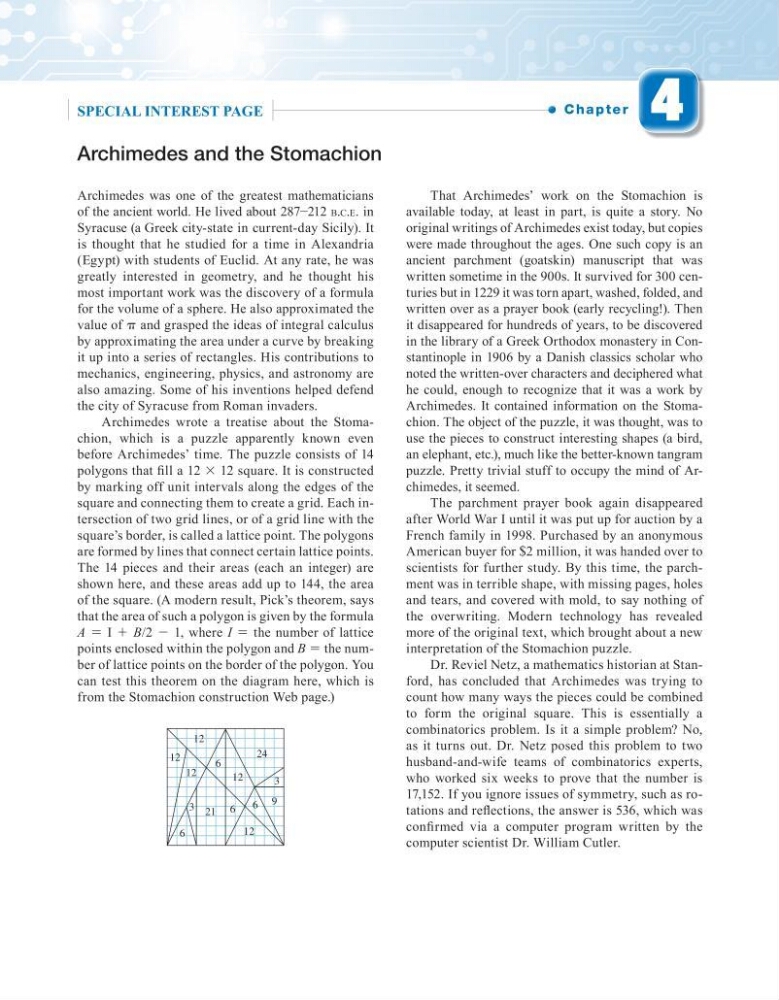
Archimedes wrote a treatise about the Stomachion, which is a puzzle apparently known even
before Archimedes’ time. The puzzle consists of 14
polygons that fill a 12 × 12 square. It is constructed
by marking off unit intervals along the edges of the
square and connecting them to create a grid. Each intersection of two grid lines, or of a grid line with the
square’s border, is called a lattice point. The polygons
are formed by lines that connect certain lattice points.
The 14 pieces and their areas (each an integer) are
shown here, and these areas add up to 144, the area
of the square. (A modern result, Pick’s theorem, says
that the area of such a polygon is given by the formula
A = I + B/2 − 1, where I = the number of lattice
points enclosed within the polygon and B = the number of lattice points on the border of the polygon. You
can test this theorem on the diagram here, which is
from the Stomachion construction Web page.)
12
12
12
12
3
3 21
12
9
6
6
6
24
6
That Archimedes’ work on the Stomachion is
available today, at least in part, is quite a story. No
original writings of Archimedes exist today, but copies
were made throughout the ages. One such copy is an
ancient parchment (goatskin) manuscript that was
written sometime in the 900s. It survived for 300 centuries but in 1229 it was torn apart, washed, folded, and
written over as a prayer book (early recycling!). Then
it disappeared for hundreds of years, to be discovered
in the library of a Greek Orthodox monastery in Constantinople in 1906 by a Danish classics scholar who
noted the written-over characters and deciphered what
he could, enough to recognize that it was a work by
Archimedes. It contained information on the Stomachion. The object of the puzzle, it was thought, was to
use the pieces to construct interesting shapes (a bird,
an elephant, etc.), much like the better-known tangram
puzzle. Pretty trivial stuff to occupy the mind of Archimedes, it seemed.
The parchment prayer book again disappeared
after World War I until it was put up for auction by a
French family in 1998. Purchased by an anonymous
American buyer for $2 million, it was handed over to
scientists for further study. By this time, the parchment was in terrible shape, with missing pages, holes
and tears, and covered with mold, to say nothing of
the overwriting. Modern technology has revealed
more of the original text, which brought about a new
interpretation of the Stomachion puzzle.
Dr. Reviel Netz, a mathematics historian at Stanford, has concluded that Archimedes was trying to
count how many ways the pieces could be combined
to form the original square. This is essentially a
combinatorics problem. Is it a simple problem? No,
as it turns out. Dr. Netz posed this problem to two
husband-and-wife teams of combinatorics experts,
who worked six weeks to prove that the number is
17,152. If you ignore issues of symmetry, such as rotations and reflections, the answer is 536, which was
confirmed via a computer program written by the
computer scientist Dr. William Cutler.
C h a p t e r
4 4
Sets, Combinatorics, and Probability
speCial interest page
archimedes and the Stomachion
Archimedes was one of the greatest mathematicians
of the ancient world. He lived about 287−212 b.c.e. in
Syracuse (a Greek city-state in current-day Sicily). It
is thought that he studied for a time in Alexandria
(Egypt) with students of Euclid. At any rate, he was
greatly interested in geometry, and he thought his
most important work was the discovery of a formula
for the volume of a sphere. He also approximated the
value of π and grasped the ideas of integral calculus
by approximating the area under a curve by breaking
it up into a series of rectangles. His contributions to
mechanics, engineering, physics, and astronomy are
also amazing. Some of his inventions helped defend
the city of Syracuse from Roman invaders.
Archimedes wrote a treatise about the Stomachion, which is a puzzle apparently known even
before Archimedes’ time. The puzzle consists of 14
polygons that fill a 12 × 12 square. It is constructed
by marking off unit intervals along the edges of the
square and connecting them to create a grid. Each intersection of two grid lines, or of a grid line with the
square’s border, is called a lattice point. The polygons
are formed by lines that connect certain lattice points.
The 14 pieces and their areas (each an integer) are
shown here, and these areas add up to 144, the area
of the square. (A modern result, Pick’s theorem, says
that the area of such a polygon is given by the formula
A = I + B/2 − 1, where I = the number of lattice
points enclosed within the polygon and B = the number of lattice points on the border of the polygon. You
can test this theorem on the diagram here, which is
from the Stomachion construction Web page.)
12
12
12
12
3
3 21
12
9
6
6
6
24
6
That Archimedes’ work on the Stomachion is
available today, at least in part, is quite a story. No
original writings of Archimedes exist today, but copies
were made throughout the ages. One such copy is an
ancient parchment (goatskin) manuscript that was
written sometime in the 900s. It survived for 300 centuries but in 1229 it was torn apart, washed, folded, and
written over as a prayer book (early recycling!). Then
it disappeared for hundreds of years, to be discovered
in the library of a Greek Orthodox monastery in Constantinople in 1906 by a Danish classics scholar who
noted the written-over characters and deciphered what
he could, enough to recognize that it was a work by
Archimedes. It contained information on the Stomachion. The object of the puzzle, it was thought, was to
use the pieces to construct interesting shapes (a bird,
an elephant, etc.), much like the better-known tangram
puzzle. Pretty trivial stuff to occupy the mind of Archimedes, it seemed.
The parchment prayer book again disappeared
after World War I until it was put up for auction by a
French family in 1998. Purchased by an anonymous
American buyer for $2 million, it was handed over to
scientists for further study. By this time, the parchment was in terrible shape, with missing pages, holes
and tears, and covered with mold, to say nothing of
the overwriting. Modern technology has revealed
more of the original text, which brought about a new
interpretation of the Stomachion puzzle.
Dr. Reviel Netz, a mathematics historian at Stanford, has concluded that Archimedes was trying to
count how many ways the pieces could be combined
to form the original square. This is essentially a
combinatorics problem. Is it a simple problem? No,
as it turns out. Dr. Netz posed this problem to two
husband-and-wife teams of combinatorics experts,
who worked six weeks to prove that the number is
17,152. If you ignore issues of symmetry, such as rotations and reflections, the answer is 536, which was
confirmed via a computer program written by the
computer scientist Dr. William Cutler.
C h a p t e r
4 4