

266
Sets, Combinatorics, and Probability
A
B
C
S
figure 4.7
example 41
A group of students plans to order pizza. If 13 will eat sausage topping, 10 will eat
pepperoni, 12 will eat extra cheese, 4 will eat both sausage and pepperoni, 5 will
eat both pepperoni and extra cheese, 7 will eat both sausage and extra cheese, and
3 will eat all three toppings, how many students are in the group?
Let
A = {students who will eat sausage}
B = {students who will eat pepperoni}
C = {students who will eat extra cheese}
Then 0 A 0 = 13, 0 B 0 = 10, 0 C 0 = 12, 0 A d B 0 = 4, 0 B d C 0 = 5, 0 A d C 0 = 7, and
0 A d B d C 0 = 3. From Equation (3),
0 A c B c C 0 = 13 + 10 + 12 − 4 − 5 − 7 + 3 = 22
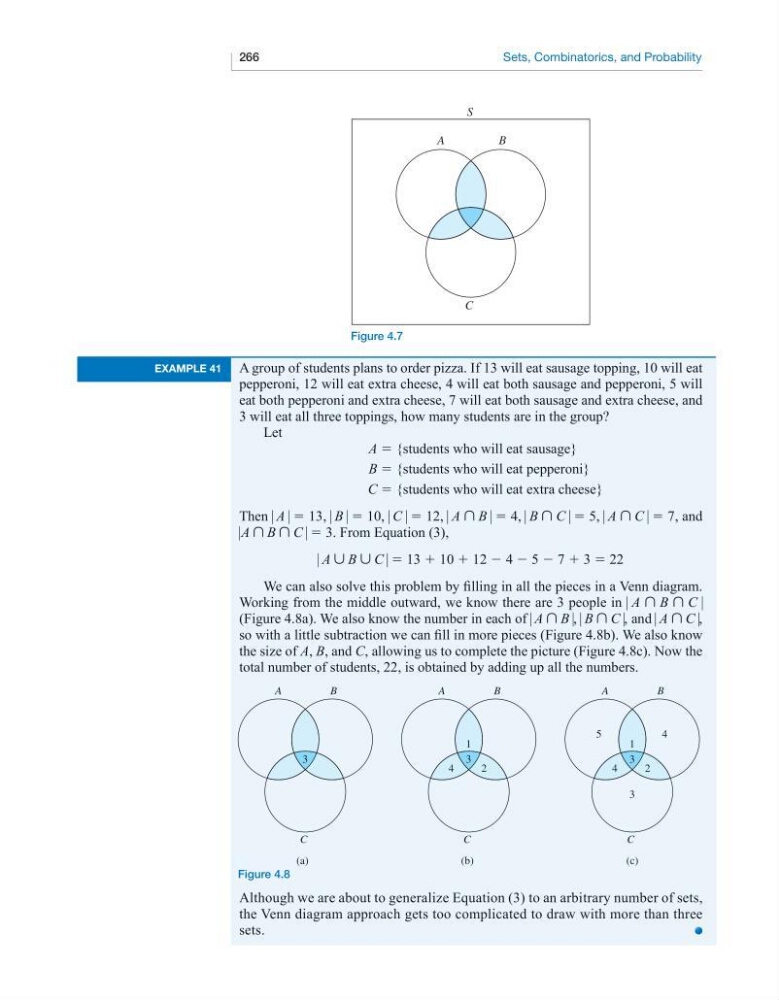
We can also solve this problem by filling in all the pieces in a Venn diagram.
Working from the middle outward, we know there are 3 people in 0 A d B d C 0
(Figure 4.8a). We also know the number in each of 0 A d B 0 , 0 B d C 0 , and 0 A d C 0 ,
so with a little subtraction we can fill in more pieces (Figure 4.8b). We also know
the size of A, B, and C, allowing us to complete the picture (Figure 4.8c). Now the
total number of students, 22, is obtained by adding up all the numbers.
A
B
C
3
A
B
C
3
1
4
2
A
B
C
3
3
1
4
2
4
5
(a)
(b)
(c)
Although we are about to generalize Equation (3) to an arbitrary number of sets,
the Venn diagram approach gets too complicated to draw with more than three
sets.
figure 4.8
Sets, Combinatorics, and Probability
A
B
C
S
figure 4.7
example 41
A group of students plans to order pizza. If 13 will eat sausage topping, 10 will eat
pepperoni, 12 will eat extra cheese, 4 will eat both sausage and pepperoni, 5 will
eat both pepperoni and extra cheese, 7 will eat both sausage and extra cheese, and
3 will eat all three toppings, how many students are in the group?
Let
A = {students who will eat sausage}
B = {students who will eat pepperoni}
C = {students who will eat extra cheese}
Then 0 A 0 = 13, 0 B 0 = 10, 0 C 0 = 12, 0 A d B 0 = 4, 0 B d C 0 = 5, 0 A d C 0 = 7, and
0 A d B d C 0 = 3. From Equation (3),
0 A c B c C 0 = 13 + 10 + 12 − 4 − 5 − 7 + 3 = 22
We can also solve this problem by filling in all the pieces in a Venn diagram.
Working from the middle outward, we know there are 3 people in 0 A d B d C 0
(Figure 4.8a). We also know the number in each of 0 A d B 0 , 0 B d C 0 , and 0 A d C 0 ,
so with a little subtraction we can fill in more pieces (Figure 4.8b). We also know
the size of A, B, and C, allowing us to complete the picture (Figure 4.8c). Now the
total number of students, 22, is obtained by adding up all the numbers.
A
B
C
3
A
B
C
3
1
4
2
A
B
C
3
3
1
4
2
4
5
(a)
(b)
(c)
Although we are about to generalize Equation (3) to an arbitrary number of sets,
the Venn diagram approach gets too complicated to draw with more than three
sets.
figure 4.8