

Section 4.1 Sets
243
31. Find ℘(S ) for S = {[, {[}, {[, {[}}}.
32. Find ℘(℘(S )) for S = {a, b}.
33. What can be said about A if ℘(A) = {[, {x}, {y}, {x, y}}?
34. What can be said about A if ℘(A) = {[, {a}, {{a}}}?
35. Prove that if ℘(A) = ℘(B), then A = B.
36. Prove that if A # B, then ℘(A) # ℘(B).
37. Solve for x and y.
a. (y, x + 2) = (5, 3)
b. (2x, y) = (16, 7)
c. (2x − y, x + y) = (−2, 5)
38. a. Recall that ordered pairs must have the property that (x, y) = (u, v) if and only if x = u and y = v.
Prove that {{x}, {x, y}} = {{u}, {u, v}} if and only if x = u and y = v. Therefore, although we know that
(x, y) ∙ {x, y}, we can define the ordered pair (x, y) as the set {{x}, {x, y}}.
b. Show by an example that we cannot define the ordered triple (x, y, z) as the set {{x}, {x, y}, {x, y, z}}.
39. Which of the following candidates are binary or unary operations on the given sets? For those that are not,
where do they fail?
a. x + y = x + 1; S = ℕ
b. x + y = x + y − 1; S = ℕ
c. x + y =
S = ℤ
d. x# = ln x; S = ℝ
40. Which of the following candidates are binary or unary operations on the given sets? For those that are not,
where do they fail?
a. x# = x
2
; S = ℤ
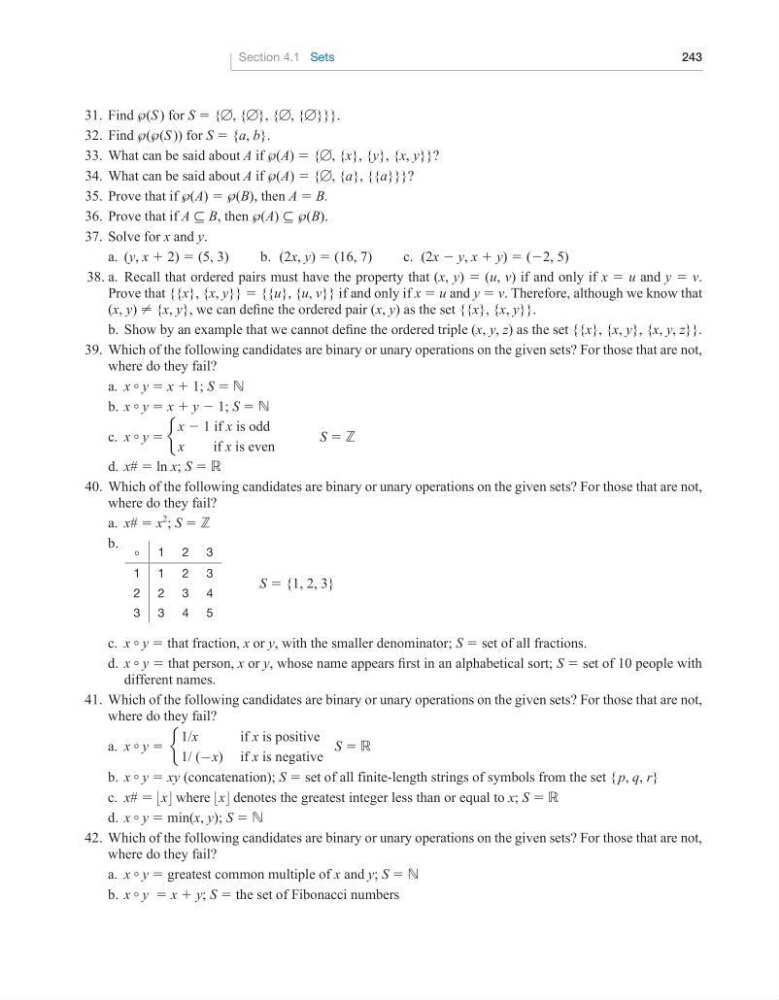
b.
e
x − 1 if x is odd
x
if x is even
+ 1 2 3
1 1 2 3
2 2 3 4
3 3 4 5
S = {1, 2, 3}
c. x + y = that fraction, x or y, with the smaller denominator; S = set of all fractions.
d. x + y = that person, x or y, whose name appears first in an alphabetical sort; S = set of 10 people with
different names.
41. Which of the following candidates are binary or unary operations on the given sets? For those that are not,
where do they fail?
a. x + y = e
1/x
if x is positive
1/ (−x) if x is negative
S = ℝ
b. x + y = xy (concatenation); S = set of all finite-length strings of symbols from the set { p, q, r}
c. x# = :x; where :x; denotes the greatest integer less than or equal to x; S = ℝ
d. x + y = min(x, y); S = ℕ
42. Which of the following candidates are binary or unary operations on the given sets? For those that are not,
where do they fail?
a. x + y = greatest common multiple of x and y; S = ℕ
b. x + y = x + y; S = the set of Fibonacci numbers
243
31. Find ℘(S ) for S = {[, {[}, {[, {[}}}.
32. Find ℘(℘(S )) for S = {a, b}.
33. What can be said about A if ℘(A) = {[, {x}, {y}, {x, y}}?
34. What can be said about A if ℘(A) = {[, {a}, {{a}}}?
35. Prove that if ℘(A) = ℘(B), then A = B.
36. Prove that if A # B, then ℘(A) # ℘(B).
37. Solve for x and y.
a. (y, x + 2) = (5, 3)
b. (2x, y) = (16, 7)
c. (2x − y, x + y) = (−2, 5)
38. a. Recall that ordered pairs must have the property that (x, y) = (u, v) if and only if x = u and y = v.
Prove that {{x}, {x, y}} = {{u}, {u, v}} if and only if x = u and y = v. Therefore, although we know that
(x, y) ∙ {x, y}, we can define the ordered pair (x, y) as the set {{x}, {x, y}}.
b. Show by an example that we cannot define the ordered triple (x, y, z) as the set {{x}, {x, y}, {x, y, z}}.
39. Which of the following candidates are binary or unary operations on the given sets? For those that are not,
where do they fail?
a. x + y = x + 1; S = ℕ
b. x + y = x + y − 1; S = ℕ
c. x + y =
S = ℤ
d. x# = ln x; S = ℝ
40. Which of the following candidates are binary or unary operations on the given sets? For those that are not,
where do they fail?
a. x# = x
2
; S = ℤ
b.
e
x − 1 if x is odd
x
if x is even
+ 1 2 3
1 1 2 3
2 2 3 4
3 3 4 5
S = {1, 2, 3}
c. x + y = that fraction, x or y, with the smaller denominator; S = set of all fractions.
d. x + y = that person, x or y, whose name appears first in an alphabetical sort; S = set of 10 people with
different names.
41. Which of the following candidates are binary or unary operations on the given sets? For those that are not,
where do they fail?
a. x + y = e
1/x
if x is positive
1/ (−x) if x is negative
S = ℝ
b. x + y = xy (concatenation); S = set of all finite-length strings of symbols from the set { p, q, r}
c. x# = :x; where :x; denotes the greatest integer less than or equal to x; S = ℝ
d. x + y = min(x, y); S = ℕ
42. Which of the following candidates are binary or unary operations on the given sets? For those that are not,
where do they fail?
a. x + y = greatest common multiple of x and y; S = ℕ
b. x + y = x + y; S = the set of Fibonacci numbers