

Section 4.1 Sets
231
operations on the set ℘(S). S in this case is called the universal set or the
universe of discourse. The universal set defines the context of the objects
being discussed. If S = ℤ, for example, then all subsets will contain only integers.
A binary operation on ℘(S) must act on any two subsets of S to produce a
unique subset of S. There are at least two natural ways in which this can happen.
example 15
Let S be the set of all students at Silicon U. Then the members of ℘(S ) are sets of
students. Let A be the set of computer science majors, and let B be the set of business majors. Both A and B belong to ℘(S ). A new set of students can be defined
that consists of everybody who is majoring in either computer science or business
(or both); this set is called the union of A and B. Another new set can be defined
that consists of everybody who is majoring in both computer science and business.
This set (which might be empty) is called the intersection of A and B.
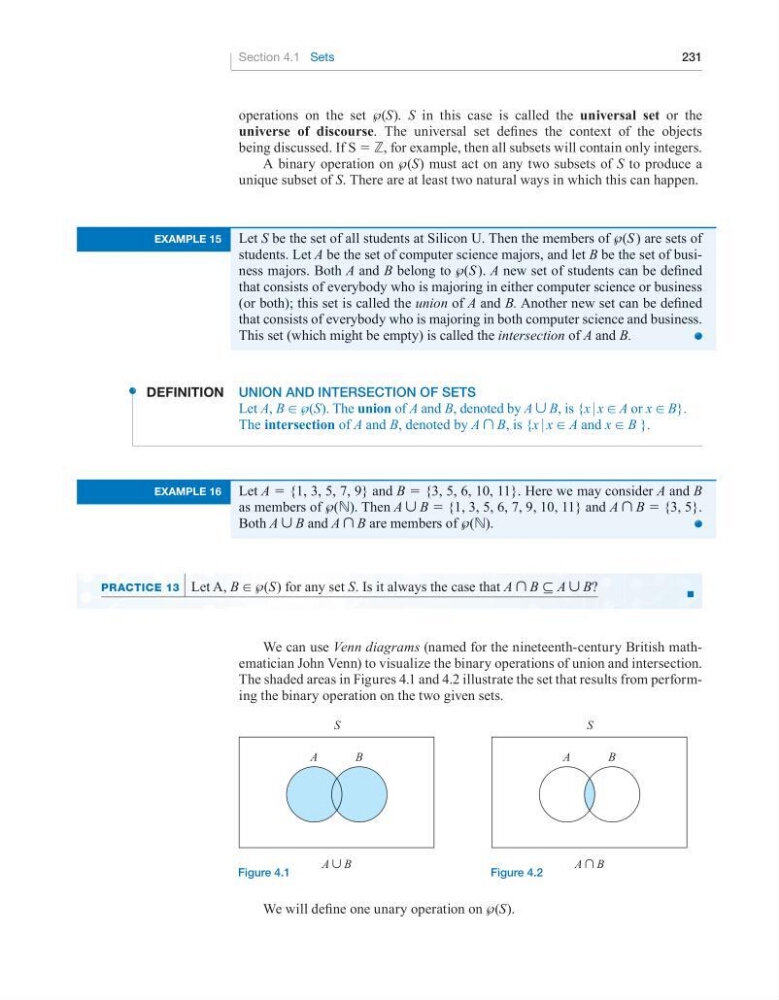
We can use Venn diagrams (named for the nineteenth-century British mathematician John Venn) to visualize the binary operations of union and intersection.
The shaded areas in Figures 4.1 and 4.2 illustrate the set that results from performing the binary operation on the two given sets.
Definition UNiON aNd iNteRSeCtiON Of SetS
Let A, B [ ℘(S). The union of A and B, denoted by A c B, is {x 0 x [ A or x [ B}.
The intersection of A and B, denoted by A d B, is {x 0 x [ A and x [ B }.
example 16
Let A = {1, 3, 5, 7, 9} and B = {3, 5, 6, 10, 11}. Here we may consider A and B
as members of ℘(ℕ). Then A c B = {1, 3, 5, 6, 7, 9, 10, 11} and A d B = {3, 5}.
Both A c B and A d B are members of ℘(ℕ).
■
PraCtiCe 13 Let A, B [ ℘(S) for any set S. Is it always the case that A d B # A c B?
$
%
6
$F%
$
%
6
$G%
We will define one unary operation on ℘(S).
figure 4.1
figure 4.2
231
operations on the set ℘(S). S in this case is called the universal set or the
universe of discourse. The universal set defines the context of the objects
being discussed. If S = ℤ, for example, then all subsets will contain only integers.
A binary operation on ℘(S) must act on any two subsets of S to produce a
unique subset of S. There are at least two natural ways in which this can happen.
example 15
Let S be the set of all students at Silicon U. Then the members of ℘(S ) are sets of
students. Let A be the set of computer science majors, and let B be the set of business majors. Both A and B belong to ℘(S ). A new set of students can be defined
that consists of everybody who is majoring in either computer science or business
(or both); this set is called the union of A and B. Another new set can be defined
that consists of everybody who is majoring in both computer science and business.
This set (which might be empty) is called the intersection of A and B.
We can use Venn diagrams (named for the nineteenth-century British mathematician John Venn) to visualize the binary operations of union and intersection.
The shaded areas in Figures 4.1 and 4.2 illustrate the set that results from performing the binary operation on the two given sets.
Definition UNiON aNd iNteRSeCtiON Of SetS
Let A, B [ ℘(S). The union of A and B, denoted by A c B, is {x 0 x [ A or x [ B}.
The intersection of A and B, denoted by A d B, is {x 0 x [ A and x [ B }.
example 16
Let A = {1, 3, 5, 7, 9} and B = {3, 5, 6, 10, 11}. Here we may consider A and B
as members of ℘(ℕ). Then A c B = {1, 3, 5, 6, 7, 9, 10, 11} and A d B = {3, 5}.
Both A c B and A d B are members of ℘(ℕ).
■
PraCtiCe 13 Let A, B [ ℘(S) for any set S. Is it always the case that A d B # A c B?
$
%
6
$F%
$
%
6
$G%
We will define one unary operation on ℘(S).
figure 4.1
figure 4.2