

Section 1.1 Statements, Symbolic Representation, and Tautologies
5
tAbLe 1.6
Statement
correct negation
Incorrect negation
It will rain tomorrow.
It is false that it will rain
tomorrow.
It will not rain tomorrow.
Peter is tall and thin.
It is false that Peter is tall
and thin.
Peter is not tall or he is
not thin.
Peter is short or fat.
Peter is short and fat.
Too strong a statement.
Peter fails to have both
properties (tallness and
thinness) but may still
have one property.
The river is shallow or
polluted.
It is false that the river is
shallow or polluted.
The river is neither shallow
nor polluted.
The river is deep and
unpolluted.
The river is not shallow or
not polluted.
Too weak a statement.
The river fails to have
either property, not just
fails to have one property.
means that if A is true, then B is necessarily true, as well. “A only if B” describes
the same thing, that A implies B.
eXAMPLe 2
The statement, “Fire is a necessary condition for smoke,” can be restated, “If there
is smoke, then there is fire.” The antecedent is “there is smoke,” and the consequent is “there is fire.”
pRaCtiCe 5 Name the antecedent and consequent in each of the following statements. (Hint: Rewrite
each statement in if-then form.)
a. If the rain continues, then the river will flood.
b. A sufficient condition for network failure is that the central switch goes down.
c. The avocados are ripe only if they are dark and soft.
d. A good diet is a necessary condition for a healthy cat.
eXAMPLe 3
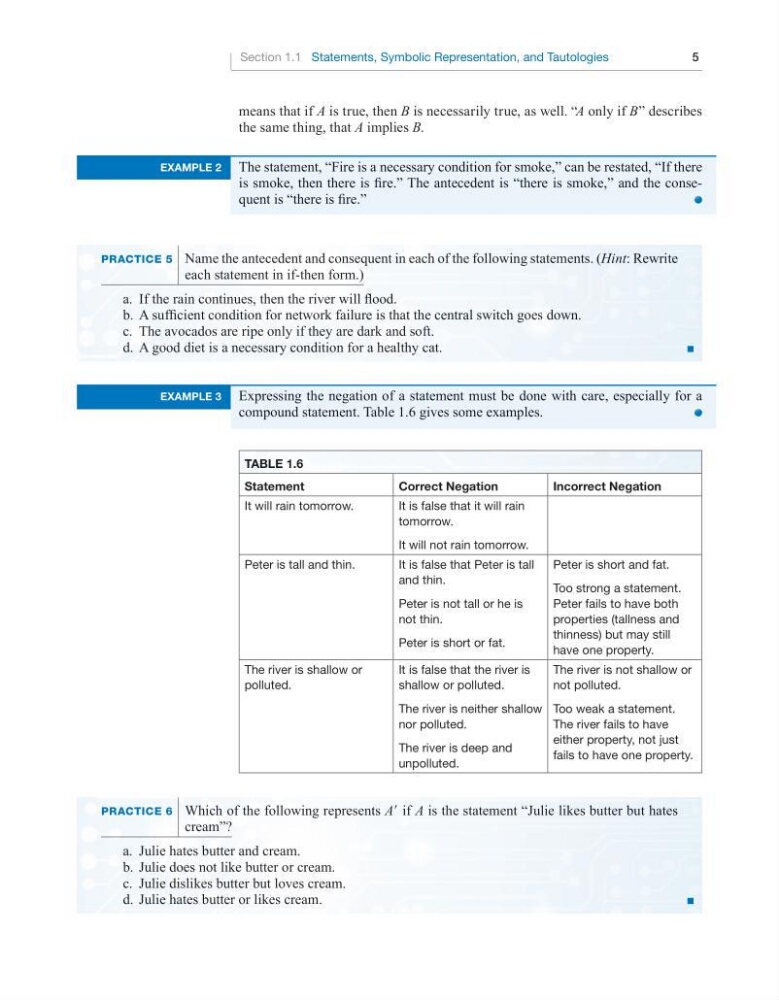
Expressing the negation of a statement must be done with care, especially for a
compound statement. Table 1.6 gives some examples.
pRaCtiCe 6 Which of the following represents A′ if A is the statement “Julie likes butter but hates
cream”?
a. Julie hates butter and cream.
b. Julie does not like butter or cream.
c. Julie dislikes butter but loves cream.
d. Julie hates butter or likes cream.
5
tAbLe 1.6
Statement
correct negation
Incorrect negation
It will rain tomorrow.
It is false that it will rain
tomorrow.
It will not rain tomorrow.
Peter is tall and thin.
It is false that Peter is tall
and thin.
Peter is not tall or he is
not thin.
Peter is short or fat.
Peter is short and fat.
Too strong a statement.
Peter fails to have both
properties (tallness and
thinness) but may still
have one property.
The river is shallow or
polluted.
It is false that the river is
shallow or polluted.
The river is neither shallow
nor polluted.
The river is deep and
unpolluted.
The river is not shallow or
not polluted.
Too weak a statement.
The river fails to have
either property, not just
fails to have one property.
means that if A is true, then B is necessarily true, as well. “A only if B” describes
the same thing, that A implies B.
eXAMPLe 2
The statement, “Fire is a necessary condition for smoke,” can be restated, “If there
is smoke, then there is fire.” The antecedent is “there is smoke,” and the consequent is “there is fire.”
pRaCtiCe 5 Name the antecedent and consequent in each of the following statements. (Hint: Rewrite
each statement in if-then form.)
a. If the rain continues, then the river will flood.
b. A sufficient condition for network failure is that the central switch goes down.
c. The avocados are ripe only if they are dark and soft.
d. A good diet is a necessary condition for a healthy cat.
eXAMPLe 3
Expressing the negation of a statement must be done with care, especially for a
compound statement. Table 1.6 gives some examples.
pRaCtiCe 6 Which of the following represents A′ if A is the statement “Julie likes butter but hates
cream”?
a. Julie hates butter and cream.
b. Julie does not like butter or cream.
c. Julie dislikes butter but loves cream.
d. Julie hates butter or likes cream.