

Section 3.2 Recurrence Relations
201
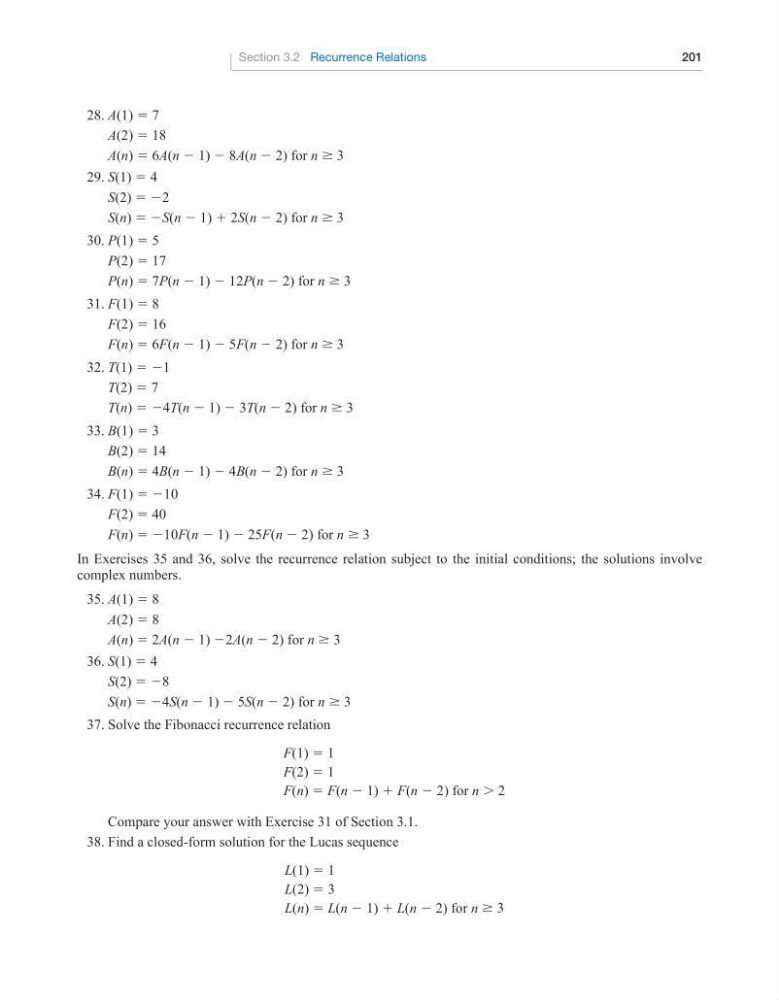
28. A(1) = 7
A(2) = 18
A(n) = 6A(n − 1) − 8A(n − 2) for n ≥ 3
29. S(1) = 4
S(2) = −2
S(n) = −S(n − 1) + 2S(n − 2) for n ≥ 3
30. P(1) = 5
P(2) = 17
P(n) = 7P(n − 1) − 12P(n − 2) for n ≥ 3
31. F(1) = 8
F(2) = 16
F(n) = 6F(n − 1) − 5F(n − 2) for n ≥ 3
32. T(1) = −1
T(2) = 7
T(n) = −4T(n − 1) − 3T(n − 2) for n ≥ 3
33. B(1) = 3
B(2) = 14
B(n) = 4B(n − 1) − 4B(n − 2) for n ≥ 3
34. F(1) = −10
F(2) = 40
F(n) = −10F(n − 1) − 25F(n − 2) for n ≥ 3
In Exercises 35 and 36, solve the recurrence relation subject to the initial conditions; the solutions involve
complex numbers.
35. A(1) = 8
A(2) = 8
A(n) = 2A(n − 1) −2A(n − 2) for n ≥ 3
36. S(1) = 4
S(2) = −8
S(n) = −4S(n − 1) − 5S(n − 2) for n ≥ 3
37. Solve the Fibonacci recurrence relation
F(1) = 1
F(2) = 1
F(n) = F(n − 1) + F(n − 2) for n > 2
Compare your answer with Exercise 31 of Section 3.1.
38. Find a closed-form solution for the Lucas sequence
L(1) = 1
L(2) = 3
L(n) = L(n − 1) + L(n − 2) for n ≥ 3
201
28. A(1) = 7
A(2) = 18
A(n) = 6A(n − 1) − 8A(n − 2) for n ≥ 3
29. S(1) = 4
S(2) = −2
S(n) = −S(n − 1) + 2S(n − 2) for n ≥ 3
30. P(1) = 5
P(2) = 17
P(n) = 7P(n − 1) − 12P(n − 2) for n ≥ 3
31. F(1) = 8
F(2) = 16
F(n) = 6F(n − 1) − 5F(n − 2) for n ≥ 3
32. T(1) = −1
T(2) = 7
T(n) = −4T(n − 1) − 3T(n − 2) for n ≥ 3
33. B(1) = 3
B(2) = 14
B(n) = 4B(n − 1) − 4B(n − 2) for n ≥ 3
34. F(1) = −10
F(2) = 40
F(n) = −10F(n − 1) − 25F(n − 2) for n ≥ 3
In Exercises 35 and 36, solve the recurrence relation subject to the initial conditions; the solutions involve
complex numbers.
35. A(1) = 8
A(2) = 8
A(n) = 2A(n − 1) −2A(n − 2) for n ≥ 3
36. S(1) = 4
S(2) = −8
S(n) = −4S(n − 1) − 5S(n − 2) for n ≥ 3
37. Solve the Fibonacci recurrence relation
F(1) = 1
F(2) = 1
F(n) = F(n − 1) + F(n − 2) for n > 2
Compare your answer with Exercise 31 of Section 3.1.
38. Find a closed-form solution for the Lucas sequence
L(1) = 1
L(2) = 3
L(n) = L(n − 1) + L(n − 2) for n ≥ 3