

Section 1.1 Statements, Symbolic Representation, and Tautologies
3
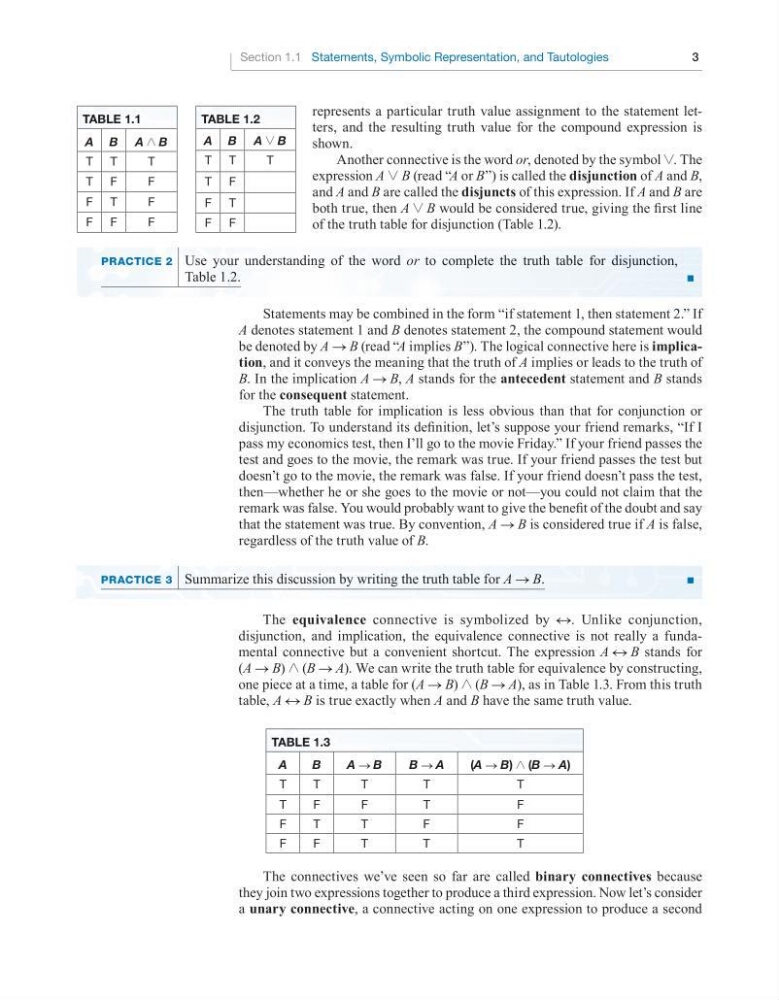
represents a particular truth value assignment to the statement letters, and the resulting truth value for the compound expression is
shown.
Another connective is the word or, denoted by the symbol ~ . The
expression A ~ B (read “A or B”) is called the disjunction of A and B,
and A and B are called the disjuncts of this expression. If A and B are
both true, then A ~ B would be considered true, giving the first line
of the truth table for disjunction (Table 1.2).
tAbLe 1.2
A B A ~ B
T T
T
T F
F T
F F
tAbLe 1.1
A B A ` B
T T
T
T F
F
F T
F
F F
F
pRaCtiCe 2 Use your understanding of the word or to complete the truth table for disjunction,
Table 1.2.
Statements may be combined in the form “if statement 1, then statement 2.” If
A denotes statement 1 and B denotes statement 2, the compound statement would
be denoted by A S B (read “A implies B”). The logical connective here is implication, and it conveys the meaning that the truth of A implies or leads to the truth of
B. In the implication A S B, A stands for the antecedent statement and B stands
for the consequent statement.
The truth table for implication is less obvious than that for conjunction or
disjunction. To understand its definition, let’s suppose your friend remarks, “If I
pass my economics test, then I’ll go to the movie Friday.” If your friend passes the
test and goes to the movie, the remark was true. If your friend passes the test but
doesn’t go to the movie, the remark was false. If your friend doesn’t pass the test,
then—whether he or she goes to the movie or not—you could not claim that the
remark was false. You would probably want to give the benefit of the doubt and say
that the statement was true. By convention, A S B is considered true if A is false,
regardless of the truth value of B.
pRaCtiCe 3 Summarize this discussion by writing the truth table for A S B.
tAbLe 1.3
A
B
A S B
B S A
(A S B) ` (B S A)
T
T
T
T
T
T
F
F
T
F
F
T
T
F
F
F
F
T
T
T
The equivalence connective is symbolized by 4. Unlike conjunction,
disjunction, and implication, the equivalence connective is not really a fundamental connective but a convenient shortcut. The expression A 4 B stands for
(A S B) ` (B S A). We can write the truth table for equivalence by constructing,
one piece at a time, a table for (A S B) ` (B S A), as in Table 1.3. From this truth
table, A 4 B is true exactly when A and B have the same truth value.
The connectives we’ve seen so far are called binary connectives because
they join two expressions together to produce a third expression. Now let’s consider
a unary connective, a connective acting on one expression to produce a second
3
represents a particular truth value assignment to the statement letters, and the resulting truth value for the compound expression is
shown.
Another connective is the word or, denoted by the symbol ~ . The
expression A ~ B (read “A or B”) is called the disjunction of A and B,
and A and B are called the disjuncts of this expression. If A and B are
both true, then A ~ B would be considered true, giving the first line
of the truth table for disjunction (Table 1.2).
tAbLe 1.2
A B A ~ B
T T
T
T F
F T
F F
tAbLe 1.1
A B A ` B
T T
T
T F
F
F T
F
F F
F
pRaCtiCe 2 Use your understanding of the word or to complete the truth table for disjunction,
Table 1.2.
Statements may be combined in the form “if statement 1, then statement 2.” If
A denotes statement 1 and B denotes statement 2, the compound statement would
be denoted by A S B (read “A implies B”). The logical connective here is implication, and it conveys the meaning that the truth of A implies or leads to the truth of
B. In the implication A S B, A stands for the antecedent statement and B stands
for the consequent statement.
The truth table for implication is less obvious than that for conjunction or
disjunction. To understand its definition, let’s suppose your friend remarks, “If I
pass my economics test, then I’ll go to the movie Friday.” If your friend passes the
test and goes to the movie, the remark was true. If your friend passes the test but
doesn’t go to the movie, the remark was false. If your friend doesn’t pass the test,
then—whether he or she goes to the movie or not—you could not claim that the
remark was false. You would probably want to give the benefit of the doubt and say
that the statement was true. By convention, A S B is considered true if A is false,
regardless of the truth value of B.
pRaCtiCe 3 Summarize this discussion by writing the truth table for A S B.
tAbLe 1.3
A
B
A S B
B S A
(A S B) ` (B S A)
T
T
T
T
T
T
F
F
T
F
F
T
T
F
F
F
F
T
T
T
The equivalence connective is symbolized by 4. Unlike conjunction,
disjunction, and implication, the equivalence connective is not really a fundamental connective but a convenient shortcut. The expression A 4 B stands for
(A S B) ` (B S A). We can write the truth table for equivalence by constructing,
one piece at a time, a table for (A S B) ` (B S A), as in Table 1.3. From this truth
table, A 4 B is true exactly when A and B have the same truth value.
The connectives we’ve seen so far are called binary connectives because
they join two expressions together to produce a third expression. Now let’s consider
a unary connective, a connective acting on one expression to produce a second