

80
5 Applications of the Metadata Standards
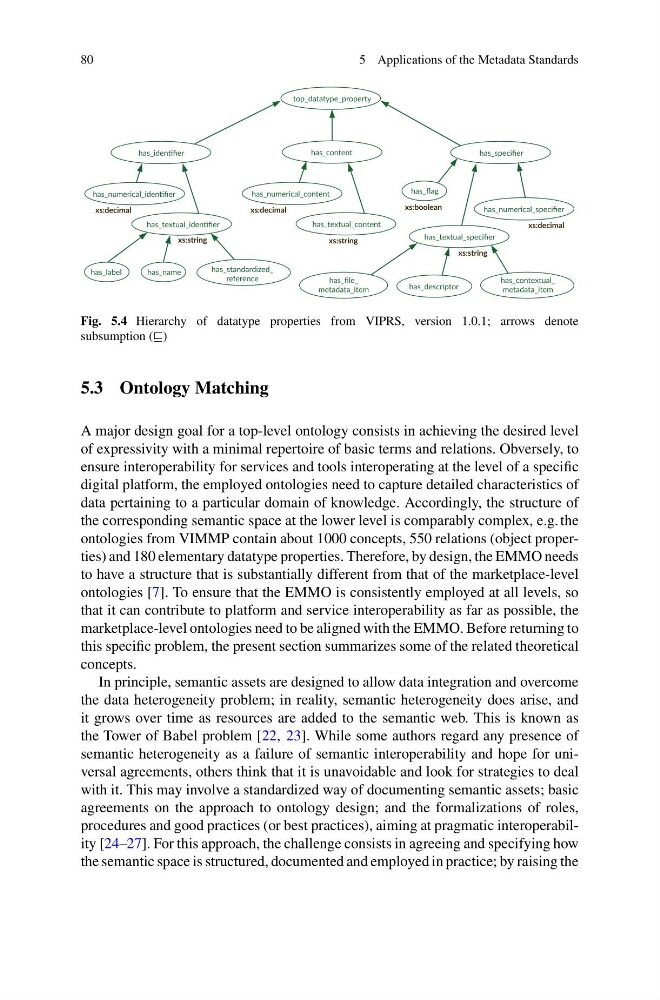
Fig. 5.4 Hierarchy of datatype properties from VIPRS, version 1.0.1; arrows denote
subsumption ()
5.3 Ontology Matching
A major design goal for a top-level ontology consists in achieving the desired level
of expressivity with a minimal repertoire of basic terms and relations. Obversely, to
ensure interoperability for services and tools interoperating at the level of a specific
digital platform, the employed ontologies need to capture detailed characteristics of
data pertaining to a particular domain of knowledge. Accordingly, the structure of
the corresponding semantic space at the lower level is comparably complex, e.g. the
ontologies from VIMMP contain about 1000 concepts, 550 relations (object properties) and 180 elementary datatype properties. Therefore, by design, the EMMO needs
to have a structure that is substantially different from that of the marketplace-level
ontologies [7]. To ensure that the EMMO is consistently employed at all levels, so
that it can contribute to platform and service interoperability as far as possible, the
marketplace-level ontologies need to be aligned with the EMMO. Before returning to
this specific problem, the present section summarizes some of the related theoretical
concepts.
In principle, semantic assets are designed to allow data integration and overcome
the data heterogeneity problem; in reality, semantic heterogeneity does arise, and
it grows over time as resources are added to the semantic web. This is known as
the Tower of Babel problem [22, 23]. While some authors regard any presence of
semantic heterogeneity as a failure of semantic interoperability and hope for universal agreements, others think that it is unavoidable and look for strategies to deal
with it. This may involve a standardized way of documenting semantic assets; basic
agreements on the approach to ontology design; and the formalizations of roles,
procedures and good practices (or best practices), aiming at pragmatic interoperability [24–27]. For this approach, the challenge consists in agreeing and specifying how
the semantic space is structured, documented and employed in practice; by raising the
5 Applications of the Metadata Standards
Fig. 5.4 Hierarchy of datatype properties from VIPRS, version 1.0.1; arrows denote
subsumption ()
5.3 Ontology Matching
A major design goal for a top-level ontology consists in achieving the desired level
of expressivity with a minimal repertoire of basic terms and relations. Obversely, to
ensure interoperability for services and tools interoperating at the level of a specific
digital platform, the employed ontologies need to capture detailed characteristics of
data pertaining to a particular domain of knowledge. Accordingly, the structure of
the corresponding semantic space at the lower level is comparably complex, e.g. the
ontologies from VIMMP contain about 1000 concepts, 550 relations (object properties) and 180 elementary datatype properties. Therefore, by design, the EMMO needs
to have a structure that is substantially different from that of the marketplace-level
ontologies [7]. To ensure that the EMMO is consistently employed at all levels, so
that it can contribute to platform and service interoperability as far as possible, the
marketplace-level ontologies need to be aligned with the EMMO. Before returning to
this specific problem, the present section summarizes some of the related theoretical
concepts.
In principle, semantic assets are designed to allow data integration and overcome
the data heterogeneity problem; in reality, semantic heterogeneity does arise, and
it grows over time as resources are added to the semantic web. This is known as
the Tower of Babel problem [22, 23]. While some authors regard any presence of
semantic heterogeneity as a failure of semantic interoperability and hope for universal agreements, others think that it is unavoidable and look for strategies to deal
with it. This may involve a standardized way of documenting semantic assets; basic
agreements on the approach to ontology design; and the formalizations of roles,
procedures and good practices (or best practices), aiming at pragmatic interoperability [24–27]. For this approach, the challenge consists in agreeing and specifying how
the semantic space is structured, documented and employed in practice; by raising the