

64
4 Semantic Technology for Simulations and Molecular Particle-Based Methods
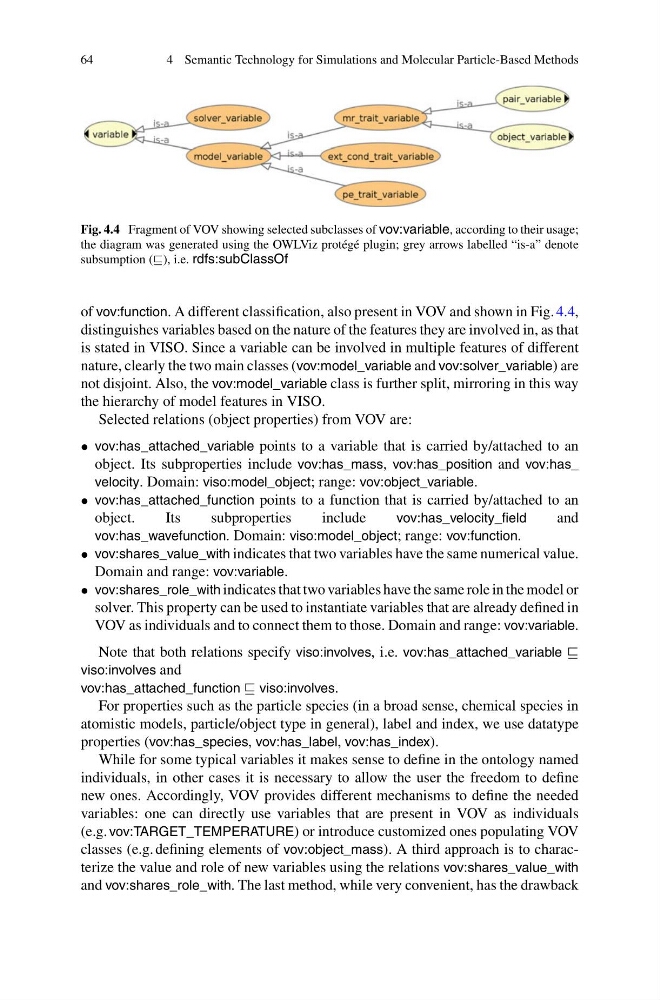
Fig. 4.4 Fragment of VOV showing selected subclasses of vov:variable, according to their usage;
the diagram was generated using the OWLViz protégé plugin; grey arrows labelled “is-a” denote
subsumption (), i.e. rdfs:subClassOf
of vov:function. A different classification, also present in VOV and shown in Fig. 4.4,
distinguishes variables based on the nature of the features they are involved in, as that
is stated in VISO. Since a variable can be involved in multiple features of different
nature, clearly the two main classes (vov:model_variable and vov:solver_variable) are
not disjoint. Also, the vov:model_variable class is further split, mirroring in this way
the hierarchy of model features in VISO.
Selected relations (object properties) from VOV are:
• vov:has_attached_variable points to a variable that is carried by/attached to an
object. Its subproperties include vov:has_mass, vov:has_position and vov:has_
velocity. Domain: viso:model_object; range: vov:object_variable.
• vov:has_attached_function points to a function that is carried by/attached to an
object.
Its
subproperties
include
vov:has_velocity_field
and
vov:has_wavefunction. Domain: viso:model_object; range: vov:function.
• vov:shares_value_with indicates that two variables have the same numerical value.
Domain and range: vov:variable.
• vov:shares_role_with indicates that two variables have the same role in the model or
solver. This property can be used to instantiate variables that are already defined in
VOV as individuals and to connect them to those. Domain and range: vov:variable.
Note that both relations specify viso:involves, i.e. vov:has_attached_variable
viso:involves and
vov:has_attached_function viso:involves.
For properties such as the particle species (in a broad sense, chemical species in
atomistic models, particle/object type in general), label and index, we use datatype
properties (vov:has_species, vov:has_label, vov:has_index).
While for some typical variables it makes sense to define in the ontology named
individuals, in other cases it is necessary to allow the user the freedom to define
new ones. Accordingly, VOV provides different mechanisms to define the needed
variables: one can directly use variables that are present in VOV as individuals
(e.g. vov:TARGET_TEMPERATURE) or introduce customized ones populating VOV
classes (e.g. defining elements of vov:object_mass). A third approach is to characterize the value and role of new variables using the relations vov:shares_value_with
and vov:shares_role_with. The last method, while very convenient, has the drawback
4 Semantic Technology for Simulations and Molecular Particle-Based Methods
Fig. 4.4 Fragment of VOV showing selected subclasses of vov:variable, according to their usage;
the diagram was generated using the OWLViz protégé plugin; grey arrows labelled “is-a” denote
subsumption (), i.e. rdfs:subClassOf
of vov:function. A different classification, also present in VOV and shown in Fig. 4.4,
distinguishes variables based on the nature of the features they are involved in, as that
is stated in VISO. Since a variable can be involved in multiple features of different
nature, clearly the two main classes (vov:model_variable and vov:solver_variable) are
not disjoint. Also, the vov:model_variable class is further split, mirroring in this way
the hierarchy of model features in VISO.
Selected relations (object properties) from VOV are:
• vov:has_attached_variable points to a variable that is carried by/attached to an
object. Its subproperties include vov:has_mass, vov:has_position and vov:has_
velocity. Domain: viso:model_object; range: vov:object_variable.
• vov:has_attached_function points to a function that is carried by/attached to an
object.
Its
subproperties
include
vov:has_velocity_field
and
vov:has_wavefunction. Domain: viso:model_object; range: vov:function.
• vov:shares_value_with indicates that two variables have the same numerical value.
Domain and range: vov:variable.
• vov:shares_role_with indicates that two variables have the same role in the model or
solver. This property can be used to instantiate variables that are already defined in
VOV as individuals and to connect them to those. Domain and range: vov:variable.
Note that both relations specify viso:involves, i.e. vov:has_attached_variable
viso:involves and
vov:has_attached_function viso:involves.
For properties such as the particle species (in a broad sense, chemical species in
atomistic models, particle/object type in general), label and index, we use datatype
properties (vov:has_species, vov:has_label, vov:has_index).
While for some typical variables it makes sense to define in the ontology named
individuals, in other cases it is necessary to allow the user the freedom to define
new ones. Accordingly, VOV provides different mechanisms to define the needed
variables: one can directly use variables that are present in VOV as individuals
(e.g. vov:TARGET_TEMPERATURE) or introduce customized ones populating VOV
classes (e.g. defining elements of vov:object_mass). A third approach is to characterize the value and role of new variables using the relations vov:shares_value_with
and vov:shares_role_with. The last method, while very convenient, has the drawback