

3.3 Modelling, Simulation and Computational Resources
39
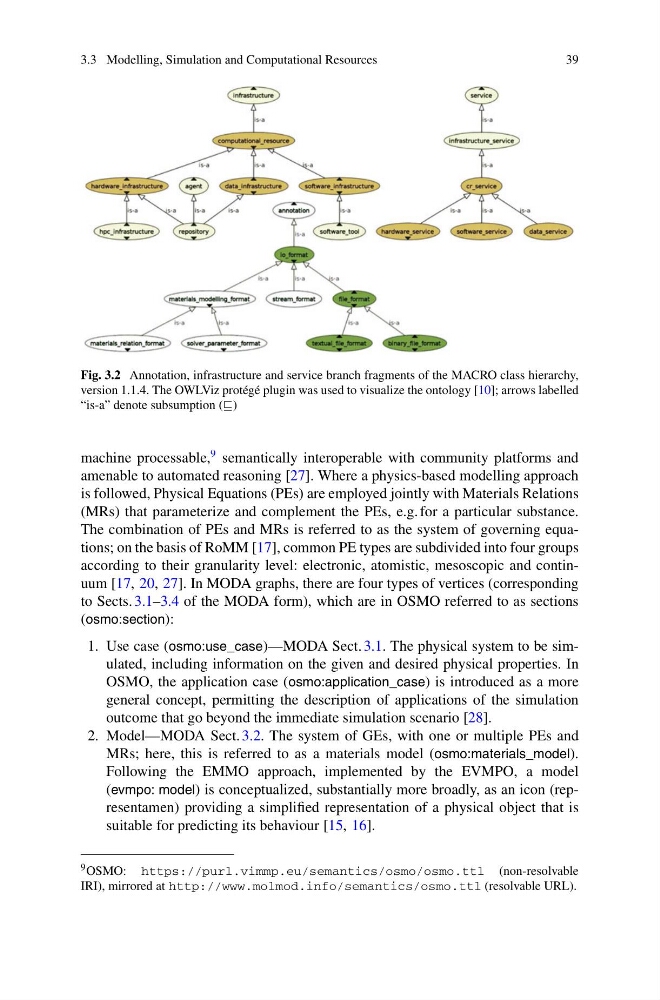
Fig. 3.2 Annotation, infrastructure and service branch fragments of the MACRO class hierarchy,
version 1.1.4. The OWLViz protégé plugin was used to visualize the ontology [10]; arrows labelled
“is-a” denote subsumption ()
machine processable,
9 semantically interoperable with community platforms and
amenable to automated reasoning [27]. Where a physics-based modelling approach
is followed, Physical Equations (PEs) are employed jointly with Materials Relations
(MRs) that parameterize and complement the PEs, e.g. for a particular substance.
The combination of PEs and MRs is referred to as the system of governing equations; on the basis of RoMM [17], common PE types are subdivided into four groups
according to their granularity level: electronic, atomistic, mesoscopic and continuum [17, 20, 27]. In MODA graphs, there are four types of vertices (corresponding
to Sects. 3.1–3.4 of the MODA form), which are in OSMO referred to as sections
(osmo:section):
1. Use case (osmo:use_case)—MODA Sect. 3.1. The physical system to be simulated, including information on the given and desired physical properties. In
OSMO, the application case (osmo:application_case) is introduced as a more
general concept, permitting the description of applications of the simulation
outcome that go beyond the immediate simulation scenario [28].
2. Model—MODA Sect. 3.2. The system of GEs, with one or multiple PEs and
MRs; here, this is referred to as a materials model (osmo:materials_model).
Following the EMMO approach, implemented by the EVMPO, a model
(evmpo: model) is conceptualized, substantially more broadly, as an icon (representamen) providing a simplified representation of a physical object that is
suitable for predicting its behaviour [15, 16].
9 OSMO: https://purl.vimmp.eu/semantics/osmo/osmo.ttl (non-resolvable
IRI), mirrored at http://www.molmod.info/semantics/osmo.ttl (resolvable URL).
39
Fig. 3.2 Annotation, infrastructure and service branch fragments of the MACRO class hierarchy,
version 1.1.4. The OWLViz protégé plugin was used to visualize the ontology [10]; arrows labelled
“is-a” denote subsumption ()
machine processable,
9 semantically interoperable with community platforms and
amenable to automated reasoning [27]. Where a physics-based modelling approach
is followed, Physical Equations (PEs) are employed jointly with Materials Relations
(MRs) that parameterize and complement the PEs, e.g. for a particular substance.
The combination of PEs and MRs is referred to as the system of governing equations; on the basis of RoMM [17], common PE types are subdivided into four groups
according to their granularity level: electronic, atomistic, mesoscopic and continuum [17, 20, 27]. In MODA graphs, there are four types of vertices (corresponding
to Sects. 3.1–3.4 of the MODA form), which are in OSMO referred to as sections
(osmo:section):
1. Use case (osmo:use_case)—MODA Sect. 3.1. The physical system to be simulated, including information on the given and desired physical properties. In
OSMO, the application case (osmo:application_case) is introduced as a more
general concept, permitting the description of applications of the simulation
outcome that go beyond the immediate simulation scenario [28].
2. Model—MODA Sect. 3.2. The system of GEs, with one or multiple PEs and
MRs; here, this is referred to as a materials model (osmo:materials_model).
Following the EMMO approach, implemented by the EVMPO, a model
(evmpo: model) is conceptualized, substantially more broadly, as an icon (representamen) providing a simplified representation of a physical object that is
suitable for predicting its behaviour [15, 16].
9 OSMO: https://purl.vimmp.eu/semantics/osmo/osmo.ttl (non-resolvable
IRI), mirrored at http://www.molmod.info/semantics/osmo.ttl (resolvable URL).