

4
1 Introduction
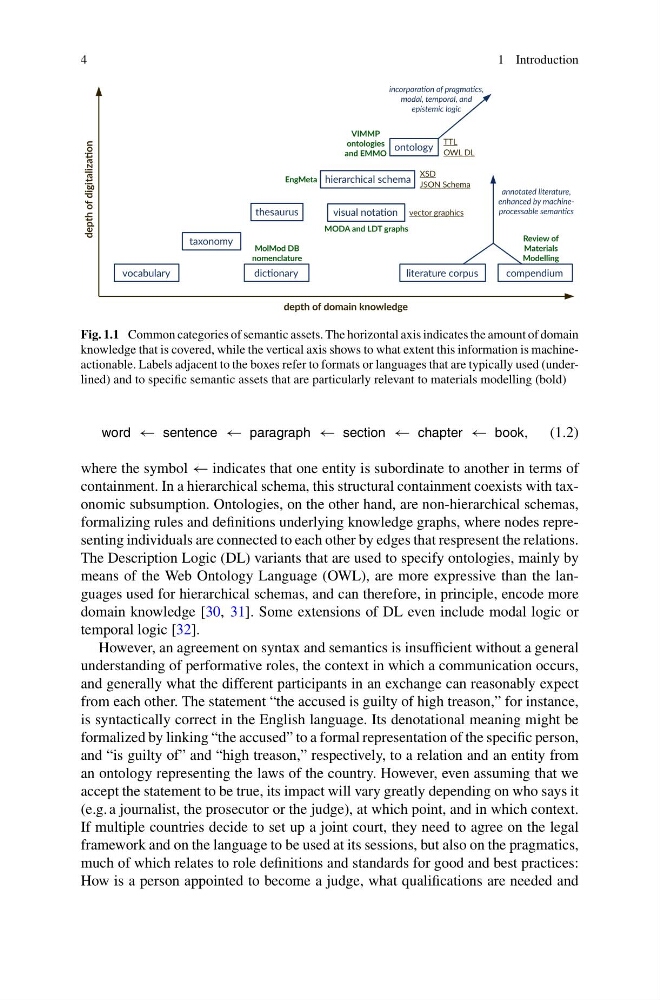
Fig. 1.1 Common categories of semantic assets. The horizontal axis indicates the amount of domain
knowledge that is covered, while the vertical axis shows to what extent this information is machineactionable. Labels adjacent to the boxes refer to formats or languages that are typically used (underlined) and to specific semantic assets that are particularly relevant to materials modelling (bold)
word ← sentence ← paragraph ← section ← chapter ← book, (1.2)
where the symbol ← indicates that one entity is subordinate to another in terms of
containment. In a hierarchical schema, this structural containment coexists with taxonomic subsumption. Ontologies, on the other hand, are non-hierarchical schemas,
formalizing rules and definitions underlying knowledge graphs, where nodes representing individuals are connected to each other by edges that respresent the relations.
The Description Logic (DL) variants that are used to specify ontologies, mainly by
means of the Web Ontology Language (OWL), are more expressive than the languages used for hierarchical schemas, and can therefore, in principle, encode more
domain knowledge [30, 31]. Some extensions of DL even include modal logic or
temporal logic [32].
However, an agreement on syntax and semantics is insufficient without a general
understanding of performative roles, the context in which a communication occurs,
and generally what the different participants in an exchange can reasonably expect
from each other. The statement “the accused is guilty of high treason,” for instance,
is syntactically correct in the English language. Its denotational meaning might be
formalized by linking “the accused” to a formal representation of the specific person,
and “is guilty of” and “high treason,” respectively, to a relation and an entity from
an ontology representing the laws of the country. However, even assuming that we
accept the statement to be true, its impact will vary greatly depending on who says it
(e.g. a journalist, the prosecutor or the judge), at which point, and in which context.
If multiple countries decide to set up a joint court, they need to agree on the legal
framework and on the language to be used at its sessions, but also on the pragmatics,
much of which relates to role definitions and standards for good and best practices:
How is a person appointed to become a judge, what qualifications are needed and
1 Introduction
Fig. 1.1 Common categories of semantic assets. The horizontal axis indicates the amount of domain
knowledge that is covered, while the vertical axis shows to what extent this information is machineactionable. Labels adjacent to the boxes refer to formats or languages that are typically used (underlined) and to specific semantic assets that are particularly relevant to materials modelling (bold)
word ← sentence ← paragraph ← section ← chapter ← book, (1.2)
where the symbol ← indicates that one entity is subordinate to another in terms of
containment. In a hierarchical schema, this structural containment coexists with taxonomic subsumption. Ontologies, on the other hand, are non-hierarchical schemas,
formalizing rules and definitions underlying knowledge graphs, where nodes representing individuals are connected to each other by edges that respresent the relations.
The Description Logic (DL) variants that are used to specify ontologies, mainly by
means of the Web Ontology Language (OWL), are more expressive than the languages used for hierarchical schemas, and can therefore, in principle, encode more
domain knowledge [30, 31]. Some extensions of DL even include modal logic or
temporal logic [32].
However, an agreement on syntax and semantics is insufficient without a general
understanding of performative roles, the context in which a communication occurs,
and generally what the different participants in an exchange can reasonably expect
from each other. The statement “the accused is guilty of high treason,” for instance,
is syntactically correct in the English language. Its denotational meaning might be
formalized by linking “the accused” to a formal representation of the specific person,
and “is guilty of” and “high treason,” respectively, to a relation and an entity from
an ontology representing the laws of the country. However, even assuming that we
accept the statement to be true, its impact will vary greatly depending on who says it
(e.g. a journalist, the prosecutor or the judge), at which point, and in which context.
If multiple countries decide to set up a joint court, they need to agree on the legal
framework and on the language to be used at its sessions, but also on the pragmatics,
much of which relates to role definitions and standards for good and best practices:
How is a person appointed to become a judge, what qualifications are needed and