

32
G. Benckiser
From the estimated 1.2 × 10
30 bacteria and archaea on Earth 4 × 10
29 may reside
in deep oceanic sub-surfaces, 5 × 10
28 in upper oceanic sediments, 3 × 10
29 in
deep continental sub-surfaces, 3 × 10
29 in soils, phyllo-, rhizospheres, and in fewer
individuals magnitudes in groundwater, the atmosphere, ocean surface microlayers,
on humans and animals skins [79, 78]. All the 1.2 × 10
30 bacteria and archaea,
involved in earth’s matter recycling (Fig. 1), are carrying viral inserts which replicate by using the host metabolism [27]. Besides procaryotes mycoviruses hosting
fungi are involved in earth’s matter recycling, more than 50,000 one-celled, freeliving, viral inserts carrying, bacteria feeding protozoa species per gram soil dry
mass, and in a hectare grassland about 2 × 10
11 bacteria, archaea feeding nematodes
may be found (Fig. 1; [15, 16, 39, 76, 95, 96, 126, 155, 258, 261, 270, 65, 178]).
Because across the different phyla of the fungal kingdom mycoviruses seem to share
significant similarities, a descenting from a common virus ancestor is suggested and
in almost every habitat present parasitic protozoa and nematodes can asymptomatically support host resistance, but also be life threatening to higher organisms. The
on bacteria feeding eukaryotic groups control the multiplication of the prokaryotes,
their abundance and activity in soils and for example the bacteria grazer Cephalobus
pseudoparvus decreased, as found by quantitative PCR after 15 and 45 days of soil
incubation. The 16S rRNA denitrification genes density by non-significant 60–80%
in gene copy numbers, but significantly in the dominant nirK denitrifier community by 8% interestingly not the nirS community activity (Baudoin et al. 2010). In
well tempered, pH controlled, with pre-chewed gras fed cow rumen biotopes around
10
5 bacteria, archaea feeding, surplus NH 4
+ excreting protozoa are counted and
around 10
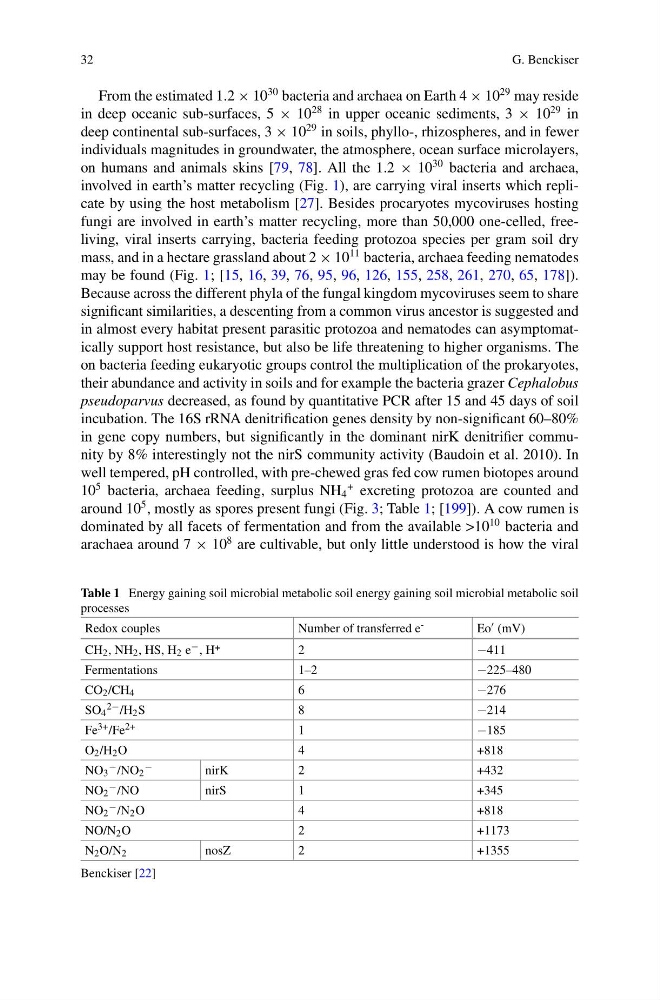
5 , mostly as spores present fungi (Fig. 3; Table 1; [199]). A cow rumen is
dominated by all facets of fermentation and from the available >10
10 bacteria and
arachaea around 7 × 10
8 are cultivable, but only little understood is how the viral
Table 1 Energy gaining soil microbial metabolic soil energy gaining soil microbial metabolic soil
processes
Redox couples
Number of transferred e -
Eo (mV)
CH 2 , NH 2 , HS, H 2 e − , H +
2
−411
Fermentations
1–2
−225–480
CO 2 /CH 4
6
−276
SO 4
2− /H 2 S
8
−214
Fe 3+ /Fe 2+
1
−185
O 2 /H 2 O
4
+818
NO 3
− /NO 2
−
nirK
2
+432
NO 2
− /NO
nirS
1
+345
NO 2
− /N 2 O
4
+818
NO/N 2 O
2
+1173
N 2 O/N 2
nosZ
2
+1355
Benckiser [22]
G. Benckiser
From the estimated 1.2 × 10
30 bacteria and archaea on Earth 4 × 10
29 may reside
in deep oceanic sub-surfaces, 5 × 10
28 in upper oceanic sediments, 3 × 10
29 in
deep continental sub-surfaces, 3 × 10
29 in soils, phyllo-, rhizospheres, and in fewer
individuals magnitudes in groundwater, the atmosphere, ocean surface microlayers,
on humans and animals skins [79, 78]. All the 1.2 × 10
30 bacteria and archaea,
involved in earth’s matter recycling (Fig. 1), are carrying viral inserts which replicate by using the host metabolism [27]. Besides procaryotes mycoviruses hosting
fungi are involved in earth’s matter recycling, more than 50,000 one-celled, freeliving, viral inserts carrying, bacteria feeding protozoa species per gram soil dry
mass, and in a hectare grassland about 2 × 10
11 bacteria, archaea feeding nematodes
may be found (Fig. 1; [15, 16, 39, 76, 95, 96, 126, 155, 258, 261, 270, 65, 178]).
Because across the different phyla of the fungal kingdom mycoviruses seem to share
significant similarities, a descenting from a common virus ancestor is suggested and
in almost every habitat present parasitic protozoa and nematodes can asymptomatically support host resistance, but also be life threatening to higher organisms. The
on bacteria feeding eukaryotic groups control the multiplication of the prokaryotes,
their abundance and activity in soils and for example the bacteria grazer Cephalobus
pseudoparvus decreased, as found by quantitative PCR after 15 and 45 days of soil
incubation. The 16S rRNA denitrification genes density by non-significant 60–80%
in gene copy numbers, but significantly in the dominant nirK denitrifier community by 8% interestingly not the nirS community activity (Baudoin et al. 2010). In
well tempered, pH controlled, with pre-chewed gras fed cow rumen biotopes around
10
5 bacteria, archaea feeding, surplus NH 4
+ excreting protozoa are counted and
around 10
5 , mostly as spores present fungi (Fig. 3; Table 1; [199]). A cow rumen is
dominated by all facets of fermentation and from the available >10
10 bacteria and
arachaea around 7 × 10
8 are cultivable, but only little understood is how the viral
Table 1 Energy gaining soil microbial metabolic soil energy gaining soil microbial metabolic soil
processes
Redox couples
Number of transferred e -
Eo (mV)
CH 2 , NH 2 , HS, H 2 e − , H +
2
−411
Fermentations
1–2
−225–480
CO 2 /CH 4
6
−276
SO 4
2− /H 2 S
8
−214
Fe 3+ /Fe 2+
1
−185
O 2 /H 2 O
4
+818
NO 3
− /NO 2
−
nirK
2
+432
NO 2
− /NO
nirS
1
+345
NO 2
− /N 2 O
4
+818
NO/N 2 O
2
+1173
N 2 O/N 2
nosZ
2
+1355
Benckiser [22]