

8
K. Ramani et al.
1.4.3 Size of the Molecules
Biodegradation of polymers are heavily influenced by the size of the molecules. The
degradation rate increases as the size of the molecule reduces.
1.4.4 Functionality
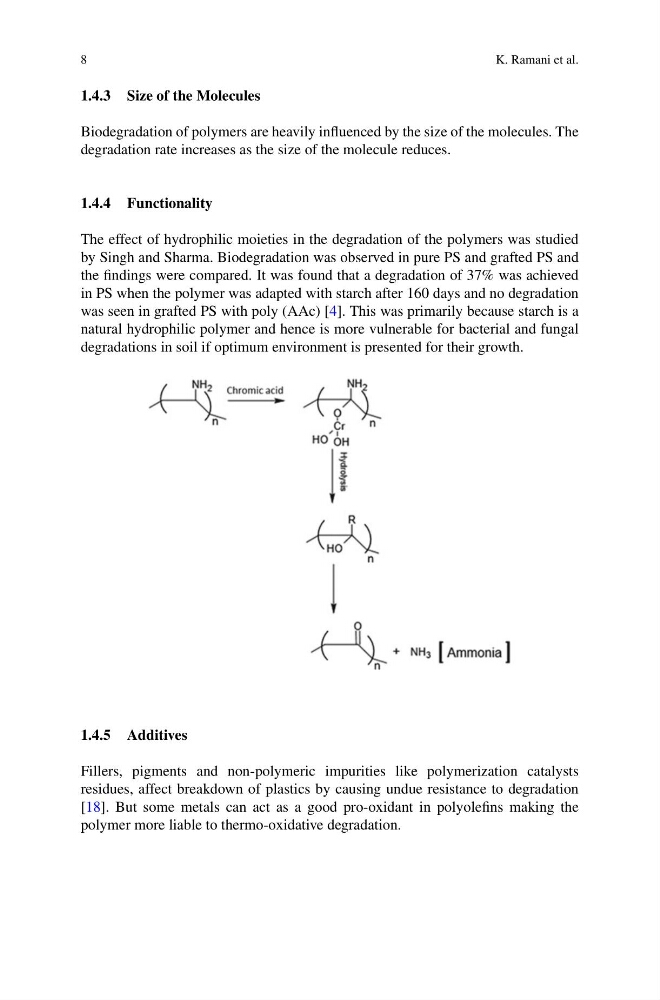
The effect of hydrophilic moieties in the degradation of the polymers was studied
by Singh and Sharma. Biodegradation was observed in pure PS and grafted PS and
the findings were compared. It was found that a degradation of 37% was achieved
in PS when the polymer was adapted with starch after 160 days and no degradation
was seen in grafted PS with poly (AAc) [4]. This was primarily because starch is a
natural hydrophilic polymer and hence is more vulnerable for bacterial and fungal
degradations in soil if optimum environment is presented for their growth.
1.4.5 Additives
Fillers, pigments and non-polymeric impurities like polymerization catalysts
residues, affect breakdown of plastics by causing undue resistance to degradation
[18]. But some metals can act as a good pro-oxidant in polyolefins making the
polymer more liable to thermo-oxidative degradation.
K. Ramani et al.
1.4.3 Size of the Molecules
Biodegradation of polymers are heavily influenced by the size of the molecules. The
degradation rate increases as the size of the molecule reduces.
1.4.4 Functionality
The effect of hydrophilic moieties in the degradation of the polymers was studied
by Singh and Sharma. Biodegradation was observed in pure PS and grafted PS and
the findings were compared. It was found that a degradation of 37% was achieved
in PS when the polymer was adapted with starch after 160 days and no degradation
was seen in grafted PS with poly (AAc) [4]. This was primarily because starch is a
natural hydrophilic polymer and hence is more vulnerable for bacterial and fungal
degradations in soil if optimum environment is presented for their growth.
1.4.5 Additives
Fillers, pigments and non-polymeric impurities like polymerization catalysts
residues, affect breakdown of plastics by causing undue resistance to degradation
[18]. But some metals can act as a good pro-oxidant in polyolefins making the
polymer more liable to thermo-oxidative degradation.