

4
K. Ramani et al.
phthalate, Diethylhexylphthalate and Butylated hydroxytoluene are released when
ABS is degraded.
1.1.6 Polyethylene, Polypropylene and Polystyrene
Polyethylene, Polypropylene and Polystyrene are types of plastics that do not contain
nitrogen in its structure but still releases nitrogen containing compounds during its
degradation namely drometrizole and benzothiazole, which possibly are included as
additives for ultraviolet stabilization and vulcanization acceleration, respectively [6].
1.2 Methods of Plastic Degradation
Polymer degradation involves bond scissions and subsequent chemical transformations that are due to the chemical, physical or biological reactions causing changes
in polymer properties. Degradation mirrors changes in material properties such as
mechanical, optical or electrical characteristics. Polymer degradations have been
classified as photo-oxidative degradation, thermal degradation, ozone-induced degradation, mechanochemical degradation, catalytic degradation and biodegradation
depending upon the nature of the causing agents.
1.2.1 Photo-Oxidative Degradation
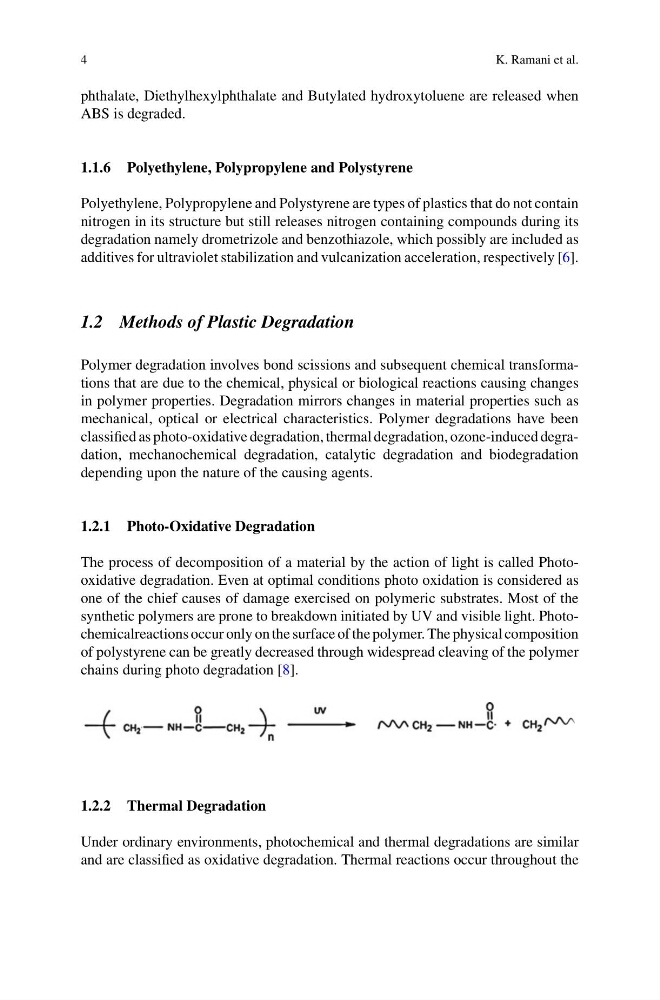
The process of decomposition of a material by the action of light is called Photooxidative degradation. Even at optimal conditions photo oxidation is considered as
one of the chief causes of damage exercised on polymeric substrates. Most of the
synthetic polymers are prone to breakdown initiated by UV and visible light. Photochemicalreactions occur only on the surface of the polymer. The physical composition
of polystyrene can be greatly decreased through widespread cleaving of the polymer
chains during photo degradation [8].
1.2.2 Thermal Degradation
Under ordinary environments, photochemical and thermal degradations are similar
and are classified as oxidative degradation. Thermal reactions occur throughout the
K. Ramani et al.
phthalate, Diethylhexylphthalate and Butylated hydroxytoluene are released when
ABS is degraded.
1.1.6 Polyethylene, Polypropylene and Polystyrene
Polyethylene, Polypropylene and Polystyrene are types of plastics that do not contain
nitrogen in its structure but still releases nitrogen containing compounds during its
degradation namely drometrizole and benzothiazole, which possibly are included as
additives for ultraviolet stabilization and vulcanization acceleration, respectively [6].
1.2 Methods of Plastic Degradation
Polymer degradation involves bond scissions and subsequent chemical transformations that are due to the chemical, physical or biological reactions causing changes
in polymer properties. Degradation mirrors changes in material properties such as
mechanical, optical or electrical characteristics. Polymer degradations have been
classified as photo-oxidative degradation, thermal degradation, ozone-induced degradation, mechanochemical degradation, catalytic degradation and biodegradation
depending upon the nature of the causing agents.
1.2.1 Photo-Oxidative Degradation
The process of decomposition of a material by the action of light is called Photooxidative degradation. Even at optimal conditions photo oxidation is considered as
one of the chief causes of damage exercised on polymeric substrates. Most of the
synthetic polymers are prone to breakdown initiated by UV and visible light. Photochemicalreactions occur only on the surface of the polymer. The physical composition
of polystyrene can be greatly decreased through widespread cleaving of the polymer
chains during photo degradation [8].
1.2.2 Thermal Degradation
Under ordinary environments, photochemical and thermal degradations are similar
and are classified as oxidative degradation. Thermal reactions occur throughout the