

Plant Demand Adapted Fertilization in Organic and Precision …
149
3.1.2 Fertigation
Fertigation is an important part of precision farming, in which dissolved fertilizers
are delivered to the crop through the irrigation system which allows the application of
precise rates of water and fertilizers at the root zone, accurately timed to the crop needs
[56], a technique first started in the late 1960s in Israel [90]. Concentrated fertilizer
solutions are prepared in stock tanks and injected into the irrigation water, using
fertilizer injectors. The irrigation system can be drip irrigation, sprinkler system,
pivot or different configurations of hydroponic systems. Since it involves frequent
application of small quantities of water on or below the soil surface as drops, irrigating
the root zone instead of the entire land, and matching with the consumptive water
demand of plant, the water and nutrient use efficiency are both improved resulting in
savings and fertilizers, minimises leaching and allows flexibility in timing of fertilizer
application and reduces the labour required for applying the fertilizers and pesticides
[47]. But most of the systems do not yet have the capability of using feedback from
sensors installed in the field and adjust fertilizer rates accordingly. Some drawbacks
like high cost of setting up and precipitation can be minimized by greater availability
of soluble and compatible fertilizers, good quality water, and synchronization of
plant demand and supply of nutrients, lack of precipitation of phosphatic fertilizers
with micronutrient mixtures, availability of corrosive resistant fertigation systems.
Sub-surface drip irrigation and fertigation in maize-wheat under conservation
agriculture in Punjab, India saved 50–60% irrigation water and 25% fertilizer nitrogen
for each crop. Similarly, the nitrogen use efficiency was higher in rice and wheat [16].
Fertigation results in optimum growth, improved yield and produce quality [44, 84]
besides substantial water saving to the tune of nearly 12–84% in different crops [64].
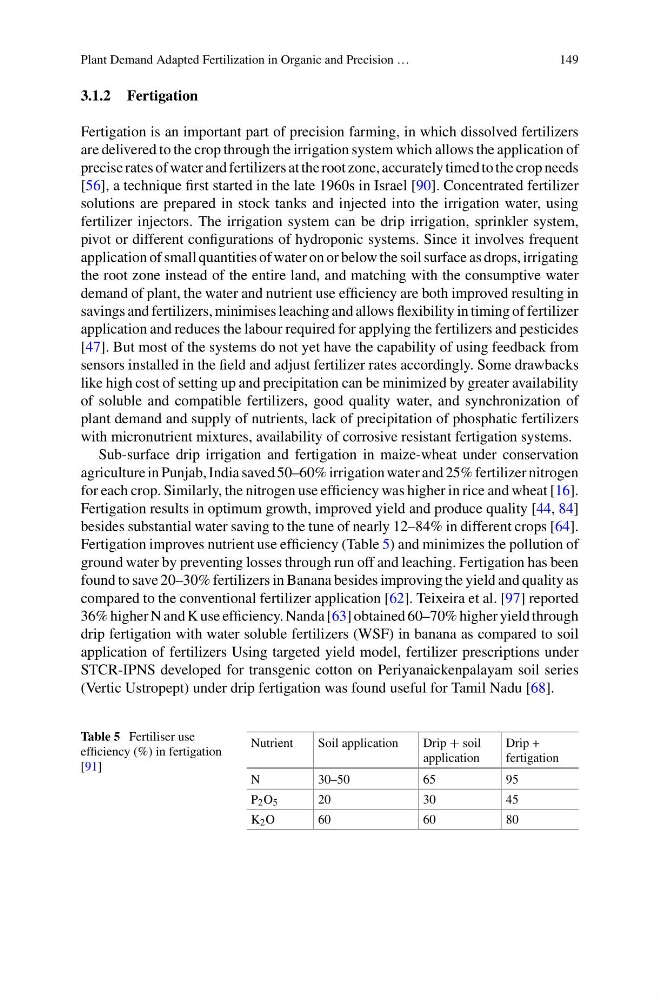
Fertigation improves nutrient use efficiency (Table 5) and minimizes the pollution of
ground water by preventing losses through run off and leaching. Fertigation has been
found to save 20–30% fertilizers in Banana besides improving the yield and quality as
compared to the conventional fertilizer application [62]. Teixeira et al. [97] reported
36% higher N and K use efficiency. Nanda [63] obtained 60–70% higher yield through
drip fertigation with water soluble fertilizers (WSF) in banana as compared to soil
application of fertilizers Using targeted yield model, fertilizer prescriptions under
STCR-IPNS developed for transgenic cotton on Periyanaickenpalayam soil series
(Vertic Ustropept) under drip fertigation was found useful for Tamil Nadu [68].
Table 5 Fertiliser use
efficiency (%) in fertigation
[91]
Nutrient
Soil application
Drip + soil
application
Drip +
fertigation
N
30–50
65
95
P 2 O 5
20
30
45
K 2 O
60
60
80
149
3.1.2 Fertigation
Fertigation is an important part of precision farming, in which dissolved fertilizers
are delivered to the crop through the irrigation system which allows the application of
precise rates of water and fertilizers at the root zone, accurately timed to the crop needs
[56], a technique first started in the late 1960s in Israel [90]. Concentrated fertilizer
solutions are prepared in stock tanks and injected into the irrigation water, using
fertilizer injectors. The irrigation system can be drip irrigation, sprinkler system,
pivot or different configurations of hydroponic systems. Since it involves frequent
application of small quantities of water on or below the soil surface as drops, irrigating
the root zone instead of the entire land, and matching with the consumptive water
demand of plant, the water and nutrient use efficiency are both improved resulting in
savings and fertilizers, minimises leaching and allows flexibility in timing of fertilizer
application and reduces the labour required for applying the fertilizers and pesticides
[47]. But most of the systems do not yet have the capability of using feedback from
sensors installed in the field and adjust fertilizer rates accordingly. Some drawbacks
like high cost of setting up and precipitation can be minimized by greater availability
of soluble and compatible fertilizers, good quality water, and synchronization of
plant demand and supply of nutrients, lack of precipitation of phosphatic fertilizers
with micronutrient mixtures, availability of corrosive resistant fertigation systems.
Sub-surface drip irrigation and fertigation in maize-wheat under conservation
agriculture in Punjab, India saved 50–60% irrigation water and 25% fertilizer nitrogen
for each crop. Similarly, the nitrogen use efficiency was higher in rice and wheat [16].
Fertigation results in optimum growth, improved yield and produce quality [44, 84]
besides substantial water saving to the tune of nearly 12–84% in different crops [64].
Fertigation improves nutrient use efficiency (Table 5) and minimizes the pollution of
ground water by preventing losses through run off and leaching. Fertigation has been
found to save 20–30% fertilizers in Banana besides improving the yield and quality as
compared to the conventional fertilizer application [62]. Teixeira et al. [97] reported
36% higher N and K use efficiency. Nanda [63] obtained 60–70% higher yield through
drip fertigation with water soluble fertilizers (WSF) in banana as compared to soil
application of fertilizers Using targeted yield model, fertilizer prescriptions under
STCR-IPNS developed for transgenic cotton on Periyanaickenpalayam soil series
(Vertic Ustropept) under drip fertigation was found useful for Tamil Nadu [68].
Table 5 Fertiliser use
efficiency (%) in fertigation
[91]
Nutrient
Soil application
Drip + soil
application
Drip +
fertigation
N
30–50
65
95
P 2 O 5
20
30
45
K 2 O
60
60
80